Preventing AI data leakage means treating every AI endpoint, model, and pipeline as a sensitive system and layering controls across access, input and output sanitization, orchestration limits, monitoring, and governance. Frameworks from NIST, OWASP, and CISA all point in the same direction, and we walk through exactly how to apply that guidance below.
TL;DR:
- Apply least privilege to every service account, model, and agent; filter retrieval by document sensitivity, and require approval before financial, legal, or irreversible actions.
- Inspect prompts and outputs for personal information, credentials, and classified content, while masking sensitive fields before embedding or storing them in logs.
- Tie prompt, output, vector store, and egress logs to identities, then schedule recurring tests for injection, extraction, and poisoning, repeating them after launch.
- Set vendor contract terms for customer data use, training, retention, and breach notification; require clear notice and consent before customer data trains models.
Table of Contents
- Where AI data leakage actually happens
- Core controls and defenses map: what to deploy and where
- Securing RAG pipelines and autonomous agents
- Integrating DLP with AI workflows and architectures
- Detecting and testing for AI data leakage
- Governance, policy, and contractual controls
- Practitioner playbook: a checklist for implementation
- Why resilient design beats the promise of a perfect defense
- Get a clear roadmap with tekRESCUE
- FAQ
- Sources
Where AI data leakage actually happens
Before you can stop leakage, you need to know where it starts. Generative AI systems create exposure points that didn’t exist in traditional software, and most security teams haven’t mapped them yet.
- Prompt injection: a hidden or crafted instruction inside user input tricks a model into ignoring its original guardrails.
- System prompt leakage: a model reveals its own configuration, instructions, or embedded secrets when asked the right way, which is why OWASP’s 2025 Top 10 for LLMs warns against treating system prompts as secret.
- Model memorization and extraction: a model trained on sensitive records can reproduce fragments of that data when queried persistently.
- Data poisoning: an attacker plants manipulated records in training or fine-tuning data to corrupt outputs later.
- Excessive agent agency: an AI agent granted broad permissions takes an action, like sending an email or querying a database, that it was never meant to take alone.
- RAG-specific exfiltration: a retrieval system pulls confidential documents into a response because nothing filtered what it could retrieve.
- Shared-resource side channels: multi-tenant model infrastructure leaks information between customers through caching or resource reuse.
Each of these maps to a real enterprise workflow: a customer service bot with document retrieval, a coding assistant with repository access, an agent that books meetings and reads calendars. None of this is theoretical anymore.
Core controls and defenses map: what to deploy and where
Once you know the threat types, the next question is where to put your defenses. Controls aren’t interchangeable. Some belong at training time, others only matter once a model is live and answering questions.
NIST’s Generative AI Profile recommends treating model weights and pipelines as protected assets, the same way you’d protect source code or a production database, and enforcing governance across the full lifecycle rather than bolting it on at the end.
- Training and fine-tuning: apply differential privacy to any dataset that includes customer or employee records, and restrict who can submit data for fine-tuning jobs.
- Data access: enforce the principle of least privilege for every service account, pipeline, and human role touching training data or model weights.
- Inference time: sanitize inputs before they reach the model and inspect outputs before they reach the user, catching leaked credentials, PII, or system prompt fragments.
- Storage: tokenize or redact sensitive fields before they ever enter a prompt, embedding, or log file.
- Orchestration: apply strict identity and access controls to any agent or tool call, scoping each credential to the single task it needs to perform.
- Vector databases: protect embeddings the same way you protect any other database, with access controls, audit logging, and limited write privileges for enrichment jobs, a point OWASP’s LLM guidance makes directly.
Pro Tip: Audit your vector store permissions the same week you audit your production database, not months later as an afterthought.
Encryption at rest and in transit still matters here, but it’s the floor, not the ceiling. The controls above are what actually stop a model from saying something it shouldn’t.
Securing RAG pipelines and autonomous agents
Retrieval-augmented generation and autonomous agents introduce risk that a simple chatbot doesn’t carry, because both are designed to reach into live systems and pull in context the model wasn’t trained on.

Controlling retrieval starts with filters and provenance. Every document a RAG system can retrieve should carry metadata tagging its sensitivity level, and the retrieval layer should enforce those tags before anything reaches the model. Grounding responses in verified sources, rather than letting a model answer from memory alone, also reduces the chance it fabricates or leaks something it shouldn’t.
CISA’s joint guidance recommends push-based or brokered architectures over giving models direct, persistent access to sensitive systems. That means:
- Use staging buffers that hold only the data a specific query needs, never a live connection to the full database.
- Scope API keys narrowly: an agent that reads calendar data should never hold a key that can also send mail or modify records.
- Rate-limit agent actions so a single compromised session can’t cascade into dozens of unauthorized calls.
- Require human-in-the-loop approval for any agent action with financial, legal, or irreversible consequences.
A detailed runbook on deployment patterns for these guardrails, including push versus pull architectures, is available from CoreWorx, which lays out practical configurations security teams can adapt directly. For enterprises standardizing identity scoping across both human and agent accounts, our own breakdown of AI access control covers the permission models that make this manageable at scale.
Integrating DLP with AI workflows and architectures
Your existing DLP program almost certainly wasn’t built with prompts, embeddings, or vector stores in mind. Extending it rather than replacing it is usually the faster path.
Start with prompt and output inspection: route both through the same inline inspection point your DLP already uses for email or file transfers, checking for PII, credentials, or classified terms before anything leaves the system. Pair that with egress controls that flag or block outbound calls carrying flagged content, and enforce data classification labels on every document before it’s eligible for retrieval or fine-tuning.
- Inline inspection catches sensitive content the moment it enters or exits a model, before it reaches a log file or a user screen.
- Staged buffers hold retrieved data temporarily, giving your DLP engine a chance to scan before the content reaches the model’s context window.
- Sandboxed enrichment pipelines keep any process that writes to a vector database isolated from production credentials.
- Masking and redaction pipelines strip identifiers from documents before they’re embedded, so even a leaked embedding reveals less.
CISA’s guidance specifically calls for integrating DLP into prompt and output inspection rather than treating AI traffic as exempt from existing policy. That’s the architectural shift most teams still need to make: your DLP rules should apply to a prompt the same way they apply to an outbound email.
Detecting and testing for AI data leakage
Controls only work if you can tell when they fail. Monitoring and testing for AI systems need their own baseline, because the attack patterns don’t look like traditional intrusion attempts.
- Log prompt and output content at the identity level, so you can trace exactly which account triggered a suspicious response.
- Monitor embedding and vector store access for unusual read volume or access from accounts that don’t normally query that data.
- Track egress by identity and destination, flagging any AI-related data transfer to an unfamiliar endpoint.
- Set anomaly thresholds for query volume and response length, since extraction attempts often involve repeated, incremental probing.
- Run adversarial tests on a schedule, not just once at launch: prompt-injection campaigns, model-extraction attempts, and poisoning simulations against your fine-tuning pipeline.
GAO’s analysis found that attackers use techniques like roleplaying and “crescendo” prompting, gradually escalating requests, to bypass safeguards and extract sensitive data, and that no current AI system is immune to this kind of manipulation. That’s a strong argument for treating red teaming as recurring maintenance rather than a one-time checkbox.
Pro Tip: Keep a record of every red-team finding and its remediation, then re-test the same vector after the fix ships. Otherwise the same weakness has a way of quietly coming back.
Our checklist for running these tests consistently is laid out in fixing prompt injection risk, built around the same OWASP and NIST references guiding this section.
Governance, policy, and contractual controls
Technical controls stop a lot, but they don’t cover everything. Policy and contract language close the gaps that firewalls can’t.
- Align your data classification and retention policies with how AI systems actually use data, not with a policy written before anyone used a model in production.
- Require explicit vendor terms on training and retention: the FTC’s January 2024 guidance warns that using customer data to train models without clear notice and consent or opt-out mechanisms can create real legal liability.
- Document who owns what: which team approves a new model deployment, who signs off on a fine-tuning dataset, who reviews agent permissions.
- Write AI-specific clauses into vendor contracts covering data use, model training rights, and breach notification timelines.
- Follow NIST-informed decommissioning practices: when a model or dataset is retired, its access credentials and derived artifacts need to be retired with it, not left dormant.
Related CISA guidance on operational technology integration echoes this, recommending contract clauses that explicitly define AI-related security obligations rather than assuming standard cloud terms cover them. For teams building a program-level policy structure, our guide to building an AI security program covers how to sequence these governance steps against the technical rollout.
Practitioner playbook: a checklist for implementation
Here’s the sequence that tends to work, in roughly this order:
- Discover every model, agent, and data pipeline currently in use, including shadow AI tools nobody formally approved.
- Classify the data each one touches and flag anything that falls under regulatory or contractual protection.
- Align policy before writing a single technical control, so engineering knows what “secure” means for your organization.
- Enforce least-privilege access on every model, agent, and vector store.
- Harden your RAG pipeline with retrieval filters, provenance tagging, and scoped credentials.
- Run red-team tests against prompt injection, extraction, and poisoning before go-live, then again quarterly.
- Stand up monitoring for prompt, output, and egress activity tied to identity.
- Lock down vendor contracts with explicit AI data use and retention terms.
- Build a prioritized roadmap for what gets fixed first.
Pro Tip: Treat this checklist as a living document. New agents and integrations show up faster than most security reviews can track, so revisit it every quarter, not every year.
That roadmap step is where most teams get stuck without outside structure. An AI Profit and Growth Assessment from tekRESCUE walks through this exact sequence and produces a prioritized plan specific to your environment, and our Managed AI Security service covers ongoing monitoring and enforcement once that plan is in motion.
Why resilient design beats the promise of a perfect defense
No AI system is immune to misuse, and we design around that reality rather than pretending a single control will hold forever. Assume-breach thinking, paired with continuous testing, catches what a one-time audit misses.
Combining security practice with AI strategy from day one, instead of layering security on afterward, is what produces outcomes you can actually measure instead of claims you have to hope to hold up.
— Randy Bryan
Get a clear roadmap with tekRESCUE
We built the AI Profit and Growth Assessment to map your actual AI exposure, not a generic checklist, and turn it into a prioritized plan your team can execute.
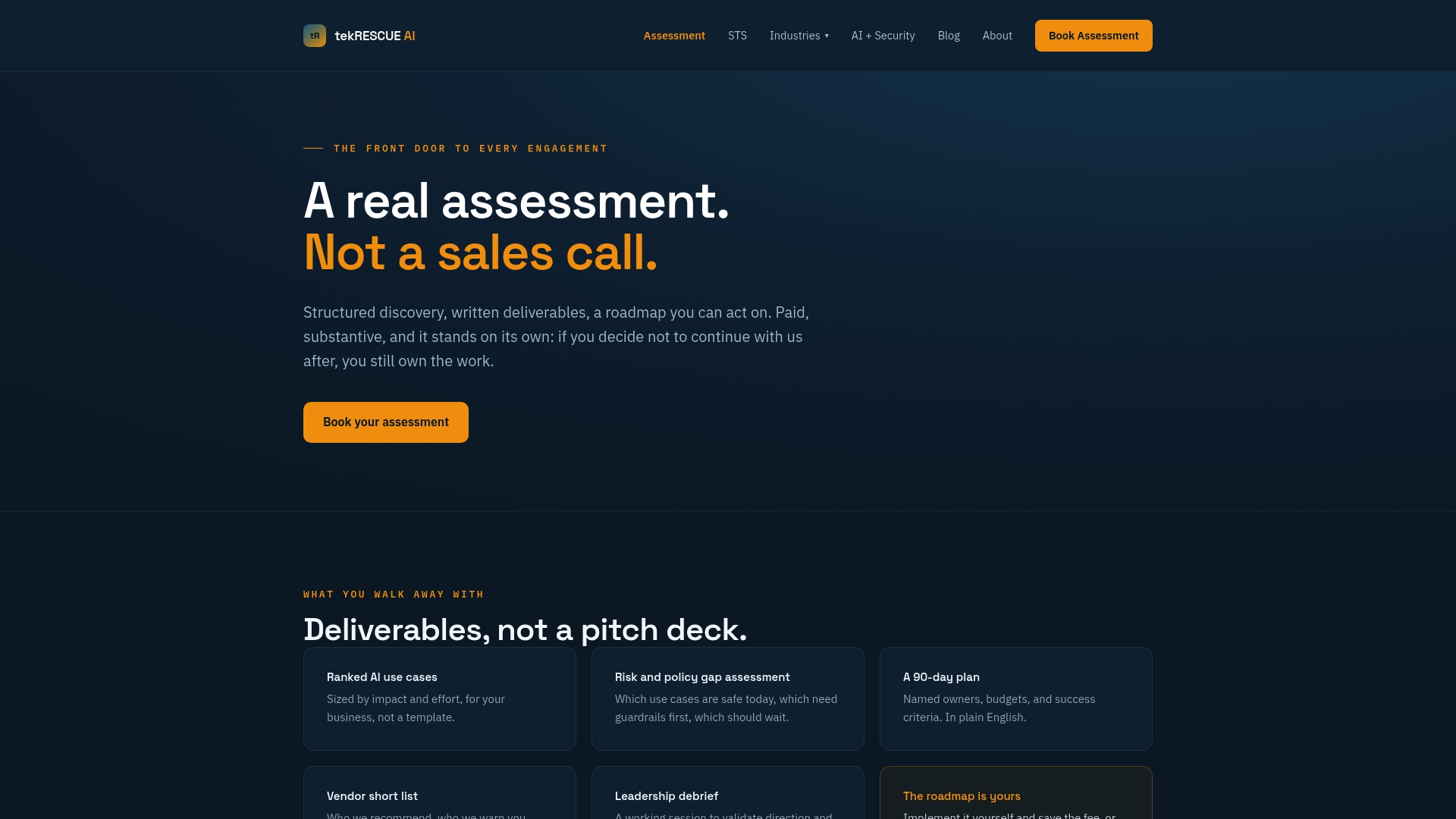
If you need ongoing enforcement once that plan is live, our Managed AI Security service covers monitoring and response so your team isn’t carrying it alone. Book an assessment to see where your AI systems stand today.
FAQ
How can data leakage be prevented?
Data leakage, in AI systems or otherwise, is reduced by combining technical controls like encryption, access restrictions, and output inspection with policy controls like data classification and vendor contract terms. The FTC’s guidance adds that clear notice and consent mechanisms are necessary wherever customer data feeds model training.
What is the 30% rule for AI?
There’s no recognized industry standard called the “30% rule” in the AI security guidance we reviewed from NIST, OWASP, or CISA. If you encountered this term elsewhere, it’s worth checking the original source directly, since definitions describing AI usage thresholds vary widely by organization and context.
Can AI leak your data?
Yes. Models can memorize and reproduce training data, agents with excessive permissions can take unauthorized actions, and retrieval systems can surface documents they shouldn’t. GAO’s analysis found that attackers can use techniques like roleplaying and gradual escalation to bypass safeguards and extract sensitive information from AI systems.
Sources
- OWASP Top 10 for LLM Applications v2025
- AI companies, uphold your privacy, confidentiality commitments, FTC (2024-01-08)
- NIST Artificial Intelligence Risk Management Framework: Generative AI Profile
- AI data security: Best practices for securing data used to train and operate AI systems, CISA (2025-05-22)
- Artificial Intelligence: Generative AI training, development, and deployment considerations, GAO