An AI security program is an organizational capability that governs, maps, measures, and manages AI-specific risks across the entire AI lifecycle, not a single tool or a one-time audit. It covers governance and ownership, system inventories, risk assessments, technical protections, ongoing monitoring, incident response, and workforce training, all working together instead of sitting in separate silos.
If you’re building one from scratch, the fastest legitimate starting point is adopting the NIST AI RMF fundamentals and running a small, high-value pilot: inventory your AI systems, then prioritize risk treatments for the two or three that matter most. Pair that with MITRE ATLAS for threat modeling, and you have a credible foundation most organizations lack.
A functioning program typically includes:
- Clear ownership and documented risk tolerance at the leadership level
- A living inventory of every AI system, model, and data source in use
- Risk assessments tied to business impact, not generic checklists
- Technical protections for models, APIs, and infrastructure
- Continuous monitoring for drift, misuse, and adversarial activity
- An incident response plan built specifically for AI failure modes
- Role-based training so the humans running the program actually understand it
Pro Tip: Don’t wait for a “complete” inventory before starting your first risk assessment. Score the systems you know about now. You can always add rows later, but a stalled pilot teaches you nothing.
tekRESCUE builds these programs for organizations that want the rigor without hiring an internal security team from scratch, using structured assessments to turn this framework into a working roadmap rather than a binder nobody opens.
Key Takeaways
An effective AI security program pairs the NIST AI RMF’s four functions with adversary informed testing from MITRE ATLAS and a named accountability owner, executed through a prioritized pilot rather than a comprehensive rollout.
| Point | Details |
|---|---|
| Start with governance, not tools | Assign a named owner and document risk tolerance before buying monitoring or testing platforms. |
| Use NIST AI RMF as your backbone | Structure the program around GOVERN, MAP, MEASURE, and MANAGE, using the Playbook for concrete action items. |
| Threat model with MITRE ATLAS | Map realistic attack patterns before designing red-team exercises or technical controls. |
| Pilot before you scale | Run the full lifecycle on one or two high-impact systems and measure residual risk reduction before expanding. |
| Get expert help building the roadmap | tekRESCUE’s AI Profit and Growth Assessment maps inventory, risk scoring, and a phased rollout to your specific systems. |
Table of Contents
- What Is an AI Security Program Built On? Key Frameworks and Standards
- How Do You Design an AI Security Program Around Your Organization?
- What Technical Controls Does an AI Security Program Need?
- Training and Skills: What Your Team Actually Needs to Know
- How tekRESCUE Turns This Framework Into a Working Roadmap
- Why Most AI Security Advice Gets the Order Wrong
- Get an AI Security Roadmap Built Around Your Actual Systems
- Sources
What Is an AI Security Program Built On? Key Frameworks and Standards
You don’t need to invent your own taxonomy for AI risk. Three resources already exist, each solving a different piece of the puzzle, and understanding how they fit together will save you months of reinventing wheels.
The NIST AI RMF organizes AI risk management into four functions: GOVERN, MAP, MEASURE, and MANAGE. GOVERN sets the policies and accountability structure. MAP identifies and characterizes your AI systems and their context. MEASURE defines how you’ll evaluate safety, security, fairness, and privacy. MANAGE turns those measurements into prioritized action. It’s intended as a voluntary, adaptable framework, which means it scales down to a five-person startup and up to a regulated enterprise without forcing either into an ill-fitting mold.
The AI RMF Playbook is where the framework stops being theoretical. It offers suggested, actionable steps aligned to each RMF subcategory, giving practitioners a starting checklist instead of a blank page. NIST frames the Playbook as a dynamic resource meant to be tailored to your sector and risk tolerance, not a static compliance form you fill out once and file away.
The most useful frameworks aren’t the ones with the most detail. They’re the ones that tell you what to do Monday morning. The RMF gives you the structure; the Playbook gives you the task list.
MITRE ATLAS fills a different gap entirely. It’s a living adversary tactics and techniques knowledge base built specifically for AI systems, mapping attack patterns across model, agent, and inference vectors. Where the RMF tells you what to govern and measure, ATLAS tells you what an attacker actually does, which is essential input for threat modeling and red-team design.
Government deployment guidance from NSA, CISA, and IC3 rounds out the picture with operational specifics: sandboxing execution environments, hardening APIs, encrypting model artifacts, and adopting a zero-trust posture for AI deployments. This maps most directly to the MEASURE and MANAGE functions, translating policy into configuration.
Together, these three resources answer three different questions: what should we govern (RMF), how might we get attacked (ATLAS), and how do we lock this down operationally (NSA/CISA/IC3). Skip any one of them and you’ll have a gap somebody eventually finds for you.
How Do You Design an AI Security Program Around Your Organization?
A program built around the four NIST functions gives you a clear division of labor and a way to measure whether you’re actually making progress, rather than just producing documentation.
-
GOVERN. Assign a named owner for AI risk, not a committee that meets quarterly. Document your risk tolerance explicitly (what level of model error, bias, or exposure is acceptable for which use cases), establish policies for acquisition and deployment, and build the inventory that everything else depends on.
-
MAP. Catalog every AI system, its data sources, its model lineage, and who depends on its outputs. This is also where you score use-case risk. The NIST AI RMF approach ties risk scoring to business impact: a model that decides credit terms or flags safety incidents deserves far more scrutiny than one that drafts internal meeting summaries.
-
MEASURE. Define concrete metrics for safety, security, fairness, and privacy before you need them in an incident review. Set up testing, evaluation, verification, and validation (TEVV) approaches and a monitoring plan that actually runs, not one that exists only in a policy document.
-
MANAGE. Prioritize risk treatments based on severity and likelihood, build an incident response plan specific to AI failure modes (data poisoning, model drift, prompt injection, output manipulation), establish change management for model updates, and define how systems get decommissioned when they’re retired.
Pro Tip: Run your first pilot on a system that’s important enough to matter but small enough to fail safely. A customer-facing chatbot for a low-stakes product line teaches you more than trying to secure your fraud-detection model on attempt one.
The mistake most organizations make here is trying to boil the ocean. Pick one or two systems, run the full GOVERN through MANAGE cycle on them, measure the residual risk reduction, and use that as your case for expanding the program. A documented pilot with measurable ROI gets budget approved. A 40-page policy document with no pilot data gets shelved.
What Technical Controls Does an AI Security Program Need?
Policy without technical enforcement is a wish list. These are the controls that actually reduce your attack surface.

Protect the model itself. Encrypt model weights and checkpoints at rest, use hardware security modules for key management, and restrict access to model artifacts the same way you’d restrict access to a production database. Joint guidance from IC3, NSA, and CISA treats model weights as high-value assets requiring strong protection, on par with source code or customer data.
Harden the API layer and infrastructure. Enforce strong authentication, apply role-based or attribute-based access control, use allow lists for permitted callers, segment AI workloads on the network, and sandbox model execution so a compromised inference doesn’t reach the rest of your environment. The same joint guidance recommends a zero-trust mindset by default for AI deployments, not as an eventual upgrade.
Monitor continuously. Watch for performance drift, anomalous input patterns, and unauthorized access attempts, and keep immutable audit logs so you can reconstruct exactly what happened during an incident. Detecting model compromise depends on baseline behavior you can compare against, which means monitoring has to start before you think you need it.
Test like an attacker. Adversarial testing and red-team exercises built around MITRE ATLAS techniques catch failure modes that standard QA never will. Combine that with regular penetration testing and secure-by-design development practices.
Operationally, this comes down to unglamorous discipline: patch on schedule, harden configurations, clean up identity and access management regularly, and keep your logging immutable so nobody, including an insider, can quietly erase the evidence.
Training and Skills: What Your Team Actually Needs to Know
Different roles need different depth. Your governance leads need to understand risk tolerance and policy, not the math behind gradient descent. Your ML engineers and security engineers need hands-on fluency in adversarial ML, secure ML lifecycle practices, and TEVV methods. Your SREs need monitoring and incident response specific to AI failure modes, and your privacy officers need data governance chops that account for model training data, not just customer records.
Core curriculum topics worth prioritizing:
- Adversarial machine learning and attack pattern recognition
- Secure ML lifecycle practices from data collection through decommissioning
- Incident response tailored to AI specific scenarios, not generic IT playbooks
- Data governance covering provenance, consent, and bias mitigation
When evaluating external courses or certificates, look for hands-on labs and scenario-based exercises, not lecture slides. Programs with red-team components and clear alignment to NIST functions tend to translate into usable skills faster than credential-focused options. Course selection matters more than course prestige here.
Pro Tip: Build a small cross-functional squad (one security engineer, one ML engineer, one governance representative) before you scale training organization-wide. Testing your curriculum on three people first saves you from rolling out a program that sounds good but doesn’t fit how your teams actually work.
Weigh internal upskilling against hiring carefully. Existing staff already understand your systems and data; new hires bring outside pattern recognition. Most mature programs end up doing both.
How tekRESCUE Turns This Framework Into a Working Roadmap
Most organizations know they need an AI security program. Few know where to start, which is exactly the gap the AI Profit and Growth Assessment closes.
The assessment maps directly to the NIST functions: it produces a system inventory (MAP), a prioritized risk profile tied to business impact (MEASURE), and a phased roadmap for treatment (MANAGE), backed by governance recommendations tailored to your organization’s risk tolerance (GOVERN). Rather than handing over a generic framework and leaving execution to you, tekRESCUE builds the roadmap around your actual systems.
A typical phased roadmap looks like this:
- Phase 1: Assessment and inventory of existing AI systems and data flows
- Phase 2: Prioritized pilot on the highest-impact, most-feasible use case
- Phase 3: Deployment of technical controls (access management, encryption, monitoring)
- Phase 4: Training rollout and continuous monitoring integration
- Phase 5: Scheduled review and program expansion
A framework tells you what good looks like. A roadmap tells you what to do this quarter. Most organizations only have the first one.
Why Most AI Security Advice Gets the Order Wrong
The conventional advice on this topic treats frameworks and tools as the starting point. Adopt NIST AI RMF, buy a monitoring platform, hire a red team, and hope it adds up to a program. It rarely does, because none of those steps mean anything without a governance owner who can force a decision when a risk assessment and a product deadline collide.
What the research actually supports is starting with accountability, not tooling. GOVERN comes first in the RMF’s own sequence for a reason: you can inventory every system and run every red-team exercise MITRE ATLAS suggests, but if nobody has the authority to say “this model doesn’t ship until we fix the access controls,” the program is theater.
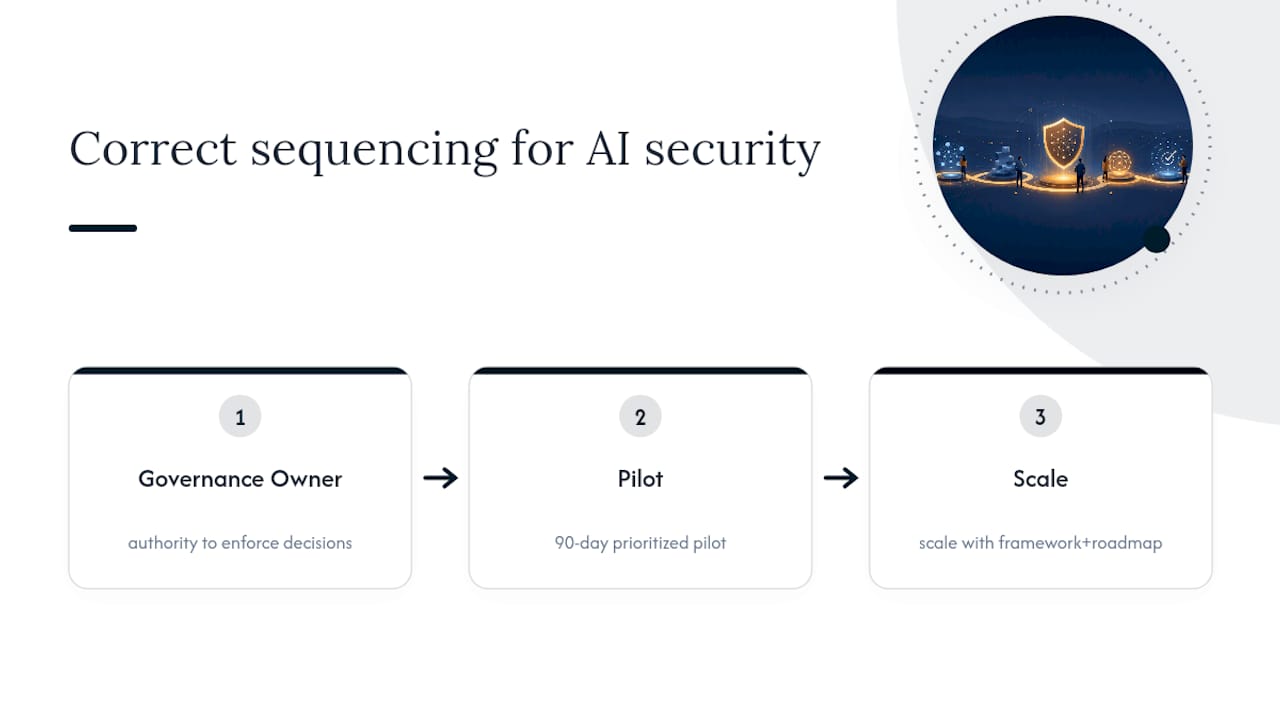
I’d also push back on the instinct to build comprehensive coverage before running a pilot. A prioritized pilot on one meaningful system, with metrics that measure whether risk actually went down, teaches an organization more in ninety days than a year spent drafting policy nobody has tested. The framework and the roadmap have to move together. One without the other either stalls in committee or ships something nobody secured.
Prioritize the owner, then the pilot, then the scale. Everything else is sequencing.
— Randy Bryan
Get an AI Security Roadmap Built Around Your Actual Systems
Reading a framework document is one thing. Turning it into an inventory, a risk score, and a working pilot for your specific systems is another problem entirely, and it’s the one most internal teams get stuck on.
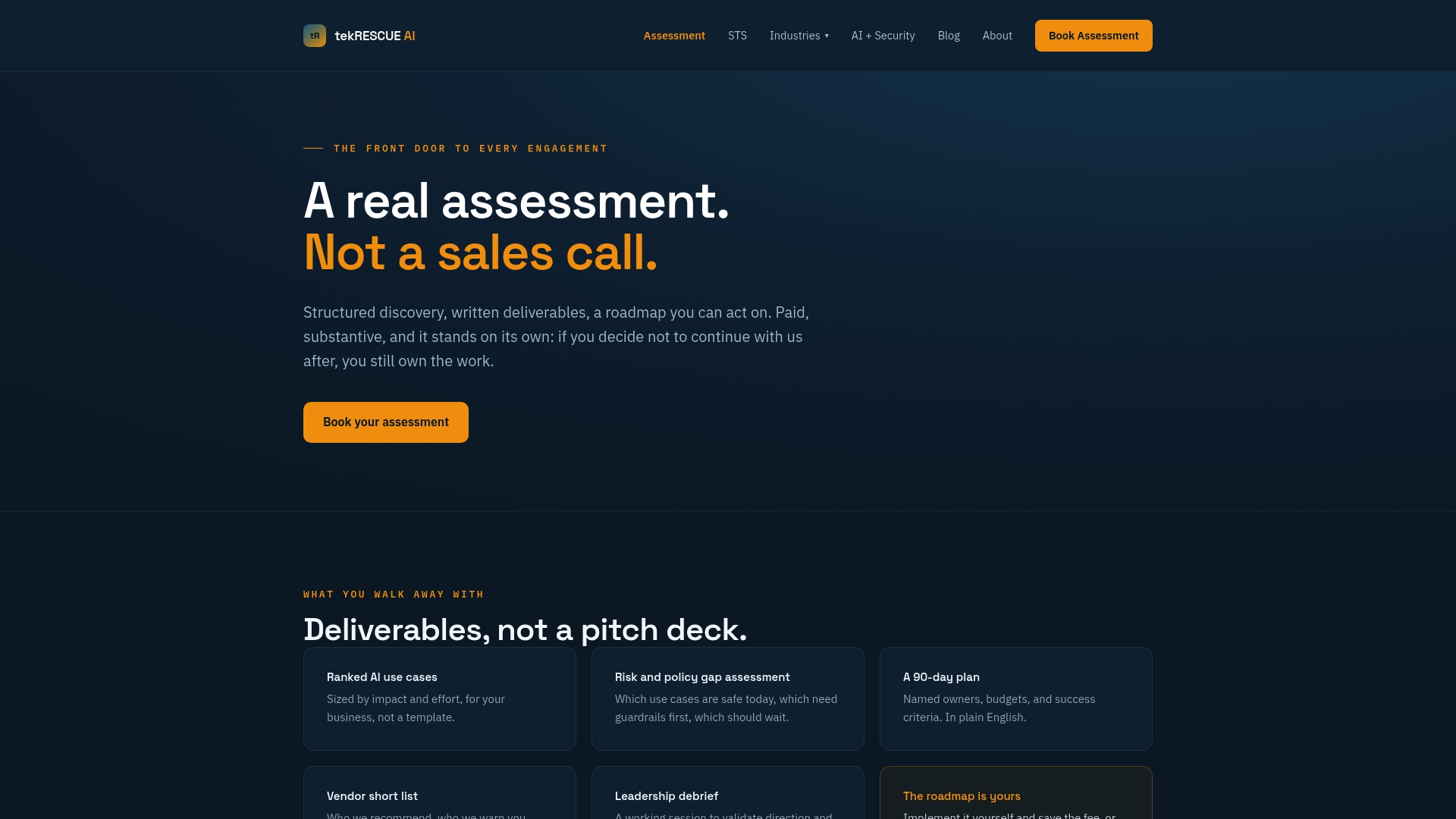
tekRESCUE built the AI Profit and Growth Assessment specifically for organizations that don’t want to hire a full internal security team just to get a working AI security program off the ground. Instead of a generic audit, you get a roadmap tied to your actual systems: what’s in use, where the risk concentrates, and which controls to deploy first based on business impact rather than a one-size-fits-all checklist. That combination of AI strategy and cybersecurity depth, built on 30 years of IT and security experience, is what separates this from a standard growth-focused engagement. If you’re ready to see where your organization actually stands, book an AI Profit and Growth Assessment and get a prioritized roadmap instead of another framework to file away.
Sources
- Artificial Intelligence Risk Management Framework (AI RMF 1.0)
- AI RMF Playbook
- MITRE ATLAS™
- Deploying AI Systems Securely (IC3/NSA/CISA joint guidance)