AI access control governs which human, service, or AI agent may perform which actions, when, and under what constraints. It’s not a new gatekeeper, it’s a smarter and more granular version of the one you already have. The NIST NCCoE concept paper published in February 2026 breaks this down into four technical focus areas your team needs to know: identification, authorization, access delegation, and logging.
Here’s the part most security teams get wrong: they treat AI agents like software features instead of identities that need their own accountability trail. If an agent can read a database, call an API, or trigger a workflow, it needs a scoped, auditable identity, not a shared credential borrowed from a human account.
The single most useful thing you can do this week:
- Inventory every AI agent, bot, and automation currently touching your systems
- Check whether each one has its own identity or is riding on a shared service account
- Scope down any permission that’s broader than the task actually requires
Everything else in this guide builds from that starting point.
Key Takeaways
AI access control works when per-agent identity, capability-scoped tokens, and per-action logging replace shared credentials and session-level trust.
| Point | Details |
|---|---|
| Audit agent identities first | Inventory every AI agent and confirm none are sharing a human or service account credential. |
| Scope tokens to single actions | Replace long-lived API keys with short-lived, capability-scoped tokens for each task. |
| Build delegation records | Require signed, time-bound delegation envelopes whenever one agent or user acts on behalf of another. |
| Map to NIST focus areas | Align your architecture with identification, authorization, delegation, and logging from the NIST NCCoE concept paper. |
| Get a prioritized roadmap | tekRESCUE’s AI Profit and Growth Assessment ranks remediation steps by risk exposure across your agent fleet. |
Table of Contents
- What Is AI Access Control and How Does It Differ From Traditional Models?
- How Does AI Access Control Work in Practice?
- What Are the Enterprise Benefits of AI-Enhanced Access Control?
- What Are the Risks and Limitations of AI Access Control?
- Translating the NIST NCCoE Concept Paper Into Requirements
- Implementation Checklist for AI-Aware Access Controls
- Integration and Operational Considerations
- tekRESCUE AI’s Take: Where Enterprises Actually Go Wrong
- Get a Prioritized Roadmap Instead of Guessing Where to Start
- Sources
What Is AI Access Control and How Does It Differ From Traditional Models?
Traditional access control was built around a simple assumption: a human logs in, a session starts, and permissions apply for the duration of that session. Role-based access control (RBAC) and attribute-based access control (ABAC) both assume a person is behind the wheel, making judgment calls a policy engine can’t fully anticipate.
AI access control breaks that assumption. An autonomous agent doesn’t have a “session” in the human sense. It might spin up, complete a task in four seconds, call three other services, and terminate, all without a person watching. That’s why per-action authorization matters more than per-session authorization for agentic workloads. The permission check needs to happen at the moment of the action, not once at login.
A few concepts you’ll need in your vocabulary:
- Non-human identity: a distinct, trackable identity assigned to a bot, service, or AI agent, separate from any human’s credentials
- Capability-scoped tokens: short-lived credentials that grant exactly one function (read this table, call this endpoint) rather than broad standing access
- Model Context Protocol (MCP): an emerging pattern for letting AI models discover and use external tools safely, with defined boundaries on what they can invoke
- Per-agent identity: the practice of issuing each agent instance its own identity rather than sharing one account across a fleet
RBAC and ABAC aren’t obsolete, but they were never designed for actors that can chain hundreds of actions per minute without a human reviewing each one. AI-driven security has to add a layer these older frameworks never anticipated.
How Does AI Access Control Work in Practice?
AI shows up in access control in five distinct ways, and most enterprise deployments end up using several at once. Understanding each one helps you evaluate what a vendor is actually offering versus what’s marketing language.
-
Behavioral analytics and anomaly detection. Machine learning models baseline normal behavior for a user or an agent, then flag deviations, a service account suddenly querying a table it’s never touched, or a human account logging in from two continents in an hour. OneLogin’s analysis of AI in identity and access management notes this pattern is one of the more mature AI applications in the space because it doesn’t require replacing existing authentication, just watching it more closely.
-
Continuous authentication and risk-based step-up. Instead of authenticating once at login, the system re-evaluates risk throughout a session. A low-risk action proceeds. A high-risk action, say, a wire transfer or a schema change, triggers a step-up challenge like an additional MFA prompt.
-
Capability-scoped tokens and short-lived credentials. Rather than issuing a broad API key that lives for months, the system issues a token scoped to one action with a lifetime measured in minutes. If the token leaks, the blast radius is small and the window closes fast.
-
Biometric and sensor-fusion authentication. AI models now combine multiple biometric signals, typing cadence, facial geometry, device posture, to reduce false positives compared to single-factor biometric checks.
-
Model-context integration for tool discovery. When an AI agent needs to call an external tool or API, MCP-style patterns let it discover available tools and request scoped delegation rather than being handed a master credential upfront.
Pro Tip: Don’t let a vendor’s “AI-powered” claim substitute for asking what specifically changed. Ask them directly: does the token scope narrow with AI recommendations, or is the AI just generating a risk score that a human still has to act on? Those are very different levels of automation.
What Are the Enterprise Benefits of AI-Enhanced Access Control?
The business case for AI access control comes down to three things: speed, scale, and evidence. Security teams that manually review entitlements once a quarter simply cannot keep pace with an environment where dozens of AI agents are provisioned and deprovisioned weekly.
- Faster detection of compromised credentials, because behavioral models flag anomalies in near real time instead of waiting for a scheduled audit
- Fewer hours spent on manual entitlement reviews, since automated systems can flag stale or over-provisioned access continuously
- Authorization that scales across large application and agent fleets without a linear increase in headcount
- Per-action audit logs that produce stronger compliance evidence than session-level logs ever could
OneLogin’s research on AI in identity management points out that automated provisioning and risk-based access decisions reduce the operational burden that typically falls on identity teams during audits and access recertification cycles. That operational relief compounds. Every entitlement review your team automates is an hour redirected toward actual threat hunting instead of spreadsheet reconciliation.
What Are the Risks and Limitations of AI Access Control?
No security leader should deploy AI-driven access decisions without understanding where the technology breaks down. These aren’t hypothetical concerns, they’re the specific failure modes that show up in production.
Model bias and explainability gaps sit at the top of the list. If a machine learning model denies access based on a pattern it learned from historical data, and that pattern reflects a bias in how past incidents were labeled, the model perpetuates the bias at machine speed. MIT Sloan’s overview of machine learning explains why understanding a model’s error modes matters before you let it make consequential decisions. An access decision that can’t be explained to an auditor is a liability, not a feature.
Agent-specific threats deserve their own line item, because they don’t map cleanly to legacy threat models:
- Delegation hijack: an attacker compromises an agent’s delegated authority rather than its credentials directly, inheriting whatever the agent was authorized to do
- Token replay: a captured short-lived token gets reused before it expires, particularly damaging if token lifetimes are set too generously
- Inter-agent injection: one compromised agent feeds malicious instructions to another agent it communicates with, propagating the compromise laterally
Privacy risk is real too. Behavioral telemetry, the same data that powers anomaly detection, often includes granular activity logs that raise data residency and retention questions, especially for organizations operating across jurisdictions.
Operational risk rounds it out. Latency introduced by continuous evaluation can degrade user experience if not architected carefully. Model drift means a model trained on last year’s behavior patterns may misfire on this year’s legitimate new workflows. And every AI access control decision is only as good as the data feeding it.

Pro Tip: Run a shadow-mode period before letting any AI-driven access model make live decisions. Let it flag what it would have blocked for two to four weeks while a human reviews the calls. You’ll catch false positives before they lock out a legitimate agent mid-task.
Translating the NIST NCCoE Concept Paper Into Requirements
The NIST NCCoE concept paper published in February 2026 isn’t abstract guidance, it’s a direct blueprint for what your agent identity architecture needs to include. It organizes the problem into four focus areas, and each one maps to a concrete requirement you can audit against today.
-
Identification. Every AI agent needs a unique, verifiable identity distinct from the human or system that deployed it. This is the NCCoE project’s core finding: conflating an agent’s identity with its deployer’s identity destroys the accountability trail the moment something goes wrong.
-
Authorization. Access decisions need to happen at the point of action, using capability-scoped tokens rather than broad standing permissions. This often means extending OAuth or OIDC flows to support agent-specific grant types.
-
Access delegation. When an agent acts on behalf of a human or another agent, that delegation needs to be explicit, signed, and time-bound, not implied by the fact that the agent has network access to a resource.
-
Logging. Every action an agent takes needs a provenance record: which identity performed it, under what delegated authority, and with what scope. Session-level logging isn’t granular enough for this.
The NCCoE’s own framing is blunt about the stakes: organizations that issue shared service accounts to agent fleets create a situation where revocation is either too broad, killing every agent at once, or effectively impossible because no one can isolate which agent needs to be cut off.
To run a gap assessment against these four areas, start by asking three questions for every AI agent in production: Does it have its own identity, or is it sharing one? Does its access get evaluated per action, or once at startup? And if you needed to revoke just this one agent right now, could you do it without affecting anything else? A Cloud Security Alliance research note maps these requirements directly to gaps in NIST SP 800-53 control families, specifically AC (access control), IA (identification and authentication), AU (audit and accountability), and SR (supply chain risk management), recommending organizations treat the concept paper as actionable guidance now rather than waiting for a finalized standard.
Implementation Checklist for AI-Aware Access Controls
Moving from principle to practice takes a sequence, not a single project. Here’s the order that holds up under scrutiny.
-
Onboard every AI tool and agent into your identity provider. Treat agents as first-class identities with lifecycle automation through SCIM, not as an afterthought bolted onto a service account.
-
Redesign your token strategy. Sign every token, scope it to one capability, and shorten its lifetime aggressively. A token that lives for a long time is a liability waiting for an incident report.
-
Build signed delegation envelopes. When Agent A hands a task to Agent B, that handoff needs a cryptographically verifiable record of what was delegated and for how long.
-
Implement continuous policy evaluation. Don’t authorize once at session start. Re-evaluate at each meaningful action, with just-in-time (JIT) elevation for anything that needs temporary higher privilege.
-
Design an atomic kill switch. You need the ability to revoke one agent’s access instantly without a cascading effect on other agents or services that happen to share infrastructure.
-
Centralize per-action logging with correlation. Logs from your identity provider, your API gateway, and your agent orchestration layer need to correlate into a single provenance record, not three disconnected systems an incident responder has to stitch together manually.
-
Set a retention strategy and incident playbook before you need them. Decide now how long agent action logs live and who gets paged when the anomaly detection model flags a delegation hijack pattern.
Pro Tip: Build your kill switch and test it before you need it in an actual incident. A revocation mechanism that only exists on paper adds thirty minutes of scrambling to what should be a thirty-second action.
Integration and Operational Considerations
Rolling this out isn’t just a security architecture decision, it’s an infrastructure and vendor management project with real tradeoffs.
- Confirm your identity provider actually supports agent-specific primitives, not just human user provisioning, before committing to a rollout timeline
- Ask vendors directly whether they support OAuth 2.1 profiles for agent authorization and SCIM-based provisioning for lifecycle automation
- Build your telemetry architecture with storage costs in mind. Per-action logging at enterprise scale generates far more data volume than session-level logging ever did
- Load test continuous evaluation under peak conditions. A policy engine that adds 200 milliseconds of latency per action is invisible in a demo and painful in production
- Establish a model governance process that checks for drift on a defined schedule, not just when something breaks
None of this is exotic engineering. It’s the same discipline you’d apply to any system making high-stakes decisions at scale, applied to a category of identity that most access control architectures weren’t built to handle.
tekRESCUE AI’s Take: Where Enterprises Actually Go Wrong
Most enterprises don’t fail at AI access control because the technology is too hard. They fail because they automate before they stabilize the identity foundation underneath it. Start with your highest-risk agent use cases, the ones touching financial systems or customer data, and get per-agent identity right there first.
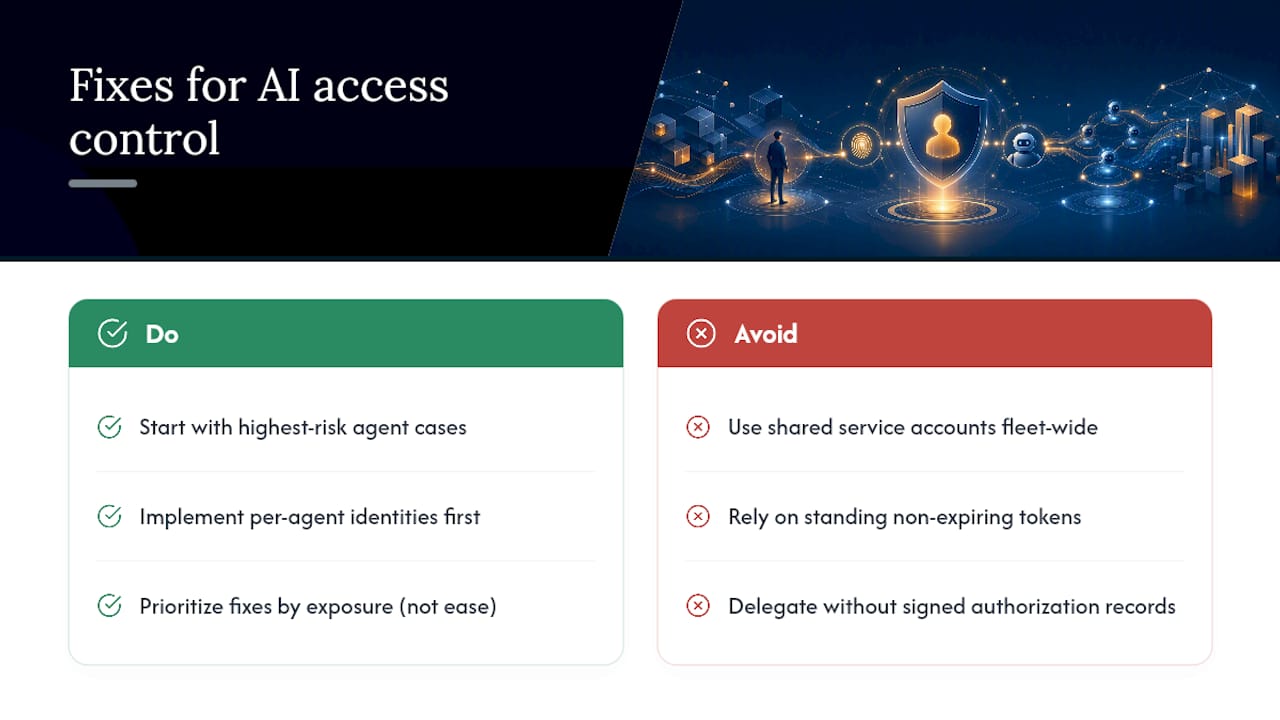
The anti-patterns we see most often: shared service accounts across an entire agent fleet, standing tokens that never expire, and delegation happening informally with no signed record of who authorized what. None of these show up as a crisis until an incident forces someone to answer “which agent did this?” and nobody can say for certain.
A structured AI Profit and Growth Assessment(https://tekrescue.ai) maps these risks against your actual environment and prioritizes remediation by exposure, not by what’s easiest to fix first.
— Randy Bryan
Get a Prioritized Roadmap Instead of Guessing Where to Start
Most organizations trying to solve this alone end up either freezing every AI project until security signs off on everything, or shipping agents into production with access controls borrowed from human user templates that were never designed for the job. Neither approach scales, and both cost you time you don’t get back.
tekRESCUE takes a different path. The AI Profit and Growth Assessment starts with a gap analysis against the exact standards this article covers, agent identity, token scoping, delegation records, and audit logging, then produces a prioritized roadmap tied to measurable milestones instead of a generic checklist. You get a plan built around your actual agent fleet and existing identity infrastructure, not a template pulled from someone else’s environment. Engaging an AI partner makes the most sense when you have agents already in production or planned within the next two quarters and no internal team dedicated to owning agent identity full time. If that’s where you are, start with tekRESCUE’s AI Profit and Growth Assessment(https://tekrescue.ai) and get a roadmap built around what your systems actually need.
Sources
- Accelerating the Adoption of Software and AI Agent Identity and Authorization, NIST NCCoE concept paper
- NIST AI agent standards: what it means for enterprise security, Cloud Security Alliance research note
- What you need to know about AI in identity and access management, OneLogin
- Machine learning explained, MIT Sloan