Zero Trust for AI applies continuous verification, least privilege, and assume-breach thinking to AI subjects, meaning data, models, pipelines, inference endpoints, and agents. The first move isn’t a purchase or a policy rewrite. It’s an AI-focused Zero Trust assessment that inventories your protect surfaces, checks model provenance, and tells you where the real exposure sits. Standards from NIST and CISA give you the map. The assessment gives you the starting coordinates.
TL;DR:
- Conduct a Zero Trust assessment focused on AI assets, including models, data, pipelines, and inference endpoints, to identify real exposure points.
- Prioritize identity management and memory governance over network segmentation, as most incidents stem from overprivileged agents or ungoverned data stores.
- Implement controls like cryptographic signing, versioning, and attestations for models, with continuous verification tying runtime telemetry to signed artifacts.
- Use a four-layer architecture—data, supply chain, pipeline, and inference—to enforce policies and provide evidence for auditability aligned with established frameworks.
- Start with quick wins like credential rotation and prompt sanitization; then automate pipeline controls, and finally establish long-term monitoring and incident response processes.
Table of Contents
- Why Zero Trust Principles Must Extend to AI
- A Zero Trust for AI Reference Architecture and Trust Layers
- Practical Patterns and Controls to Implement Now
- How to Sequence an Assessment Into a Roadmap
- DevSecOps, Model Supply Chain Security, and Reproducible Provenance
- Runtime Monitoring, Detection, and Incident Response for AI Systems
- Mapping Zero Trust for AI to NIST AI RMF, CISA, and CSA Guidance
- tekRESCUE AI Perspective: How We Operationalize Zero Trust for AI
- How to Apply Zero Trust
- Sources
- FAQ
Why Zero Trust Principles Must Extend to AI
Perimeter security was built for a world with clear edges: a network, a server, a user logging in. AI systems don’t respect those edges. A model can pull sensitive data into its context window, an agent can call five external tools in a single task, and a memory store can quietly retain something it should have forgotten. That’s a different shape of risk than the one most enterprise security stacks were designed to catch.
The trust boundaries multiply fast. You’re no longer just verifying human users. You’re verifying agent identities, memory stores, model artifacts, and inference endpoints, each with its own attack surface:
- Agent identities: non-human accounts that act autonomously and often inherit broader permissions than they need
- Memory stores: persistent context that can leak across sessions, users, or tenants if not governed
- Model artifacts: weights and checkpoints that can be tampered with or substituted without triggering traditional file-integrity alarms
- Inference endpoints: APIs that accept untrusted input directly and generate output that downstream systems may trust blindly
Layer on the threat list and the case for lifecycle controls gets stronger. Prompt injection can hijack an agent’s instructions mid-task. Data exfiltration can happen through a model’s own responses. Model poisoning corrupts training data before you ever deploy. Supply-chain compromise hides in a dependency you never audited. Emergent agent behavior, meaning actions no one explicitly programmed, can bypass rules written for a narrower version of the system.
Assume-breach and least privilege still apply, but the targets change. You’re not just assuming a laptop gets compromised. You’re assuming a model can be manipulated through its own inputs, so every AI subject needs the same skepticism you’d apply to an unpatched server on the open internet.

A Zero Trust for AI Reference Architecture and Trust Layers
Practitioner research describes a four-layer architecture that treats AI assets as first-class trust subjects, not bolt-ons to existing IT controls. Each layer gets its own reference architecture and assurance framework, with specific controls, policy enforcement points, and evidence artifacts.
- Data Trust Layer: governs training and inference data. Controls include data classification, access policies tied to sensitivity, and lineage tracking. Evidence: data hashes, access logs, and lineage records showing where a dataset originated.
- Model Supply Chain Trust Layer: governs how models are built, sourced, and versioned. Controls include cryptographic signing and dependency scanning. Evidence: signed model artifacts, version manifests, and vendor attestations.
- Pipeline Trust Layer: governs the CI/CD and training pipeline itself. Controls include isolated build environments and approval gates. Evidence: build logs, reproducible-build hashes, and pipeline configuration snapshots.
- Inference Trust Layer: governs runtime behavior when the model is actually answering requests. Controls include input sanitization, output validation, and rate limiting. Evidence: request/response logs, policy evaluation records, and anomaly flags.
Each layer needs a policy enforcement point, meaning a gate that actually checks the policy rather than just documenting it. Mapping this to NIST SP 800-207, the tenets of continuous verification, least privilege, and microsegmentation apply directly. The Data and Inference layers map most closely to continuous verification. The Model Supply Chain layer maps to least privilege for build and deployment credentials. The Pipeline layer is where microsegmentation keeps a compromised training job from touching production inference.
Crosswalked against NIST’s AI RMF, the Govern function ties to policy definitions across all four layers, Map ties to the Data layer’s classification work, Measure ties to Inference layer telemetry, and Manage ties to incident response tied to the Pipeline and Model Supply Chain layers.
Practical Patterns and Controls to Implement Now
You don’t need to solve every layer before you start. These are the controls that produce measurable risk reduction fastest, based on patterns the Cloud Security Alliance recommends for LLM environments.
- Fix identity first. Human and non-human identities both need short-lived credentials, MFA where humans are involved, and workload identities for agents rather than shared API keys. Capability-based tokens that expire and scope narrowly beat static credentials every time.
- Apply least privilege and context-based access control to models, memory, connectors, and APIs. An agent that only needs read access to a customer database should never hold write credentials, even temporarily, even for convenience.
- Control prompts and tool use directly. Allowlist which tools an agent can call, sanitize inputs before they reach the model, bound what capabilities are available per task, and verify outputs before they trigger downstream actions.
- Govern memory as its own boundary. Microsoft’s Zero Trust for AI guidance treats memory as a governed asset with retention limits, access controls, and provenance tracking, not a bottomless scratchpad that persists indefinitely across sessions.
- Segment model endpoints and vector stores at the network layer. Inference APIs and the vector databases behind retrieval-augmented systems deserve the same microsegmentation you’d apply to a payment processing system, not open access from every internal service.
If you’re authenticating AI agents that send or receive email as part of a workflow, provisioning that infrastructure with scoped, auditable credentials rather than shared mailboxes closes a surprisingly common gap, something Sendmux’s agent infrastructure approach addresses directly.
Pro Tip: Start with identity and memory governance before you touch network segmentation. Most AI incidents trace back to an overprivileged agent or an ungoverned memory store, not a network misconfiguration.
How to Sequence an Assessment Into a Roadmap
Turning principles into a working program follows a sequence, not a single leap. Here’s the path that keeps momentum without overwhelming a security team already stretched thin.
- Scope the assessment. Inventory every model, dataset, pipeline, agent, and inference endpoint in scope. Include shadow AI, meaning tools business units adopted without security’s knowledge, because that’s often where the biggest exposure hides.
- Prioritize by impact, not novelty. Rank findings by business impact, data sensitivity, endpoint exposure, and model criticality. A customer-facing chatbot with access to billing data outranks an internal experimentation model every time.
- Run a workshop to translate findings into action. Bring security, engineering, and business stakeholders together to agree on what gets fixed first. The output should split into three buckets:
- First: short-term controls you can deploy in weeks, like credential rotation and prompt sanitization
- Then: medium-term automation, like CI/CD gates and signed artifact enforcement
- Next: long-term assurance work, like audit trails and third-party attestation processes
- Set a review cadence. AI systems change faster than most compliance calendars assume. Quarterly reassessment, at minimum, keeps the roadmap honest.
This sequencing mirrors what Microsoft describes in its own workshop and assessment expansions for AI security programs, though the specific pillars and pacing should reflect your organization’s actual risk tolerance, not a generic template.
DevSecOps, Model Supply Chain Security, and Reproducible Provenance
A model you can’t prove the origin of is a model you can’t trust, no matter how well it performs in testing. Supply-chain integrity has to start at build time, not after deployment.
- Sign every artifact. Cryptographic hashes and signed weights let you verify a model in production is the exact model that passed review, not a substitute or a tampered checkpoint.
- Version everything, including data. Model versioning without matching dataset versioning creates gaps auditors will find eventually.
- Build an AI-BOM. An AI bill of materials should track model lineage, training data sources, dependency versions, and licensing, mirroring the software SBOM practices most security teams already run.
- Use attestation frameworks. Frameworks like SLSA and in-toto give you a standardized way to prove a build pipeline wasn’t tampered with, and they translate well into vendor contract language when you’re procuring third-party models.
- Push provenance requirements into vendor contracts. If a cloud provider or model vendor can’t produce lineage records on request, that’s a gap worth flagging before signing, not after an incident.
Operational assurance for this layer should tie runtime telemetry back to signed artifacts, creating an evidence package auditors can actually verify rather than a folder of disconnected logs. Reproducible builds matter here too: if you can’t rebuild a model from its recorded inputs and get the same result, your provenance claims are aspirational, not verified.
Runtime Monitoring, Detection, and Incident Response for AI Systems
Static pre-deployment testing catches known problems. It doesn’t catch what a model does after six months of real-world inputs, which is why runtime telemetry matters as much as architecture.
Log everything that matters for forensics later: inputs, outputs, model decisions, policy evaluation results, and artifact hashes tied to each inference call. Without that trail, an incident becomes a guessing game.
- Build behavioral baselines so anomaly detection has something to compare against; a model suddenly answering questions outside its normal domain is a signal worth investigating
- Integrate AI telemetry into existing SIEM and XDR platforms rather than building a parallel monitoring stack nobody checks
- Update incident response playbooks with AI-specific steps: model quarantine, rollback to a known-good version, and human-in-the-loop validation before any automated action resumes
For AI touching operational technology, CISA’s guidance recommends designing failsafe states into the response plan and favoring passive, non-invasive monitoring so security tooling doesn’t itself become a new failure point in a physical system. Agentic AI raises the stakes further, since emergent behavior can bypass rules written for a narrower version of the system, making runtime monitoring the backstop static policy can’t provide.
Mapping Zero Trust for AI to NIST AI RMF, CISA, and CSA Guidance
Executives don’t want architecture diagrams. They want to know the program aligns with something auditable, and mapping your controls to recognized frameworks gets you there.
- Govern maps to policy definitions, role assignments, and the assessment cadence you’ve committed to.
- Map maps to the protect-surface inventory: every model, dataset, and agent identified in your assessment.
- Measure maps to runtime telemetry, anomaly detection thresholds, and the metrics you report to leadership.
- Manage maps to incident response, remediation tracking, and vendor risk decisions.
CISA’s joint guidance on secure AI integration into operational technology adds safety-focused recommendations relevant to any organization running AI near physical processes, particularly around segmentation and human oversight. Auditors will expect a specific evidence package: signed model artifacts, access logs tied to identity, lineage records, policy evaluation logs, and documented remediation timelines. Store these centrally, not scattered across team wikis, because the value of an evidence package is in how fast you can produce it under pressure.
tekRESCUE AI Perspective: How We Operationalize Zero Trust for AI
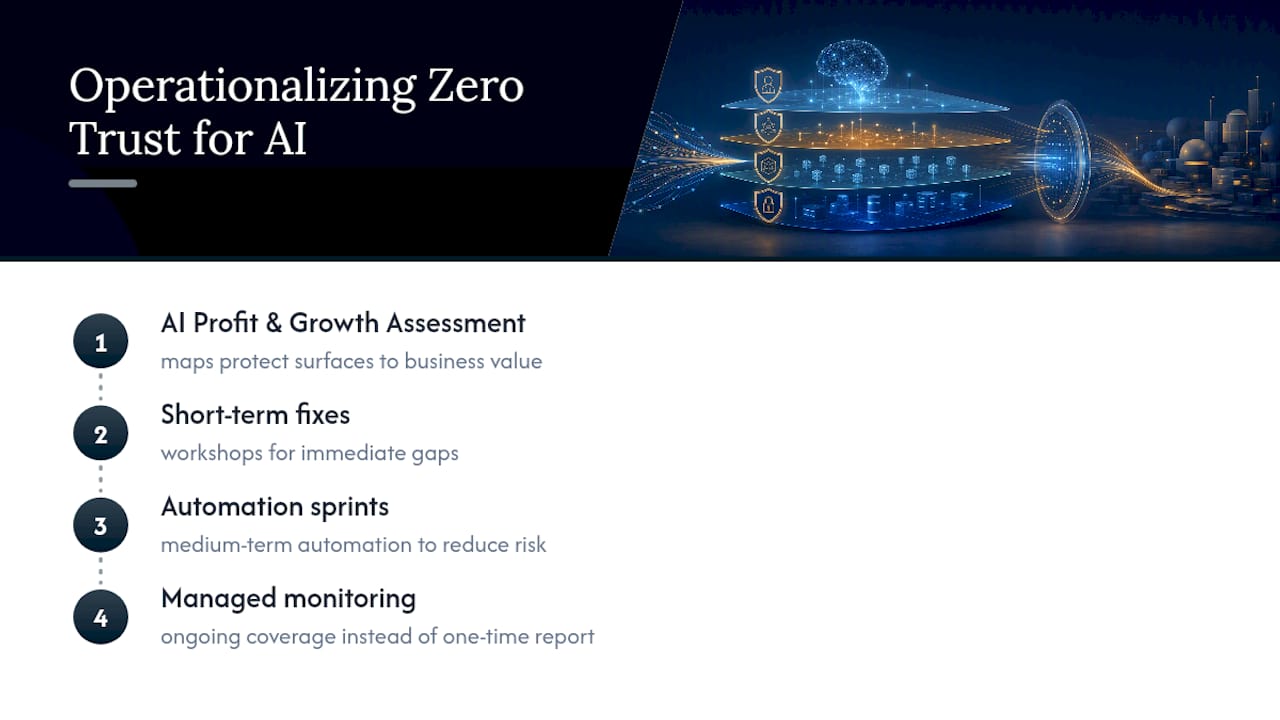
Most Zero Trust guidance stops at architecture diagrams. The gap we see constantly is between having a framework and actually running it against a real business with real deadlines. That’s the problem the AI Profit and Growth Assessment exists to solve: it maps protect surfaces directly to business value, so a construction firm’s estimating model and a professional services firm’s client intake agent get evaluated on what they actually put at risk, not a generic checklist.
The work is often structured in the same First, Then, Next sequence outlined earlier: short-term fixes in workshops, automation sprints for the medium term, and managed monitoring for organizations that need ongoing coverage rather than a one-time report.
— Randy Bryan
How to Apply Zero Trust
Every framework in this article, from NIST’s four functions to the four-layer architecture, describes what good looks like. Turning that into a working program inside your own environment is the harder part, requiring hands-on IT and cybersecurity practice rather than theory.
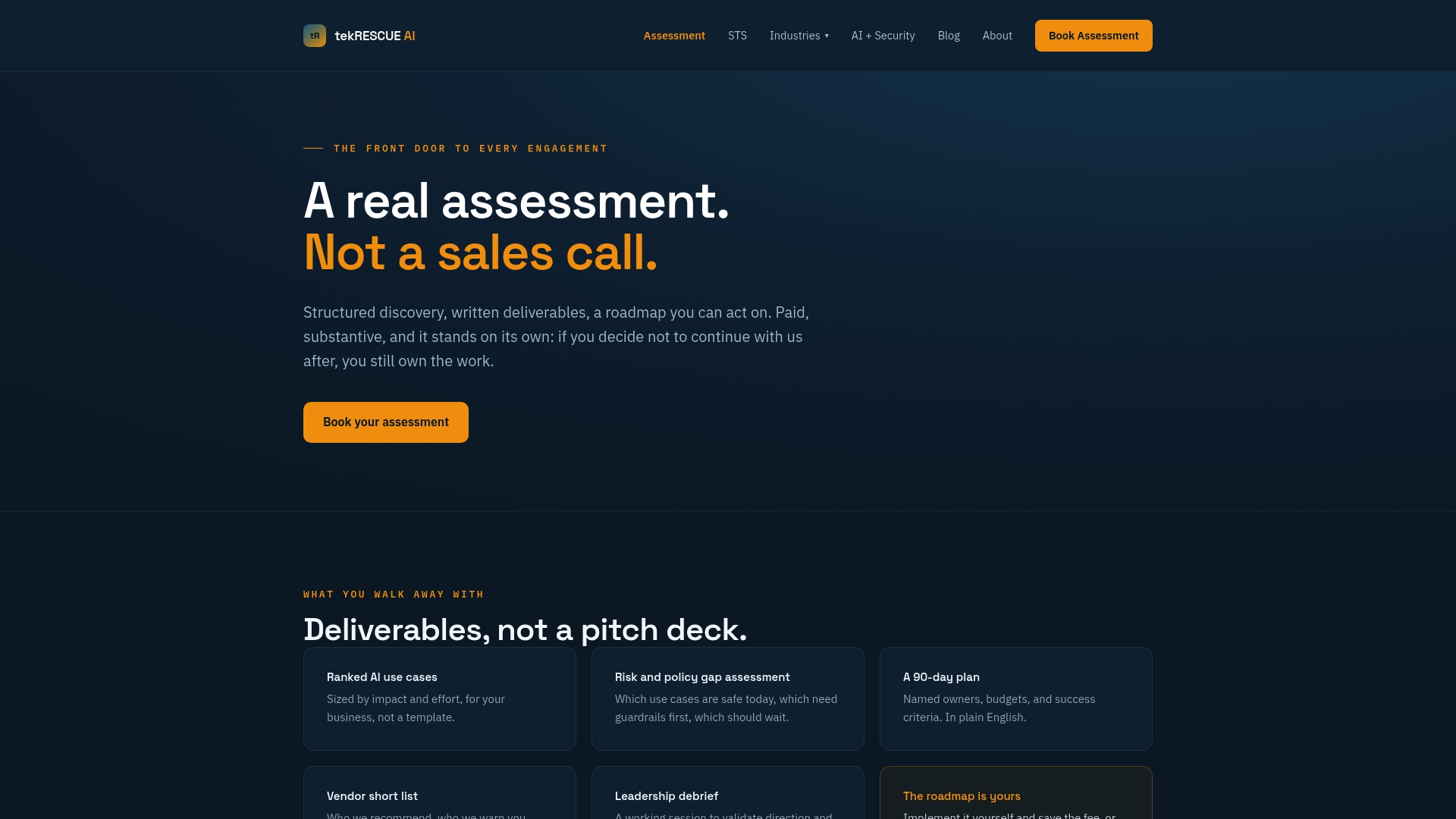
The AI Profit and Growth Assessment inventories your protect surfaces, checks model provenance, and hands you a prioritized roadmap scoped to your actual risk, not a generic industry template. If you’d rather hand off ongoing coverage entirely, Managed AI Security provides continuous monitoring so anomalies get caught before they become incidents. For teams building new AI systems from scratch, Build It Right integrates security into the development lifecycle from day one instead of retrofitting it later. Book the assessment to get a clear picture of where you stand and what to fix first.
Sources
- Zero Trust Architecture (NIST SP 800-207)
- New tools and guidance: Announcing Zero Trust for AI — Microsoft Security Blog
- Using Zero Trust to secure enterprise information in LLM environments — Cloud Security Alliance
- Adapting Zero Trust principles to operational technology — CISA (joint guide)
FAQ
What Did Bill Gates Warn About AI?
Bill Gates has publicly discussed concerns about AI systems being deployed faster than organizations can govern or secure them, though specific warnings vary by interview and context. The broader security concern echoed across the industry is the same one driving Zero Trust adoption: capability is outpacing oversight, and the gap between deployment speed and security maturity is where incidents happen.
What Are the 7 Pillars of Zero Trust?
Definitions vary slightly by framework, but common versions include identity, devices, networks, applications and workloads, data, visibility and analytics, and automation and orchestration. When extending Zero Trust to AI, an AI pillar covering models, agents, and memory is increasingly treated as an additional layer on top of these foundational pillars.
Is There a Reason to Not Trust AI?
AI systems carry specific risks that traditional software doesn’t, including prompt injection, data exfiltration through model outputs, and emergent agent behavior that bypasses static rules. That’s not a reason to avoid AI. It’s the reason Zero Trust principles, continuous verification, least privilege, and assume-breach thinking, need to extend into every AI subject an organization deploys.
Is Zero Trust Still Relevant?
Zero Trust remains one of the most widely referenced security models for enterprise environments, and its relevance has grown as AI systems introduce new, harder-to-perimeter risks like agent identities and inference endpoints. NIST SP 800-207 continues to serve as the baseline reference architecture that AI-specific guidance builds on rather than replaces.
How Much Does tekRESCUE AI’s Assessment Cost?
Pricing for the AI Profit and Growth Assessment is available on the tekRESCUE AI site rather than published as a flat rate, since scope depends on the number of protect surfaces and systems involved. Reach out through the assessment page directly to get a scoped quote for your organization.