If you’re wondering where to start with AI at your nonprofit, start small: run a governed pilot on one to three high-value workflows, put an Acceptable Use Policy and human review in place first, and lock down your data before you scale anything. That’s it. That’s the whole first move. An AI partner can help you build the roadmap, but the sequence matters more than the tools.
TL;DR:
- Most nonprofits should start with a small pilot on high-impact, low-risk workflows like drafting appeals or summarizing reports, with clear success criteria.
- An Acceptable Use Policy must be established beforehand, focusing on data security, human review, and approved tools to prevent misuse and data breaches.
- Data handling practices should prioritize security, including role-based access, redacting sensitive information, and avoiding consumer-grade AI tools on work devices.
- Assigning dedicated roles, providing short targeted training, and engaging staff, board, and community transparency are key to successful AI integration.
- Measure pilot impact through efficiency, quality, risk, and mission-related metrics over a structured timeline before deciding to expand or cease efforts.
Table of Contents
- A practical roadmap to start AI in your nonprofit
- High-value nonprofit AI use cases and concrete examples
- Building an Acceptable Use Policy and oversight
- Data, privacy, and security practices for nonprofit AI
- People, training, and change management
- Measuring impact, risk, and ROI for nonprofit AI projects
- Phased implementation checklist and timeline
- Why a risk-aware AI partner matters for nonprofit rollouts
- Funding and resource allocation strategies for nonprofit AI projects
- Stakeholder engagement and transparency in AI adoption
- Realistic expectations for nonprofit AI in the next two years
- How tekRESCUE helps you build a secure AI roadmap
- Authoritative resources and templates worth bookmarking
- Sources
- FAQ
A practical roadmap to start AI in your nonprofit
You don’t need a big rollout to get real value from AI. You need a tight, well-supervised pilot and a clear plan for what happens after it.
Here’s a sequence that works for most nonprofits over the next three to twelve months:
- Pick one to three pilot workflows where the impact is high and the risk is low: drafting fundraising appeals, summarizing grant reports, or triaging intake requests are good starting points.
- Write your governance rules before you touch a tool. An Acceptable Use Policy, a human-in-the-loop requirement, and basic data handling rules come first, not after.
- Scope the pilot tightly. Decide who runs it, what “success” looks like, and how long it runs, usually 30 to 90 days.
- Monitor as you go. Someone should be checking outputs weekly, not just at the end.
- Review against your decision gate. Did it save time, hold up under human review, and avoid data or bias problems? If yes, plan a scale-up. If no, adjust or stop.
- Document what you learned, even the failures, so the next pilot starts smarter.
This isn’t a technology rollout so much as a risk-managed experiment. Nonprofits that skip the governance step tend to end up improvising policy after something has already gone wrong, which is a much harder position to fix from.
High-value nonprofit AI use cases and concrete examples
The nonprofits getting real value from AI right now aren’t chasing the flashiest tools. They’re applying AI to the tasks that eat staff time without needing much judgment.
- Fundraising: draft variations of a donor appeal, summarize giving history for a major gift officer, or flag lapsed donors worth a personal follow-up.
- Constituent support: triage incoming requests, draft first-pass responses for staff to edit, and summarize long intake forms before a human review.
- Administrative work: first drafts of grant reports, meeting summaries, and scheduling logistics.
- Program analytics: cleaning messy spreadsheets, spotting outreach gaps, or flagging which communities aren’t being reached.
None of these replace judgment. They remove the blank-page problem and the repetitive cleanup work, which frees staff to spend time on the parts of the job that actually need a person.
Pro Tip: Start with the task your staff complains about most, not the task that sounds most impressive to a funder.
Building an Acceptable Use Policy and oversight
Before any pilot goes live, you need a policy that tells staff exactly what they can and can’t do. This isn’t bureaucracy for its own sake. TechSoup’s guidance on generative AI use policies centers the policy on data handling and human review, because that’s where nonprofits actually get hurt: a staffer pastes a client’s case notes into a public chatbot, or an AI-drafted appeal goes out with a factual error nobody caught.
Your policy should cover:
- What data can never go into a public AI tool: donor financial details, client case notes, health information, and anything covered by a confidentiality agreement.
- Human review requirements: no AI-generated content reaches a donor, client, or the public without a person signing off first.
- Approved tools list: which platforms are cleared for which tasks, and who approves new ones.
- Incident reporting: what staff do if they suspect data was exposed or an output was wrong or biased.
NIST’s Generative AI profile organizes this kind of work into four functions: Govern, Map, Measure, and Manage. Govern is your policy and roles. Map is figuring out where AI touches your data and workflows. Measure is testing for errors and bias before you scale. Manage is the ongoing job of watching for problems and fixing them. Assign someone, even part time, to own each function.
Pro Tip: Review your policy regularly. AI tools change faster than most nonprofit policy cycles are built for.
Data, privacy, and security practices for nonprofit AI
Treat AI adoption as a data-security project first and a productivity project second. That framing changes almost every decision you make.
Some data should never touch a consumer-grade AI tool: client case notes, photos of people you serve, health or immigration status details, and anything a donor gave you in confidence. Practitioner guidance in the nonprofit sector is blunt about this: ban consumer-grade AI tools on work devices unless they’re on an approved list, because free tools often use your inputs for further model training.
- Separate enterprise tools from consumer tools. An enterprise-tier AI platform with a signed data agreement is a different risk category than a free public chatbot.
- Check supplier contracts for how long your data is retained, whether it’s used for training, and who can access it.
- Use role-based access so only the staff who need a tool have it, and log who used what.
- Redact before you paste. Strip names, case numbers, and identifying details out of anything going into an AI tool, even an approved one.
A local IT partner can help you translate these into practice; general nonprofit IT and cybersecurity guidance covers the basics of supplier vetting and access control that apply directly here.
People, training, and change management
AI adoption fails more often from missing skills than missing tools. Before you scale a pilot, make sure someone actually owns each piece of it.
- Assign four roles, even if one person holds two: an executive sponsor, a data steward, a security lead, and a program owner who runs the pilot day to day.
- Brief the board twice a year on what’s being piloted, what data is involved, and what the risk register looks like.
- Run short training, not a full course: one session on what the policy allows, one on how to write a decent prompt, and a shared library of approved prompts staff can reuse.
- Cover volunteers and contractors in the same policy. A well-meaning volunteer with a personal AI account is still a data risk.
Sector benchmarking from NTEN found that many nonprofits still lack AI-specific policies, and that staff capacity and training are the most common barriers to moving past basic experimentation. Solving that is cheaper and faster than most organizations expect: a few hours of training and one clear document usually gets you most of the way there.
Measuring impact, risk, and ROI for nonprofit AI projects
Pick a small number of metrics before you start, or you’ll have no way to judge the pilot honestly.
- Efficiency metrics: hours saved per week on the target task, measured by the staff doing the work.
- Quality metrics: error rate in AI-drafted content caught during human review.
- Risk metrics: any data exposure incidents, bias complaints, or policy violations.
- Mission metrics: whether the outreach or service the pilot touches is actually reaching more of the community you intend to serve.
A nonprofit sector survey found that adopting AI tools is a rising organizational priority, though relatively few organizations yet use advanced machine learning for program decisions, according to the 2025 Data Empowerment Report. That gap between interest and advanced use is exactly why a small, measured pilot beats a broad rollout.
Run a 30/60/90 day check: at 30 days, confirm the pilot is running as designed; at 60, review the metrics above; at 90, decide to scale, adjust, or stop.
Phased implementation checklist and timeline
A simple sequence keeps a pilot from turning into an open-ended experiment.
- Pre-pilot (weeks 1 to 4): finalize the Acceptable Use Policy, assign roles, and choose your one to three pilot workflows.
- Pilot (weeks 5 to 12): run the workflow with human review on every output, track your chosen metrics weekly.
- Decision point (week 12 to 16): score against your KPIs and risk log, decide scale, adjust, or stop.
- Scale (months 4 to 12): expand to more staff or workflows only after the decision gate passes, with the same review discipline.
Budget conservatively: most of the cost in year one is staff time for policy work and review, not software licenses. TechSoup’s guidance and templates can lower that cost further through discounted enterprise tools and community training built for nonprofits. Whatever vendor you choose, require contract terms covering data retention limits, no use of your data for model training without consent, and a clear deletion process when the relationship ends.
Why a risk-aware AI partner matters for nonprofit rollouts
Most nonprofits don’t have a full-time security team to map every AI risk before a rollout. That’s where an AI partner earns its place. tekRESCUE’s AI Profit and Growth Assessment produces a prioritized roadmap and a risk register specific to your organization, built on active cybersecurity practice rather than general advice. Bringing in a partner makes the most sense once you’ve picked your pilot workflows but before you touch sensitive data: that’s when NIST-aligned governance and real operational oversight matter most, and when the tekRESCUE team can help you make the AI Profit and Growth Assessment count.
Funding and resource allocation strategies for nonprofit AI projects
Most nonprofit AI budgets in year one should go toward people and policy, not software. A staffer’s time spent building the Acceptable Use Policy and reviewing pilot outputs is the real cost of doing this safely, and it’s usually underestimated in initial planning.
Look for lower-cost paths before committing to a paid platform. Many enterprise AI tools offer nonprofit discounts or donated licenses through TechSoup, which can meaningfully cut the cost of running a properly governed pilot instead of settling for free consumer tools with weaker data protections.
When you build the budget line, split it three ways: policy and training time, tool costs, and a reserve for security review or an outside partner’s assessment. Funders are increasingly open to supporting this kind of infrastructure work, especially when it’s framed as capacity building rather than a flashy new program. If you’re applying for a grant to cover AI adoption, describe the governance and training costs explicitly rather than folding them into a vague “technology” line. Grant reviewers respond better to a clear plan than a request for a new gadget.
Resist the urge to buy tools first and figure out governance later. It’s the most common budgeting mistake nonprofits make with AI, and it tends to cost more in cleanup than it would have cost to do right the first time.

Stakeholder engagement and transparency in AI adoption
Your staff, board, and the community you serve all have a stake in how you use AI, and each needs a different kind of input.
Staff should be part of choosing the pilot workflows, since they know where the repetitive pain points actually are. A workflow picked by leadership without frontline input often misses the mark. Board members need enough visibility to ask good questions, which means a plain-language briefing twice a year rather than a technical deep dive.
The community you serve deserves transparency too, particularly wherever AI touches how they’re screened, triaged, or communicated with. If an AI tool drafts the first response to an intake request, say so. If a triage process uses any automated scoring, be ready to explain it in plain terms and let people opt for a human contact instead. Practitioner commentary on nonprofit AI adoption argues that mission alignment and equitable outcomes should outrank efficiency gains whenever the two are in tension, and that’s a good filter to apply before any pilot goes live: ask who benefits, and who might be disadvantaged, before you scale.

Realistic expectations for nonprofit AI in the next two years
AI will save your staff time on drafting and cleanup. It won’t transform your mission overnight, and treating it that way sets you up for disappointment. The organizations that do well spend the first year on governance and staff capacity, not automation at scale. Pick pilots that give people back time on repetitive tasks while keeping a human making the actual calls.
— Randy Bryan
How tekRESCUE helps you build a secure AI roadmap
Once you’ve decided a pilot is worth running, the hardest part is often not the technology, it’s making sure the rollout doesn’t create a data problem you didn’t see coming. That’s the gap tekRESCUE AI fills for mission-driven organizations.
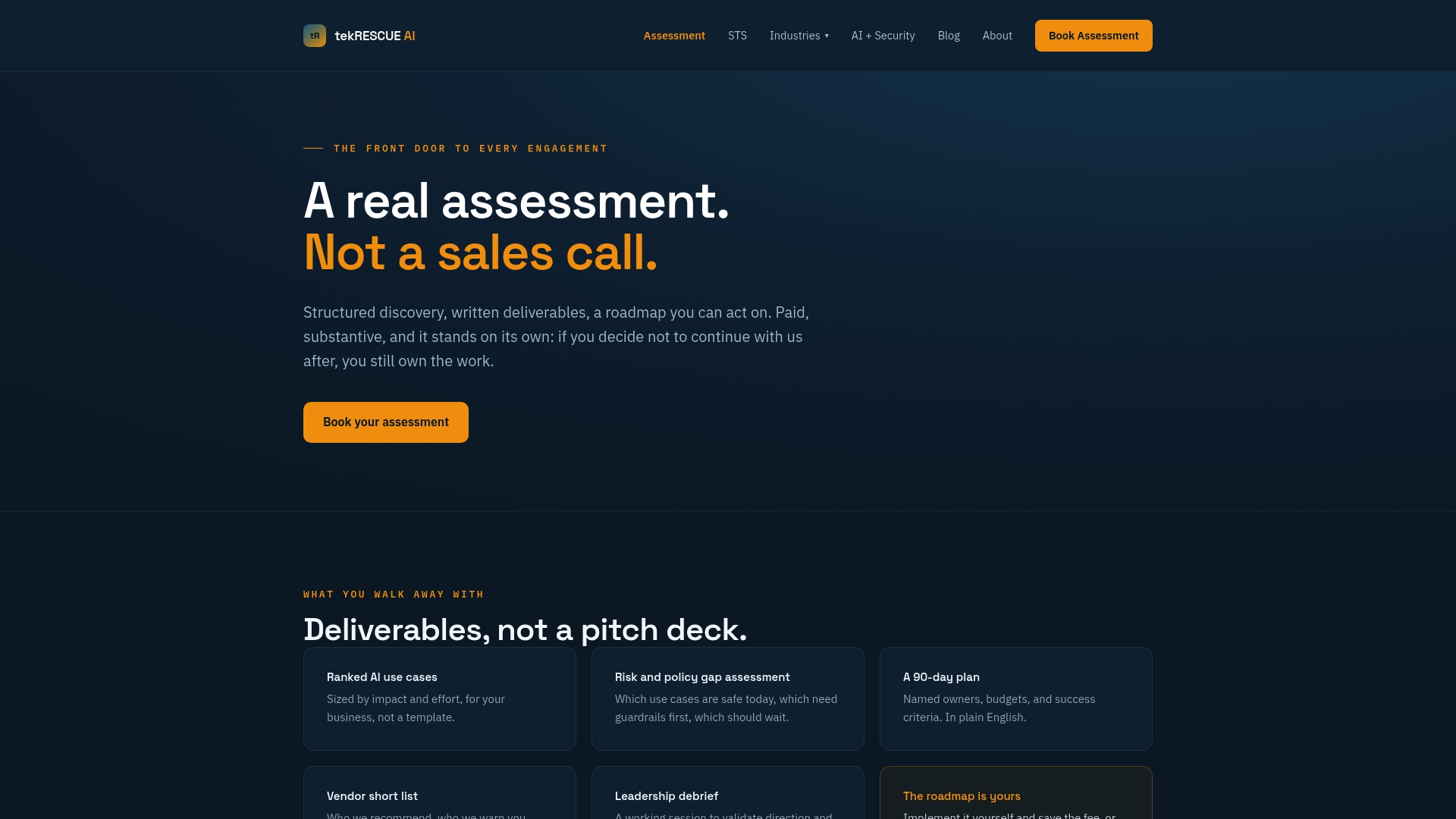
The AI Profit and Growth Assessment maps your workflows, flags where sensitive data is at risk, and hands you a prioritized plan built on active cybersecurity practice rather than general talking points. It’s built for organizations that want to move on AI without guessing at the risks. If your team is ready to plan a rollout instead of improvising one, request an AI Profit and Growth Assessment and see what a governed roadmap looks like for your organization.
Authoritative resources and templates worth bookmarking
For deeper reading, NIST’s AI Risk Management Framework covers governance in detail, NTEN’s sector benchmarking tracks adoption trends, and TechSoup offers ready-to-adapt policy templates for nonprofits getting started.
Sources
- Artificial Intelligence Risk Management Framework: Generative Artificial Intelligence Profile
- How to Create a Generative AI Use Policy for Your Nonprofit
- State of Nonprofit AI Adoption and Governance
FAQ
What is the 30% rule for AI?
Definitions vary by organization, so treat any specific percentage you encounter as one group’s internal guideline rather than a sector standard.
What should a nonprofit organization actually do with AI?
Start with a small, governed pilot on one to three workflows where AI saves staff time without touching sensitive data, such as drafting fundraising copy or summarizing reports. Put an Acceptable Use Policy and human review in place before the pilot begins, then measure results against clear KPIs before scaling.
What is the 80/20 rule for nonprofits?
The 80/20 principle is not a fixed AI standard and definitions vary depending on who’s using it. In practice, most nonprofits get the most value by focusing AI efforts on a small number of high-impact, low-risk tasks rather than spreading thin across many use cases.
What is the best AI tool for nonprofit organizations?
There’s no single best tool. The right choice depends on your workflow, budget, and data sensitivity, and enterprise-tier tools with signed data agreements are generally safer than free consumer tools for anything touching donor or client information. TechSoup offers discounted access to several vetted platforms built for nonprofit budgets.
How do we know if our AI pilot is working?
Track hours saved, error rates caught in human review, and any data or bias incidents over a 30/60/90 day window. If the pilot holds up against those metrics without creating risk, it’s ready to scale; if not, adjust the scope or stop.