To manage AI model risk you have to operationalize a lifecycle program built on the NIST AI RMF, covering Govern, Map, Measure, and Manage, backed by an inventory, testing and evaluation, ongoing monitoring, and a cross-functional governance board. Start with your highest-priority systems first. Document every decision along the way, because supervisors and auditors will eventually ask to see it.
TL;DR:
- Organizations should prioritize their highest-impact AI systems first, building a comprehensive inventory and risk profiles within the first three months.
- Feedback loops like fairness, robustness, and adversarial testing are essential to identify AI-specific failure modes and emergent behaviors.
- A cross-disciplinary governance board with regular meetings and veto power over deployment is crucial for credible AI risk management.
- Operational controls must include detailed documentation, continuous monitoring for drift, automatic anomaly detection, and well-planned decommissioning procedures.
- Conducting an AI Profit and Growth Assessment helps establish a tailored, prioritized roadmap for implementing effective AI risk management.
Table of Contents
- Why AI changes model risk management and what that means for your program
- Turn NIST AI RMF into action: Govern, Map, Measure, Manage
- Model validation and TEVV that fit AI
- Operational controls every program needs
- Governance and roles: how to run Data and AI Governance effectively
- Hands-on techniques and tooling patterns
- How tekRESCUE AI supports implementation
- Practitioner perspective: timelines, pitfalls, and where to focus first
- Start with an AI Profit and Growth Assessment
- Sources
- FAQ
Why AI changes model risk management and what that means for your program
Traditional model risk management was built for models that behave the same way every time you run them. AI doesn’t always work that way, and that’s the shift you need to plan around.
A few things make AI models trickier to manage:
- Training data can drift over time, so a model that worked fine last quarter might not today.
- Decision logic is often opaque, especially in complex machine learning and generative systems.
- Models can develop emergent behaviors nobody explicitly programmed.
- Generative systems can produce confident, plausible, and wrong answers, sometimes called hallucinations.
Some risks are AI-specific and need new controls. Others are just your normal business risks wearing a new hat. The GAO’s assessment of generative AI found real risks around misinformation and workforce effects, which is part of why regulators are paying closer attention.
Turn NIST AI RMF into action: Govern, Map, Measure, Manage
The NIST AI RMF Core gives you four functions. Here’s how to turn each one into work your team can actually schedule.
- Govern (days 1 to 30): Write an AI risk policy, charter a Data and AI Governance Board, set risk tolerances, assign a RACI chart, and add AI clauses to procurement contracts.
- Map (days 30 to 90): Build a full inventory of AI systems in use, profile each by risk based on its use case, and trace data lineage and dependencies for every model.
- Measure (days 60 to 120): Define metrics for each model, write a TEVV plan, run fairness and safety tests, and set monitoring thresholds that trigger a review.
- Manage (days 90 to 180): Build treatment plans for identified risks, write incident playbooks, and set change control and decommissioning procedures before you need them.
The AI RMF Playbook maps specific suggested actions to each of these subcategories, which is worth keeping open while you draft your own checklist.
Pro Tip: Start Govern and Map at the same time. You can’t set meaningful risk tolerances until you know what’s actually running in your environment.
Don’t try to do all four at once across every system. Pick your two or three highest-impact AI use cases, run them through the full cycle, and use what you learn to speed up the next batch.
Model validation and TEVV that fit AI
Testing, evaluation, verification, and validation, TEVV for short, looks a little different for AI than it did for older statistical models. You still need holdout performance testing and backtesting, but you also need methods built for AI’s particular failure modes.
- Fairness audits to check for disparate outcomes across groups.
- Adversarial and robustness tests to see how the model handles bad or manipulated inputs.
- Red teaming to find emergent failures that normal quality checks miss.
The NIST AI RMF frames Measure as a distinct function precisely because AI risks need dedicated metrics, not just a checklist borrowed from traditional model validation.
Package your evidence the way an examiner would want to see it: test plans, test results, remediation logs, and versioned artifacts tied to each model release. Metrics worth tracking include calibration, false positive and false negative rates, and drift indicators that flag when a model’s inputs no longer look like what it was trained on.
Operational controls every program needs
Your inventory is the backbone of the whole program. If a model isn’t in it, you can’t manage its risk, full stop.
Track these fields for every AI system:
- Purpose, business owner, and the data sources feeding it.
- Model lineage, including what it was built on and when it was last retrained.
- Current TEVV status and assigned risk tier.
Monitoring should catch drift, show performance on a dashboard leadership actually looks at, flag anomalies automatically, and log who accessed or changed the model. When a system reaches end of life, decommissioning needs a rollback plan, a data retention decision, and a short post-mortem so the next team doesn’t repeat the same mistakes.
Governance and roles: how to run Data and AI Governance effectively
A governance board only works if the right people are in the room and it actually meets on a schedule.
- Include legal, privacy, security, business owners, and your model risk leads, not just data science.
- Set a regular meeting cadence with clear decision gates and approval thresholds for anything classified as high-impact.
- Require human-in-the-loop review, documentation sign-off, and external disclosure where a model’s use affects customers or the public.
Cross-disciplinary governance like this is what the FTC’s AI policy materials point to as central to a credible program, including inventory attestation and supervisory review of AI use cases.
Pro Tip: Give the board veto power over deployment, not just advisory input. A board that can only comment gets ignored the first time a deadline is tight.
Hands-on techniques and tooling patterns
Red teaming works best as an adversarial exercise run by people who didn’t build the model. That independence matters, because the team that built something is usually the worst judge of where it breaks. Good scenarios to simulate include prompt injection, data poisoning, and edge cases the model has never seen.

Human-in-the-loop checkpoints should sit wherever an AI system’s output reaches a customer or a regulator without a person reviewing it first.
For tooling, think in categories rather than brand names:
- Explainability frameworks that show why a model made a given decision.
- Drift detectors that flag when inputs shift away from training data.
- Secure MLOps pipelines and monitoring platforms that log everything by default.
A practical guide to AI tooling categories is a reasonable starting point if you’re building this stack from scratch.
How tekRESCUE AI supports implementation
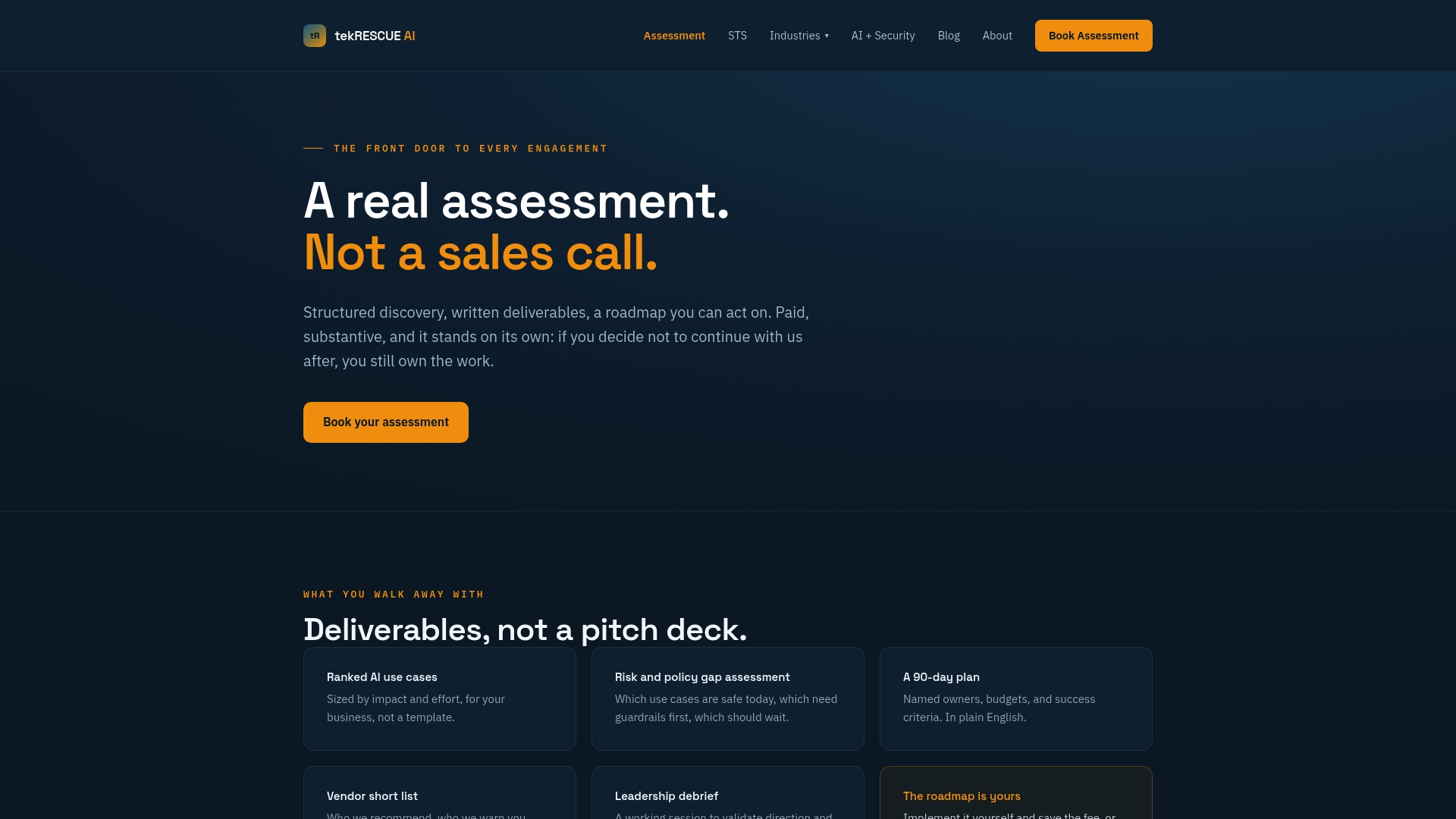
Building all of this from a blank page is a lot to take on alone, and that’s where an AI partner earns its keep. tekRESCUE AI’s AI Profit and Growth Assessment is built as a first step: it baselines your current AI risk exposure and turns it into a prioritized roadmap instead of a stack of generic recommendations.
Typical deliverables include an inventory baseline, a prioritized TEVV plan, governance templates for board use, and a remediation roadmap ranked by impact. From there, tekRESCUE AI’s STS: Strategy, Training, Systems and Managed AI Security services carry the work forward.
Practitioner perspective: timelines, pitfalls, and where to focus first
Most organizations underestimate how long inventory takes. Thirty days gets you governance basics in place. Ninety days should get you a real inventory and your first risk profiles done. By day 180, you want TEVV running on your highest-impact systems and monitoring thresholds actually catching things.

The pitfalls are predictable: skipping inventory because it feels tedious, running thin TEVV that wouldn’t survive an audit, and trusting a vendor’s safety claims without independent testing. None of these are AI problems specifically. They’re the same shortcuts that get organizations in trouble with any risk program, just faster and quieter with AI.
The organizations that do this well treat AI risk as an extension of their cybersecurity practice, not a separate discipline bolted on afterward. Access controls, logging, and incident response already exist in most security programs. Point them at your AI systems instead of building a parallel structure from scratch.
— Randy Bryan
Start with an AI Profit and Growth Assessment
If you’re staring at this checklist wondering where to even begin, that’s normal, and it’s exactly what the assessment is for. It’s a diagnostic look at your current AI exposure that ends in a roadmap ranked by what matters most, not a generic template.
Here’s how to get started:
- Ask about Managed AI Security if ongoing monitoring is your biggest gap right now.
- Reach out through tekRESCUE AI to talk through where your program stands today.
Sources
Keep these on hand for policy work and audit reference:
- Artificial Intelligence Risk Management Framework (AI RMF) Core
- SR 26-2: Revised Guidance on Model Risk Management
- Artificial Intelligence: Generative AI’s Environmental and Human Effects
- FTC AI use policy and Data and AI Governance Board materials
FAQ
How can AI be used in risk management?
AI can help risk teams spot patterns in large datasets faster than manual review, flagging anomalies, forecasting exposure, and supporting fraud detection. It works best as a support tool alongside human judgment, not a replacement for it, especially given the opacity issues the NIST AI RMF is designed to address.
Will FRM be replaced by AI?
No credible source supports the idea that AI will replace financial risk management as a discipline. AI is changing the tools risk managers use, but frameworks like SR 26-2 still center human governance, oversight, and accountability, not automation replacing the role.
What are the core functions of an AI risk management model?
The NIST AI RMF organizes AI risk management into four functions: Govern, Map, Measure, and Manage. Govern sets policy and structure, Map builds your inventory and context, Measure defines your testing and metrics, and Manage handles ongoing treatment and response.
Which AI is best for risk management?
There’s no single best AI tool for risk management since needs vary by organization size, industry, and existing infrastructure. A better first step is running a diagnostic assessment, like tekRESCUE AI’s AI Profit and Growth Assessment, to identify what your specific risk exposure actually requires before choosing tools.
Does recent supervisory guidance apply to generative AI models?
The updated SR 26-2 guidance explicitly excludes generative and agentic AI from its scope while still reiterating core governance principles for traditional models. Organizations using generative AI should still apply frameworks like the NIST AI RMF, since supervisory expectations in this area continue to develop.