Managed AI security means treating your AI agents, models, and infrastructure like the assets they are: inventoried, access-controlled, and watched around the clock. The single most important thing you can do this week is to find every non-human identity your AI systems use and cut their access down to just what they need, only when they need it. That one move, backed by guidance from NIST, CISA, OWASP, and MITRE, closes the door most agentic AI attacks walk through.
TL;DR:
- Securing AI systems requires identifying and minimizing access for all non-human identities, especially privileged credentials, to prevent cascading failures.
- Protecting agentic AI involves safeguarding models, runtimes, prompt templates, memory, connectors, and credentials, not just the models themselves.
- Continuous discovery, short-lived credentials, role-based access, sandboxing, and detailed logging are critical controls to reduce rapid attack surface exposure.
- Regular validation, red-team exercises, and monitoring drift help detect and contain risks like prompt injection, memory poisoning, and privilege abuse over time.
- Partnering with experienced AI security providers can streamline inventory, control implementation, and ongoing validation, reducing internal resource burden.
Table of Contents
- What managed AI security covers: assets, boundaries, and team responsibilities
- The agentic threat landscape and common attack classes
- Inventory, discovery, and non-human identity lifecycle controls
- Secure-by-design procurement, development, and deployment controls
- Monitoring, logging, and AI-enabled detection with human-in-the-loop safeguards
- Governance, validation cadence, and incident response for AI systems
- Operational playbooks and a prioritized 90-day checklist
- tekRESCUE AI perspective on operationalizing managed AI security
- How tekRESCUE AI can help: assessment and managed AI security services
- Sources
- FAQ
What managed AI security covers: assets, boundaries, and team responsibilities
Here’s the thing a lot of security teams get wrong: they treat an AI agent like a web app with a chatty user interface. It’s not. An agent can call tools, write to memory, chain actions across systems, and make decisions without anyone clicking a button. That changes what you need to protect.
Managed AI security means covering the full stack around an AI system, not just the model sitting at its center. That includes:
- Models and model artifacts, the weights, checkpoints, and fine-tuned versions your teams deploy.
- Agent runtimes, the environments where agents execute tasks and call external tools.
- Prompt templates and system instructions, which shape agent behavior and can be tampered with.
- Memory stores, where agents keep context, conversation history, or learned preferences.
- Connectors and integrations, including MCP servers and API bridges to your other systems.
- Non-human identities (NHIs), the service accounts, API keys, and tokens agents use to act.
Predictive AI, the kind that scores a loan application or flags a fraud pattern, mostly needs protection from data poisoning and evasion attacks. Agentic AI needs all of that plus protection from itself: an agent with too much privilege can do real damage simply by doing its job wrong.
Ownership gets messy fast. SecOps usually owns monitoring and incident response. AppSec owns code and pipeline security. AI ops or a platform engineering team often owns the runtime and model lifecycle. If nobody has written down who owns NHI provisioning or who approves a new agent connector, that gap is where incidents start.
The agentic threat landscape and common attack classes
Agentic systems fail in ways traditional software rarely does, because they act instead of just responding. The OWASP Top 10 for Agentic Applications, published in December 2025, lays out the priority risk classes: goal hijacking, tool misuse, identity and privilege abuse, and memory poisoning among them. Each one maps to a real production failure mode, not a theoretical edge case.
Statistic callout: MITRE’s OpenClaw investigation found that a single compromised agent can trigger cascading failures across an entire agent cluster through chokepoint techniques. That’s the core danger of agentic architecture: one weak link doesn’t stay contained.
MITRE ATLAS gives you the tactics behind these incidents, mapping how adversaries actually reach and exploit AI systems in production rather than in a lab. Combined with OWASP’s risk list, it gives security teams a shared vocabulary for threats that didn’t have names two years ago.
The threats worth prioritizing right now:
- Prompt injection, where malicious input hidden in a document, email, or web page hijacks an agent’s instructions.
- Memory poisoning, where an attacker corrupts what an agent remembers, shifting its future behavior.
- Tool misuse, where an agent is tricked into calling a legitimate tool for an illegitimate purpose.
- Privilege abuse, where an agent’s own credentials are used to reach systems it was never meant to touch.
- Cascading failures, where one compromised agent’s output feeds another agent, spreading the problem downstream.
What makes these different from a typical breach is speed. An agent doesn’t need a human to click a phishing link. It can act on bad input the moment it receives it, which is why detection and containment have to be built into the runtime, not bolted on after the fact.
Inventory, discovery, and non-human identity lifecycle controls
You can’t secure what you can’t see, and most organizations have no accurate list of every agent, model, and NHI running in their environment. Fixing that comes first.
Start discovery with these methods:
- Pull runtime telemetry from your agent orchestration platform to see which agents are active and what they’re calling.
- Scan for MCP servers and similar connector runtimes, since these are often stood up quickly and forgotten.
- Check model stores and registries for deployed and shadow models that never went through formal review.
- Ask engineering teams for an informal list, then reconcile it against what telemetry actually shows. The gap is usually bigger than expected.
Once you find an agent or NHI, capture the metadata that lets you manage it: owner, business purpose, privilege scope, connected systems, and whether a human approval gate exists before it can take a consequential action. Without that record, you’re back to square one the next time someone asks what an agent can touch.
NHI lifecycle management is where most of the real risk reduction happens. Provision credentials with the minimum scope needed for the task, issue short-lived tokens instead of standing keys, rotate on a fixed schedule, and decommission immediately when an agent or integration is retired. NIST’s Cyber AI Profile frames this kind of lifecycle discipline as core to securing AI components rather than an optional hardening step.
Pro Tip: Treat every NHI credential like a temporary visitor badge: give it a clear purpose, an expiration date, and a reason to be revoked the moment that purpose ends.
Secure-by-design procurement, development, and deployment controls
Whether you’re buying an AI product or building your own agent, the same questions apply, and asking them before deployment costs a lot less than asking them after an incident.
Before you procure any AI service, get vendor answers on data handling, model provenance, and how they support your logging and monitoring requirements. CISA’s guidance on agentic AI adoption recommends aligning any new AI service with your existing cybersecurity framework rather than treating it as a separate risk category. If a vendor can’t answer basic questions about how their agent handles credentials or logs its actions, that’s your answer.
For systems you build or fine-tune, bake these controls in from the start:
- Prompt hygiene, meaning clear separation between system instructions and user or external input, so injected text can’t masquerade as an instruction.
- Model signing, so you can verify a deployed model hasn’t been swapped or tampered with.
- SBOM and AIBOM records, tracking the components and dependencies inside your models and agent pipelines the same way you’d track software dependencies.
- Sandboxed tool execution, so an agent’s tool calls run in a contained environment rather than with direct production access.
- Rate limiting, to slow or stop an agent that starts making abnormal volumes of calls.
Deployment controls matter just as much as design ones. Segment agent networks away from core production systems, mediate every API call through a gateway rather than letting agents talk to backends directly, enforce role-based access control on every connector, and add runtime guardrails that validate an agent’s output before it’s acted on.
Frameworks like NIST CSF and ISO 27001 already give you a governance baseline for most of this. If your organization hasn’t settled on one, this comparison of ISO 27001 and NIST CSF is a useful starting point for deciding which fits your existing program.
Monitoring, logging, and AI-enabled detection with human-in-the-loop safeguards
Good monitoring for agentic AI starts with a simple question: if something goes wrong, will your logs actually tell you what happened? For a lot of teams right now, the answer is no.
Capture these at minimum: full prompts and system instructions, every tool call an agent makes, model outputs before and after any filtering, memory writes and reads, credential usage tied to each NHI, and the API calls agents make to other systems. Miss any one of these and you’ll have a gap exactly where an incident investigation needs a full picture.
Statistic callout: CISA’s logging reference architecture calls for treating AI and machine learning used in logging pipelines as managed information assets, with source fidelity preserved and human review points built in for consequential decisions. That guidance applies just as much to the AI you’re monitoring as to any AI you use to do the monitoring.
Using AI to help detect anomalies in agent behavior can genuinely speed up response, but it comes with a catch. Any AI-assisted detection that could affect evidence handling or trigger an automated enforcement action needs a human checkpoint before it executes. That preserves chain-of-custody if the incident ends up in a legal or compliance review, and it keeps a machine from making an irreversible call on incomplete information.
A few habits keep this practical instead of theoretical:
- Log at the point of action, not after the fact, so timestamps and sequences stay trustworthy.
- Keep AI-generated alerts separate from human-verified findings until a person signs off.
- Test your logging pipeline the same way you’d test a backup: by trying to restore from it.
Governance, validation cadence, and incident response for AI systems
None of the controls above hold up without governance behind them. That means assigning clear roles: who classifies an AI system as high-impact, who approves new agents, who owns the incident response runbook when something goes sideways.
A workable governance structure includes:
- Classification. Decide which AI systems count as high-impact based on what they touch and what they can do autonomously, then document that decision.
- Policy. Write down who can deploy an agent, what approval it needs, and what data it can access, in plain language your engineering teams will actually read.
- Validation cadence. Run adversarial testing, regression checks against known prompt injection patterns, and periodic red team exercises against your agent fleet, not just your traditional applications.
- Drift monitoring. Track whether a model’s behavior or an agent’s decision patterns are shifting over time, since drift is often the first sign something upstream has changed.
NIST’s Cyber AI Profile and CISA’s agentic adoption guidance both point toward the same conclusion: AI risk work belongs inside your existing cybersecurity program, not off in its own silo with its own rules.
When an incident does happen, agentic systems need a different response sequence than a typical breach. Preserve the model artifacts and logs involved before anything gets rolled back or redeployed, so there’s something left to investigate. Revoke the NHIs tied to the compromised agent immediately, since a standing credential left active is how one incident becomes two. Have a rollback plan ready that restores a known-good model version without losing the forensic trail. Once the immediate fire is out, run a post-incident validation pass to confirm the fix actually closed the gap rather than just hiding the symptom.
Operational playbooks and a prioritized 90-day checklist

A 90-day window gives you enough time to move from “we don’t know what we have” to “we have working controls,” without stalling on a plan that never ships.
Weeks 0 through 2: discovery and emergency containment
- Build a critical-path inventory of every agent, model, and NHI you can find through telemetry, registries, and connector scans.
- Convert any standing NHI credentials you find to short-lived tokens as an emergency measure, even before the full inventory is done.
- Identify the handful of agents with the widest system access and put manual approval gates on their highest-risk actions.
Weeks 3 through 8: hardening and monitoring
- Roll out role-based access control across every agent connector and API gateway.
- Add rate limiting to agents that touch external systems or sensitive data.
- Stand up logging that captures prompts, tool calls, and credential usage in one place.
- Write detection rules for the attack patterns from the OWASP Agentic Top 10 that apply to your environment.
- Move any unsandboxed tool execution into a contained environment.
Weeks 9 through 12: governance and validation
- Run a first-pass red team exercise against your highest-impact agents.
- Complete an access audit confirming least privilege actually holds across your NHI fleet.
- Set KPIs for ongoing operations: time to detect an anomalous agent action, percentage of NHIs on short-lived credentials, and number of unreviewed high-impact agent actions per month.
| Phase | Focus | Primary output |
|---|---|---|
| Weeks 0 to 2 | Discovery and containment | Verified inventory, short-lived credentials in place |
| Weeks 3 to 8 | Hardening and monitoring | RBAC, sandboxing, and centralized logging live |
| Weeks 9 to 12 | Governance and validation | Red team results, access audit, tracked KPIs |
Sustaining this past day 90 means folding the inventory, rotation, and validation steps into your regular security cadence instead of treating them as a one-time project.
tekRESCUE AI perspective on operationalizing managed AI security
Most of the guidance above is straightforward on paper and genuinely hard to execute under deadline pressure, staffing gaps, and a backlog of higher-visibility fires. That’s the real reason so many organizations have an AI inventory that’s three months out of date the moment anyone looks at it.
An experienced AI partner approaches this from extensive IT and cybersecurity practice, not from a slide deck. A structured starting point is needed before teams can operationalize any of the controls in this playbook: a real inventory, a prioritized roadmap, and a clear view of where risk actually sits.
An AI partner’s job in this relationship is practical, not advisory in the abstract. That means automating discovery instead of relying on spreadsheets, helping implement the playbook’s controls in the order that reduces the most risk first, training internal teams so the work doesn’t stall when the engagement ends, and returning periodically to validate that controls are still holding as agents and models change.
— Randy Bryan
How tekRESCUE AI can help: assessment and managed AI security services
Running this playbook alone, on top of everything else on your plate, is a lot to ask of any team. That’s exactly the gap the AI Profit and Growth Assessment is built to close.
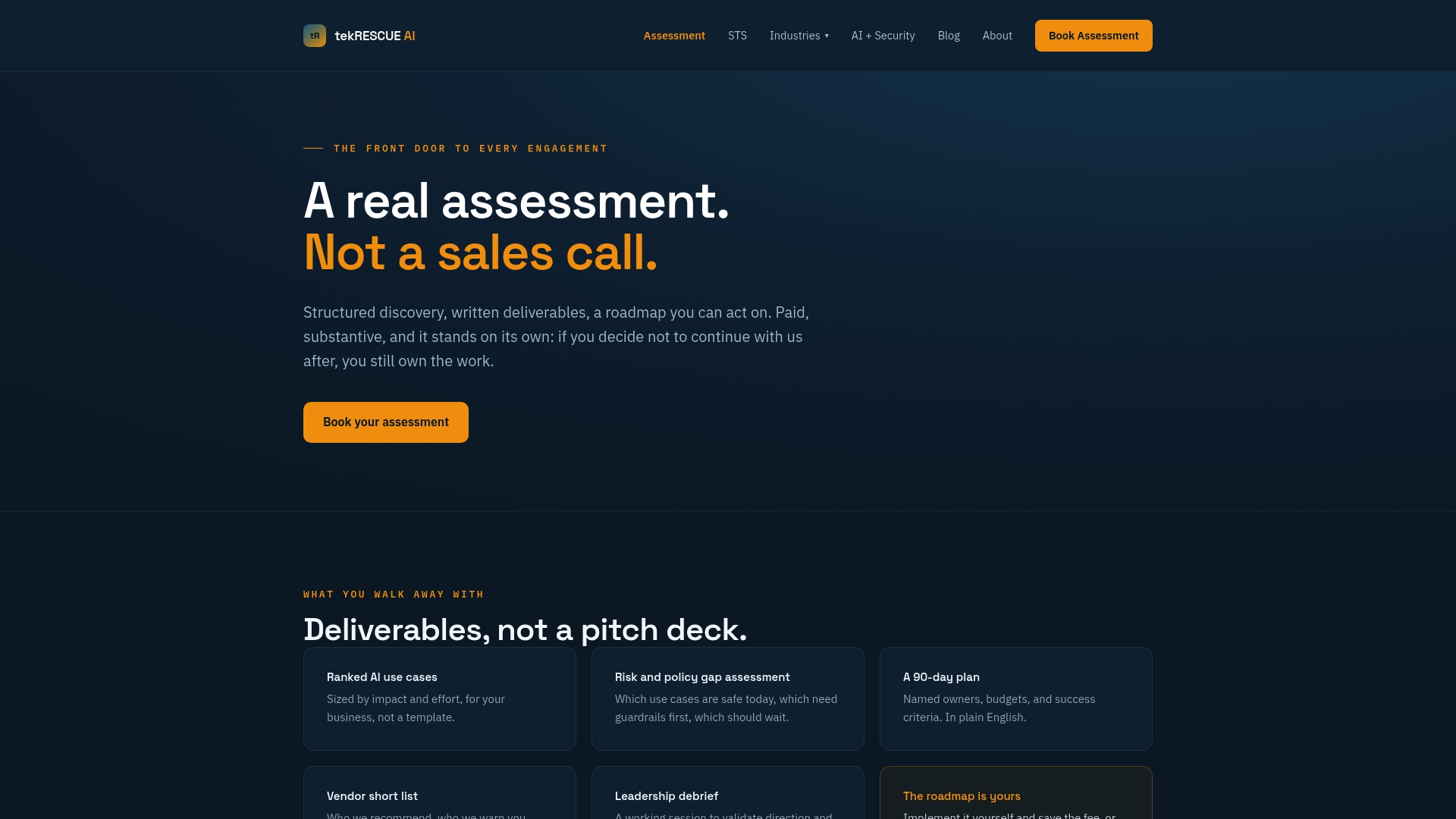
The assessment starts with a real inventory of your AI agents, models, and non-human identities, then produces a prioritized roadmap that tells you which controls to fix first and which can wait. From there, a managed AI security service can pick up the ongoing work: ongoing monitoring, credential lifecycle management, and ongoing validation so your controls don’t quietly go stale six months after go-live.
If you’d rather have an AI partner handle the discovery, hardening, and validation cycle described above instead of building it internally from scratch, start with the AI Profit and Growth Assessment or look at what Managed AI Security covers on an ongoing basis.
Sources
The controls in this playbook draw directly from published standards rather than general best-practice advice. NIST’s Cyber AI Profile (NISTIR 8596) and its adversarial machine learning taxonomy cover securing AI components and known attack classes. CISA’s guidance on agentic AI adoption addresses lifecycle risk management, while MITRE ATLAS and the OWASP Agentic Top 10 map real attack patterns in agentic systems.
- Cybersecurity Framework profile for artificial intelligence (NISTIR 8596)
- Careful adoption of agentic AI services (CISA)
- OWASP Top 10 for Agentic Applications
- MITRE ATLAS OpenClaw investigation (CTID)
FAQ
What is managed AI security?
Managed AI security is the ongoing practice of inventorying, controlling access to, and monitoring the agents, models, and non-human identities an organization runs, based on the same discipline applied to traditional IT assets. It covers everything from model artifacts and agent runtimes to the credentials those systems use to act, following guidance such as NIST’s Cyber AI Profile.
How is agentic AI security different from traditional AI security?
Agentic AI can take actions autonomously, calling tools and chaining decisions without a human clicking anything, which introduces risks like tool misuse and privilege abuse that don’t exist in static predictive models. The OWASP Top 10 for Agentic Applications catalogs these agent-specific risk classes separately from traditional AI risks.
What should be the first step in securing AI systems?
Build an accurate inventory of every agent, model, and non-human identity in your environment, then move any standing credentials to short-lived, scoped tokens. This single step closes off the access path behind many of the agentic attack patterns documented by MITRE’s ATLAS research.
How often should AI systems be validated or red-teamed?
Validation cadence depends on how frequently your models and agents change, but adversarial testing, regression checks, and periodic red team exercises should run on a recurring schedule rather than once at launch. Drift in agent behavior often shows up gradually, so continuous monitoring alongside scheduled testing catches problems that a single annual review would miss.
Can tekRESCUE help with ongoing AI security instead of just an assessment?
Yes, tekRESCUE offers Managed AI Security as an ongoing service that follows the initial AI Profit and Growth Assessment, covering continued monitoring, credential lifecycle management, and validation. Pricing for managed engagements is available on request through tekRESCUE’s assessment process.