The single highest-impact move in LLMOps is treating safety, observability, and inference performance as one connected system, not three separate checklists. The NIST Generative AI Profile and the OWASP Top 10 for LLM Applications both point the same direction: govern first, measure constantly, deploy carefully. Start this week with a data inventory and a set of golden prompts. Everything else in this guide builds on that.
TL;DR:
- Managing safety, observability, and inference performance as an integrated system is crucial for effective LLMOps, starting with a data inventory and golden prompts.
- Continuous governance and measurement are essential across all lifecycle stages to prevent deployment risks, including drift, prompt issues, and security threats like prompt injection.
- Prioritize data provenance, licensing, and versioning, and run new data sources against golden prompts before production to catch quality shifts early.
- Inference optimization, such as batching, distillation, and staged models, provides the largest cost and latency benefits, as training improvements have limited impact on production costs.
- Ongoing security, regular red-team testing, and layered prompt injection mitigations are critical to maintain safety, compliance, and risk management in production environments.
Table of Contents
- What Is LLMOps and How Is It Different From MLOps?
- What Are the Core Components of an LLMOps Lifecycle?
- How Do You Manage Data Safely for LLM Systems?
- Should You Fine-Tune or Just Improve Your Prompts?
- What’s the Best Way to Optimize LLM Inference in Production?
- How Do You Monitor and Evaluate LLMs in Production?
- What Security and Governance Risks Should You Watch For?
- How Should CI/CD Change for Non-Deterministic Models?
- How Do You Build Effective Human-in-the-Loop Review?
- What Should Your First 90 to 180 Days of LLMOps Look Like?
- How Does tekRESCUE AI Approach LLMOps in Practice?
- What Actually Matters Most for Engineering Teams?
- Want Help Building Your LLMOps Roadmap?
- Where to Read More on LLMOps Standards
- Sources
- FAQ
What Is LLMOps and How Is It Different From MLOps?
LLMOps is the discipline of running large language models in production, and it borrows heavily from MLOps while solving problems traditional machine learning never had to face. A fraud detection model gives you a number. An LLM gives you paragraphs of free-form text that might be brilliant, might be wrong, and might occasionally hand a customer instructions for something you never intended to offer.
That difference changes everything downstream. Classic MLOps optimizes for training pipelines and model accuracy. LLMOps spends most of its energy on inference cost, latency, prompt engineering, and retrieval quality, because most teams are working with a foundation model they didn’t train and can’t fully inspect. Non-determinism makes testing harder. Retrieval-augmented generation (RAG) adds a whole new failure surface, since a bad document chunk can poison a perfectly good model’s answer.
Safety and governance also carry more weight here. The NIST AI Risk Management Framework’s Generative AI Profile recommends weaving governance, TEVV (test, evaluation, validation, and verification), and continuous monitoring across the entire lifecycle, not bolting them on at the end. That single principle separates teams that ship confidently from teams that ship and then panic.

What Are the Core Components of an LLMOps Lifecycle?
Think of the lifecycle in four connected stages, each with a clear owner and a handoff to the next.
Data comes first. Someone owns sourcing, licensing, and provenance, and that person needs to sign off before anything touches a model. Model development follows: prompt engineering, fine-tuning decisions, and versioning live here, usually with ML engineers driving and product owners reviewing outputs. Deployment and inference is where platform engineers take over, tuning batching, routing, and autoscaling to hit latency and cost targets. Monitoring and governance wraps around all three, continuously, with security and compliance stakeholders watching for drift, injection attempts, and policy violations.

The handoffs matter more than the stages themselves. A dataset that passes muster for training might still trigger governance review before it feeds a customer-facing RAG pipeline. A prompt that tested well in staging can behave differently once real users start typing things you never anticipated. Every later section of this guide maps back to one of these four stages, so if you’re building a runbook, use this structure as your table of contents.
How Do You Manage Data Safely for LLM Systems?
Every dataset feeding a model, whether for fine-tuning or retrieval, needs a paper trail. Record where it came from, what license governs it, and what transformations touched it along the way. Teams already using tools like PyTorch or TensorFlow for model development often skip this step for data, treating it as a training detail rather than a supply chain risk. It’s the opposite.
Practical steps that actually get implemented:
- Build a lightweight ML bill of materials tracking source, license, and transformation history for every dataset.
- Version datasets with a tool like DVC or MLflow so you can reproduce and roll back, not just track model versions.
- Scrub personally identifiable information before it enters any training or retrieval corpus.
- Vet third-party data suppliers with a short contract checklist covering licensing terms and breach notification.
- Maintain a “golden prompt” set that stays fixed across releases, so you can detect when new data quietly shifts model behavior.
Pro Tip: Before you buy or scrape a new data source, run it against your golden prompts in a sandbox first. If the answers shift in ways nobody expected, you’ve caught a data quality problem before it reaches production, not after.
Should You Fine-Tune or Just Improve Your Prompts?
Fine-tuning earns its cost when you have a narrow, well-defined task, a dataset large enough to matter, and latency or accuracy requirements that prompt engineering can’t reach alone. Prompt engineering wins almost everywhere else: it’s faster to iterate, costs nothing to test, and doesn’t require GPU budget to experiment.
When fine-tuning does make sense, parameter-efficient methods like LoRA and adapters cut compute costs dramatically compared to full fine-tuning, and they make it realistic to maintain several specialized variants of one base model. Track every experiment the way you’d track any other model artifact:
- Log prompts, parameters, and outputs the same way you’d log training runs in MLflow.
- Pair automated metrics with a human sampling process. Weights & Biases’ operational guidance on LLMOps is direct about this: automated metrics alone are insufficient for production evaluation, and task-specific human review closes the gap.
- Run new prompts or fine-tuned checkpoints against your golden prompt set before every release.
- Roll out staged changes to a small traffic slice first, with an automatic rollback trigger if quality metrics dip.
What’s the Best Way to Optimize LLM Inference in Production?
Inference, not training, eats most LLMOps budgets. Weights & Biases’ guidance on LLM operations notes that practitioners see the biggest returns from optimizing inference, through batching, distillation, and smarter routing, rather than chasing marginal training improvements.
Three techniques deliver most of the gains:
- Token-aware batching with prefill/decode decoupling. Separating the compute-heavy prefill stage from the memory-bound decode stage lets you scale each independently instead of over-provisioning for the worst case.
- Stage-aware autoscaling and modality-aware routing. Research on ModServe found that stage-aware resource management delivered several times higher throughput and cut serving costs significantly while still meeting P99 latency targets.
- Distillation, quantization, and caching. A distilled model handling routine queries, with the full model reserved for complex ones, often cuts cost per request without hurting the experience users actually notice.
Statistic Callout: Crude token-count baselines are poor predictors of tail latency. Roofline-guided attribution models that account for hardware constraints can cut relative error at the 99th percentile substantially compared to token-count-only estimates. If you’re still sizing infrastructure off average token counts, you’re likely misjudging your worst-case latency by a wide margin.
How Do You Monitor and Evaluate LLMs in Production?
Averages hide the failures that actually matter.
Build observability around what the business actually cares about:
- Track task-specific metrics tied to real outcomes, not just BLEU or ROUGE scores.
- Run a rotating sample of production traffic against golden prompts to catch silent quality drift.
- Instrument hallucination detection through structured human review, not just automated flagging.
- Correlate model-level events (a spike in refused answers, a jump in retry rates) with system-level signals like latency and error rate.
- Set alert thresholds tied to business KPIs, like conversion rate or support escalation, not just model confidence scores.
Weights & Biases frames this well: production success depends on combining automated metrics with human-in-the-loop feedback and real-world success rates. Neither signal alone tells you the full story.
What Security and Governance Risks Should You Watch For?
The OWASP Top 10 for LLM Applications lays out the risks that show up again and again in real deployments, and prompt injection tops the list for good reason: it remains a largely unresolved problem, not a solved one. OWASP’s own guidance on prompt injection recommends layered mitigations rather than a single fix, because no single control stops every variant.
Priority mitigations worth implementing now:
- Filter both inputs and outputs, and validate that model responses match expected formats before they reach downstream systems.
- Apply least-privilege access to any tool or API the model can call. A model should never hold more permission than the task strictly requires.
- Require human approval for any action with real-world consequences, especially anything that writes to an external system.
- Treat excessive agency as a critical risk category on its own. OWASP explicitly flags it and recommends strict verification workflows and guardrails before letting an agent act autonomously.
- Log every model decision and tool call with enough detail to reconstruct what happened during an incident review.
NIST’s Generative AI Profile reinforces this with lifecycle-wide governance: documentation and retention policies should support TEVV and incident review, and vendor SLAs need to specify what happens when a third-party model changes behavior without notice.
Pro Tip: Write your incident response plan for LLM failures before you need it, not during an outage. A model that starts hallucinating pricing information at 2 a.m. needs a documented escalation path, not an improvised Slack thread.
How Should CI/CD Change for Non-Deterministic Models?
Standard CI/CD assumes deterministic output: run the test, get the same result every time, pass or fail cleanly. LLMs break that assumption constantly, so pipelines need new gates layered on top of the old ones.
- Add adversarial and attack-pattern tests alongside unit tests. A pipeline that only checks code correctness will miss a prompt injection vulnerability entirely.
- Validate output semantics, not just format. A response can be syntactically perfect and still factually wrong or off-policy, so quality gates need to check meaning, not just structure.
- Roll out through canaries with automated rollback triggers, watching quality metrics on a small traffic slice before a full release.
- Feed red-team findings back into release control, so a vulnerability discovered last month becomes a required test this month, not a one-time fix.
How Do You Build Effective Human-in-the-Loop Review?
Human reviewers catch what automated systems miss, particularly subtle drift and adversarial inputs designed to slip past filters. Design the review process around three distinct jobs rather than one vague “human check.”
- Triage: a fast first pass that flags anything unusual for deeper review.
- Approval: a required human sign-off gate for high-risk actions, especially anything OWASP flags under excessive agency.
- Continuous labeling: ongoing feedback that feeds back into evaluation datasets, not a one-time audit.
Pair this with scheduled red-team campaigns and adversarial fuzzing, run at a regular cadence rather than only after an incident. Cognistry’s guidance on human-in-the-loop leadership makes a useful point here: HITL isn’t just a technical control, it’s a leadership capability that needs deliberate investment, not an afterthought bolted onto engineering.
What Should Your First 90 to 180 Days of LLMOps Look Like?
Trying to implement everything above at once is how good intentions turn into a stalled project. Sequence the work instead.
- Days 1 to 30: Complete a data inventory, build your first golden prompt set, stand up basic monitoring, and enforce least-privilege access on every model integration.
- Days 30 to 90: Build automated evaluation pipelines, adopt dataset and prompt versioning, and start staged rollouts with rollback triggers.
- Days 90 to 180: Establish a recurring adversarial testing cadence, formalize TEVV workflows, mature vendor SLAs, and start actively optimizing inference costs.
| Phase | Primary Focus | Key Deliverable |
|---|---|---|
| Days 1 to 30 | Foundation | Data inventory, golden prompts, least-privilege access |
| Days 30 to 90 | Reliability | Evaluation pipelines, versioning, staged rollouts |
| Days 90 to 180 | Maturity | Adversarial testing cadence, TEVV, cost optimization |
How Does tekRESCUE AI Approach LLMOps in Practice?
tekRESCUE AI builds LLMOps roadmaps the way this checklist is structured: security and governance first, then monitoring, then optimization. That sequencing comes from 30 years of hands-on IT and cybersecurity work, not a theoretical framework borrowed from a slide deck.
The AI Profit and Growth Assessment maps directly onto the phases above. It examines what data you’re already feeding into AI systems, where excessive agency risks might be hiding in current workflows, and which inference costs are quietly draining budget. From there, it builds a prioritized roadmap tailored to your organization’s actual complexity, not a generic template.
What that looks like in practice:
- A data and access audit that flags least-privilege gaps before they become incidents.
- A prioritized roadmap that sequences monitoring and governance ahead of speed-focused optimization.
- Ongoing managed AI security so risk monitoring doesn’t stop the day the assessment ends.
What Actually Matters Most for Engineering Teams?
Most teams overinvest in model selection and underinvest in the boring parts: governance, logging, and a monitoring setup that actually catches problems before customers do. If you’re deciding where to spend your first sprint, spend it on access controls and a documented incident path, not a better prompt.
Once governance is in place, basic monitoring with a solid golden prompt set is the next priority, because you cannot fix drift you cannot see. Inference optimization comes third, not because it doesn’t matter, but because a fast, cheap system that’s wrong or unsafe is worse than a slower one that’s trustworthy.
Bringing in outside help makes sense the moment your team is guessing instead of measuring, particularly around security posture or vendor risk. Continuous adversarial testing and documentation aren’t glamorous work, and that’s exactly why so many teams skip them until something forces the issue.
— Randy Bryan
Want Help Building Your LLMOps Roadmap?
Most AI consultants hand you a model recommendation and disappear before deployment. tekRESCUE approaches it differently: every roadmap comes out of active IT and cybersecurity practice, so the security controls, monitoring plan, and inference strategy get built together instead of patched on later.
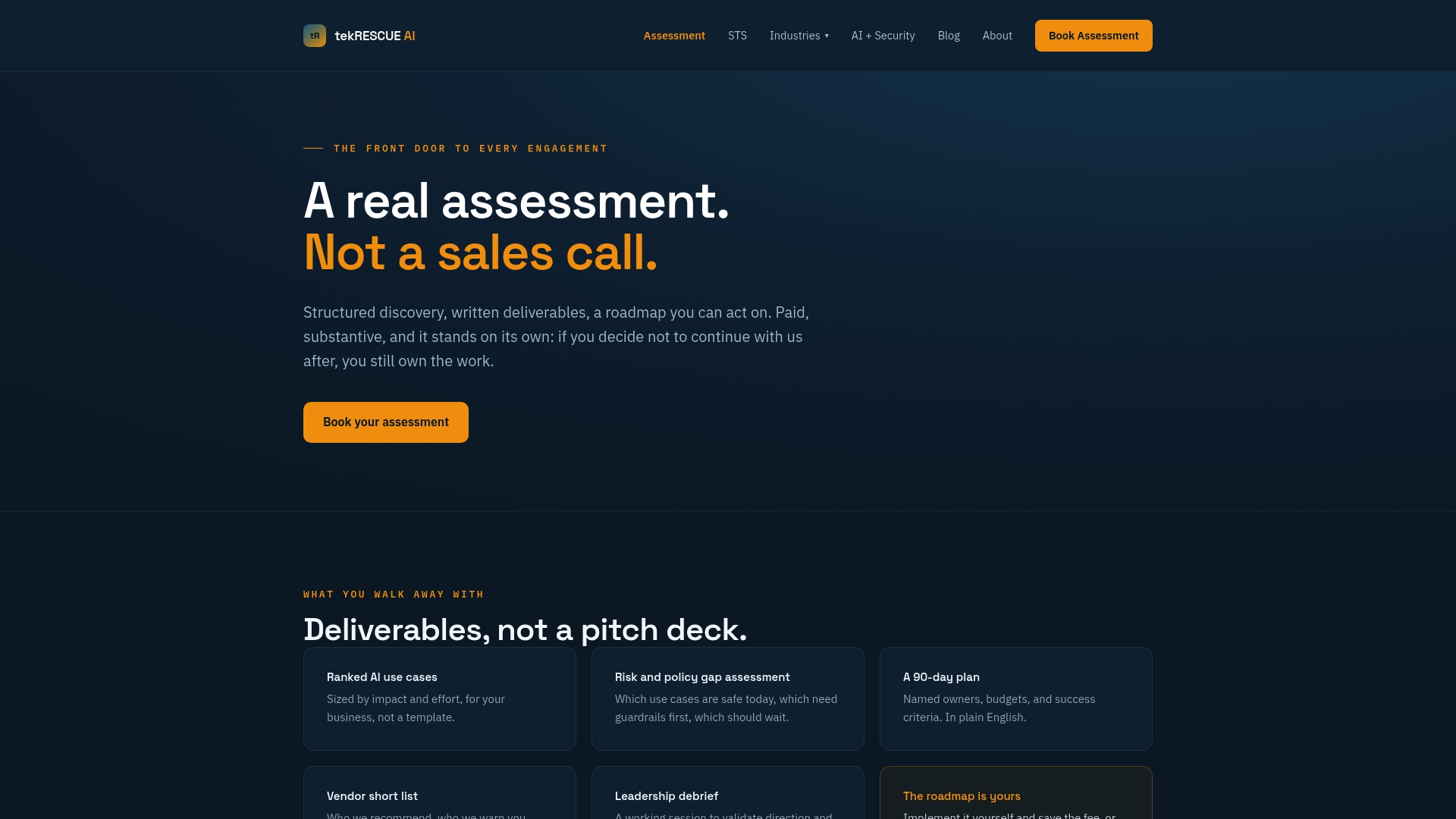
The AI Profit and Growth Assessment walks through your current data practices, access controls, and inference costs, then hands you a prioritized roadmap that follows the same sequence this guide recommends: governance first, monitoring second, optimization third. Teams that want ongoing help executing that roadmap can move into STS: Strategy, Training, Systems for structured delivery, or Managed AI Security for continuous risk monitoring once systems are live. If your team is past the assessment stage and needs the systems built correctly from the start, Build It Right covers that work directly. Start with the assessment and see where your current setup actually stands.
Where to Read More on LLMOps Standards
- NIST Generative AI Profile: the governance and TEVV framework behind most enterprise AI risk programs.
- OWASP Top 10 for LLM Applications: the standard security taxonomy for prompt injection and related risks.
- ModServe research: peer-reviewed findings on stage-aware serving and latency SLOs.
- Weights & Biases LLMOps guidance: practitioner-level detail on evaluation and inference cost management.
Sources
- Roofline-guided attribution models for latency prediction (arXiv)
- OWASP Top 10 for Large Language Model Applications
- Artificial Intelligence Risk Management Framework: Generative AI Profile (NIST)
- LLMOps explained: Managing large language model operations (Weights & Biases)
- ModServe: Modality-aware serving for LLM backends (arXiv)
FAQ
What Is LLMOps in Simple Terms?
LLMOps is the set of practices for deploying, monitoring, and governing large language models in production, covering everything from data provenance to inference cost control. It differs from MLOps mainly around non-determinism, retrieval dependencies, and heightened safety requirements outlined by frameworks like the NIST Generative AI Profile.
What Are the Biggest LLMOps Best Practices to Start With?
Start with a data inventory, a golden prompt set, and least-privilege access controls before touching optimization work. The OWASP Top 10 for LLM Applications and NIST’s TEVV guidance both point to governance and monitoring as the foundation everything else builds on.
How Is LLMOps Different From Traditional MLOps?
LLMOps focuses more heavily on inference cost, prompt engineering, and RAG pipeline quality, since most teams work with pretrained foundation models rather than models they trained from scratch. Safety and governance also carry more operational weight, given the non-deterministic nature of generated text.
How Often Should Teams Run Red Team Testing on LLMs?
Red-team campaigns and adversarial testing should run on a recurring schedule, not just after an incident, ideally tied into your release cycle so new vulnerabilities get caught before each deployment. Teams without the internal capacity to run this consistently often benefit from an outside review through something like tekRESCUE’s AI Profit and Growth Assessment.
What Does tekRESCUE’s AI Assessment Cost?
Pricing for the AI Profit and Growth Assessment is available on request directly through tekRESCUE. The engagement is scoped to each organization’s complexity, so cost depends on the systems and data involved.