Hallucination mitigation means putting organizational controls around AI-generated false outputs: written governance, human validation on risky outputs, monitoring and logging, vendor accountability, and incident readiness. The single move to make this week is simple. Inventory every AI use case in your business, rank each by consequence, and require a go/no-go approval before anyone deploys AI into a high-stakes workflow. An AI partner can help you run that inventory as part of a structured assessment.
TL;DR:
- Prioritize creating governance policies that specify who owns AI risk decisions and set clear error thresholds to trigger deployment stops.
- Implement validation by requiring human sign-off for outputs touching critical sources like contracts, pricing, or compliance before external use.
- Establish logging and monitoring procedures that capture all AI prompt responses and responses, applying automated checks and sampling for drift detection.
- Include strict contractual obligations for AI vendors, such as transparency reports, notification of model changes, and rollback rights in case of flawed outputs.
- Integrate hallucination incident response into existing plans, retaining detailed records and running tabletop exercises early to anticipate and mitigate real incidents.
Table of Contents
- What Controls Should You Adopt First?
- How Do You Roll This Out Without Stalling the Business?
- Who Owns the Policy, and What Should It Say?
- How Do You Actually Detect a Hallucination Before It Ships?
- What Should You Demand From AI Vendors in Your Contracts?
- How Should Hallucination Incidents Fit Into Your IR Plan?
- How Do You Build Real Human Oversight, Not Just a Checkbox?
- What Do Practitioners Get Wrong Most Often?
- How tekRESCUE Turns This Playbook Into a Working System
- Where to Verify These Standards Yourself
- Sources
- FAQ
What Controls Should You Adopt First?
Not every control matters equally. Some cut risk fast with little effort; others take longer to pay off. Here’s the order that gets you the most protection per hour invested.
- Governance: Write a short policy naming who owns AI risk decisions and what output error rate triggers a stop.
- Validation: Identify your canonical sources of truth (contracts, pricing sheets, compliance rules) and require human sign-off before AI output touching those areas goes external.
- Monitoring: Log every AI prompt and response, apply data loss prevention (DLP) to prompts, and sample outputs weekly for drift.
- Vendor terms: Add contract language requiring transparency about model changes and mandatory notification when a vendor detects flawed outputs.
- Incident readiness: Fold hallucination scenarios into your existing incident response (IR) plan and retain testing, evaluation, validation, and verification (TEVV) records as proof of due diligence.
NIST’s Generative AI Profile calls this pattern of false but confident output “confabulation,” and it maps each of these controls directly to its broader AI Risk Management Framework.
How Do You Roll This Out Without Stalling the Business?
You don’t need a year-long transformation to get real coverage. A phased rollout gets you from zero to steady-state oversight in a few deliberate steps, each one building on the last.
- Phase 0, Inventory and alignment. List every AI tool touching customers, money, or compliance. Rank each by what happens if it’s wrong. Get legal, security, and the business owner in the same room before anything ships.
- Phase 1, Policy and human review. Write the acceptable-use policy. Require human review on anything ranked high-consequence. This is the phase where most companies stop, and that’s a mistake.
- Phase 2, Vendor and observability. Rewrite vendor contracts to demand transparency and notification. Stand up logging that captures prompts, responses, and context, feeding your TEVV records.
- Phase 3, Automation and continuous testing. Automate sampling and alerting. Run red-team exercises against your own AI workflows. Review and update policy on a fixed cadence, not just after something breaks.
Pro Tip: Don’t wait for Phase 3 to run your first tabletop exercise. Run a lightweight one in Phase 1, even with just legal, IT, and one business owner in the room, so you catch policy gaps before they become real incidents.
Who Owns the Policy, and What Should It Say?
Your acceptable-use policy needs teeth, not just intentions. It should name the specific error threshold that triggers a stop, who signs off on high-risk deployments, and how often the policy itself gets reviewed. Vague language like “use AI responsibly” gives your team nothing to act on when something goes wrong.
Accountability works best as a shared model across four roles. Legal owns regulatory exposure and vendor contract language. Security owns logging, access control, and DLP. Product or engineering owns the technical validators and monitoring pipeline. The business owner, whoever answers for the outcome, owns the final go/no-go call on deployment.

Set your review cadence up front, quarterly for high-risk use cases, annually for low-risk ones, and write it into the policy itself so it survives staff turnover. NIST’s framework treats this kind of repeatable assurance cycle as core to managing information-integrity risk, not a nice-to-have layered on top of it.
How Do You Actually Detect a Hallucination Before It Ships?
Detection starts with defining what “true” means for each output type. Build validators that check AI output against a canonical source, your pricing database, your contract terms, your compliance rules, rather than trusting the model’s confidence. If the AI can’t be checked against a fixed reference, treat that output as higher risk by default.
Collect and retain every prompt, response, and surrounding context. Feed that data into your existing security information and event management (SIEM) system and apply DLP to catch sensitive data leaking into prompts in the first place. CISA’s guidance on secure AI integration treats this kind of logging as an extension of standard cybersecurity practice, not a separate discipline bolted onto AI.
For sampling, don’t review everything, that doesn’t scale. Pull a fixed percentage of outputs weekly for human review, weighted toward your highest-risk use cases, and layer in automated anomaly detection to flag responses that deviate sharply from historical patterns.

What Should You Demand From AI Vendors in Your Contracts?
Your vendor contract is a control, not paperwork. Require something like a software bill of materials for the AI components involved, documented disclosure of model components that lets you know what changed and when. Ask for TEVV evidence upfront, proof the vendor actually tested the system before selling it to you.
Push for notification and rollback clauses specifically: if the vendor’s own monitoring catches the model giving improper advice, your contract should obligate them to tell you and give you a path to disable that feature immediately, not wait for the next release cycle. Add audit rights and a right to disable specific features unilaterally. Service-level agreements should cover output correctness, not just uptime.
How Should Hallucination Incidents Fit Into Your IR Plan?
Your existing incident response plan almost certainly doesn’t mention hallucinations. Fix that by adding specific escalation paths: who gets notified when an AI output causes customer harm, financial loss, or a compliance gap, and how fast.
Retention matters here more than most teams expect. Keep TEVV records, test inputs and outputs, versioned model snapshots, who approved each deployment, and changelogs from retraining. If you’re ever challenged on an outcome, this is what proves you did your diligence rather than just hoping the AI got it right.
After any real incident, run a structured after-action review. Update the policy, renegotiate the vendor clause that failed, and adjust your monitoring thresholds. CISA’s operational guidance treats this update cycle as inseparable from ongoing cybersecurity practice, and it applies just as directly to AI failures as to any other breach.
How Do You Build Real Human Oversight, Not Just a Checkbox?
Role-based approval works only if the thresholds are specific. Define exactly which output types require sign-off, and by whom, before anything reaches a customer or a filing.
Run periodic red-team testing against your own AI workflows, plus regular sampling audits and tabletop exercises that simulate a hallucination incident before you’re living through a real one. Track a few concrete metrics: sampled error rate, mean time to detect a bad output, and time to remediate once caught. Those three numbers tell you more about your actual exposure than any vendor accuracy claim ever will.
What Do Practitioners Get Wrong Most Often?
The failures I see repeat themselves: no TEVV records at all, vendor contracts silent on notification, and logging that captures nothing useful when something goes wrong. Weak governance doesn’t announce itself until there’s already a problem on the table.
The wins are smaller than people expect. A weekly sample audit. A clear go/no-go gate that someone actually enforces. A vendor clause that forces disclosure instead of hoping they’ll volunteer it. None of that requires a massive budget, it requires someone deciding to do it before the incident, not after.
— Randy Bryan
How tekRESCUE Turns This Playbook Into a Working System
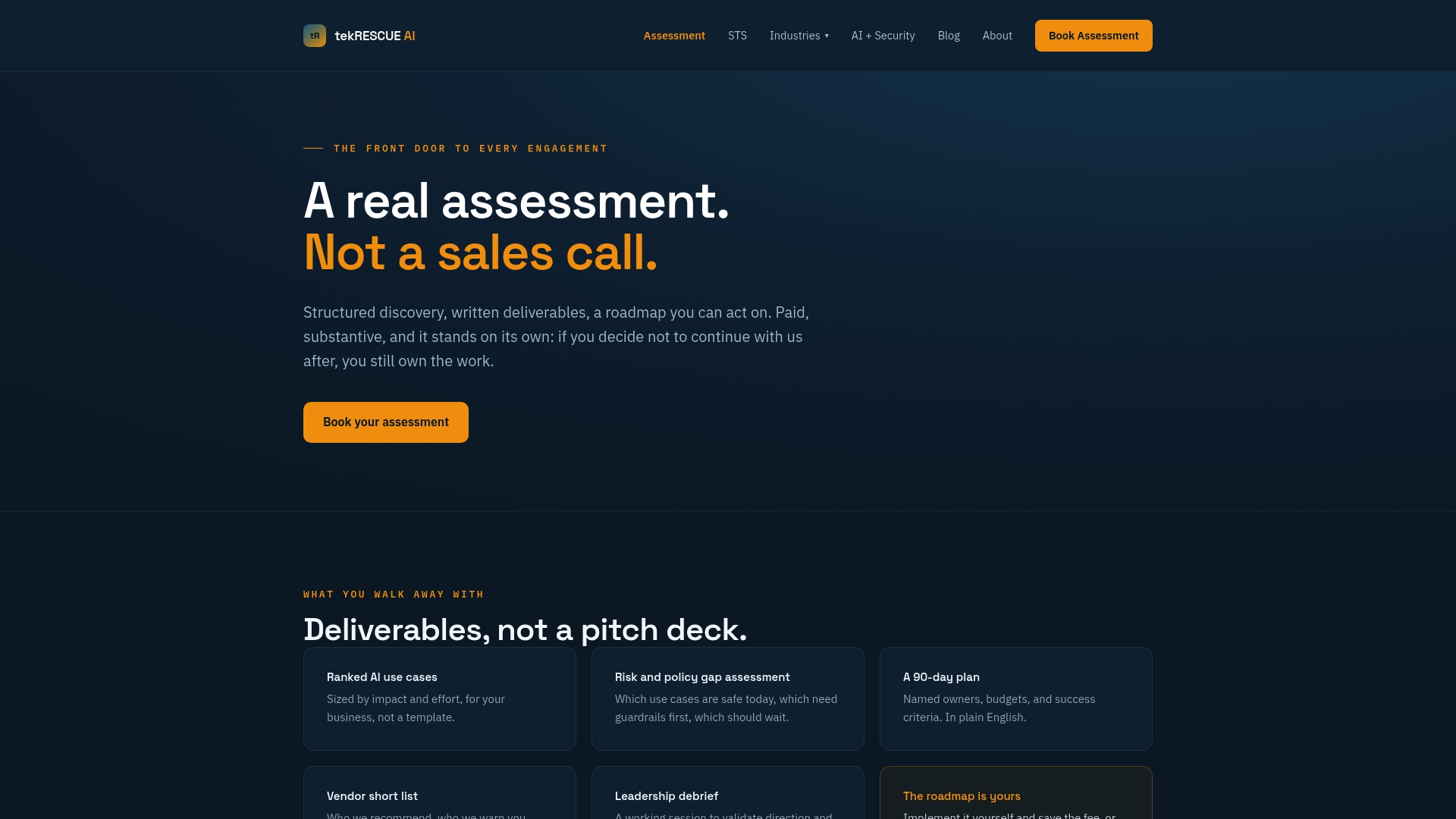
Reading a checklist and running one are different problems. tekRESCUE’s AI Profit and Growth Assessment does the inventory and risk-tiering work directly, mapping your actual AI use cases against the governance, validation, and monitoring gaps this playbook describes, then handing you a roadmap built on active cybersecurity practice rather than theoretical frameworks.
Once the roadmap exists, STS: Strategy, Training, Systems carries the policy and human-oversight pieces into daily operation, training your team on the approval thresholds and testing cadence you just read about. Managed AI Security then keeps the monitoring, logging, and TEVV retention running as a steady-state service instead of a project that quietly stalls after quarter one. If your team is weighing a broader AI rollout, Byram Advisory Group’s insights offer useful context on tying these controls to day-to-day business process. Start with the assessment, and you’ll know within weeks exactly where your exposure sits.
Where to Verify These Standards Yourself
- NIST’s Generative AI Profile for risk-tiering and TEVV guidance
- CISA’s secure AI integration principles for technical controls
- FTC’s policy statement on AI accuracy for disclosure obligations
Sources
- Artificial Intelligence Risk Management Framework: Generative Artificial Intelligence Profile
- Principles for the secure integration of artificial intelligence in operational technology
- Federal Trade Commission’s Proposed Policy Statement Concerning the Suppression of Accuracy In Artificial Intelligence Systems
FAQ
What Is Hallucination Mitigation in Business Terms?
It’s the set of organizational controls, governance, validation, monitoring, vendor contracts, and incident response, that reduce the risk of AI-generated false outputs causing operational, legal, or reputational harm. NIST’s framework treats it as an information-integrity risk to be managed continuously, not solved once.
Do We Need a Written AI Policy Before Deploying Any Tool?
Yes. A written policy naming risk owners, approval thresholds, and TEVV retention rules is what lets you demonstrate due diligence if an output causes harm later. Without it, you have no documented basis for the decisions your team made.
How Often Should We Re-Test AI Outputs for Accuracy?
High-risk use cases warrant sampling regularly with periodic policy reviews; lower-risk uses can shift to a lighter cadence. The right frequency depends on how consequential a bad output would be for that specific workflow.
Can Contract Language With Vendors Reduce Our Risk?
Yes, contracts that require notification when a vendor detects flawed outputs, plus rollback rights and audit access, shift real accountability onto the supplier. FTC guidance also expects firms to hold competent evidence behind any accuracy claims they make to customers.
What Does tekRESCUE’s Assessment Cost?
Pricing for the AI Profit and Growth Assessment is currently listed as 197 USD per month; current details are available directly on the tekRESCUE pricing page. The assessment itself maps your AI use cases against the governance and monitoring gaps covered in this playbook.