Yes, GDPR can reach a U.S. AI project, but only under specific conditions tied to who you serve and what you monitor. Before anything else, run a jurisdictional check against the EU’s three tests, inventory every place personal data touches your AI system, and screen for whether a data protection impact assessment is required. Get those three things right first, and the rest of this playbook shows you exactly how to build out the controls behind them.
TL;DR:
- GDPR applies to U.S. AI projects if they process data from EU residents, offer services to EU customers, or track EU individuals’ behavior across sessions or devices.
- Key compliance points include conducting jurisdictional checks, inventorying personal data touchpoints, and assessing if a data protection impact assessment is necessary before project development.
- Data minimization, purpose limitation, storage limiting, and individual rights management are critical principles influencing AI design and operation.
- High-risk areas include model memorization, ineffective anonymization, access control gaps in retrieval systems, and vendor data practices, requiring rigorous technical and contractual controls.
- U.S. companies must run parallel GDPR and AI Act compliance processes, with the latter adding layered risk classifications and phased requirements beyond current U.S. privacy laws.
Table of Contents
- How Does GDPR Apply to AI Systems in the U.S.?
- Which GDPR Principles Actually Change How You Build AI?
- Where GDPR Risk Actually Shows Up in AI Systems
- A Practical GDPR Compliance Checklist for AI Projects
- What Belongs in a DPIA for AI, and What Counts as Human Review?
- Does the EU AI Act Replace GDPR Obligations?
- What U.S. Rules Actually Govern AI Data Privacy Right Now?
- What tekRESCUE Sees in the Field When Companies Build AI Under GDPR
- Ready to Build GDPR-Aware AI Without the Guesswork?
- Sources
- FAQ
How Does GDPR Apply to AI Systems in the U.S.?
GDPR reaches a U.S. organization when it has an establishment in the EU, offers goods or services to people in the EU, or monitors their behavior. That third test catches more American AI teams off guard than the other two combined. A chatbot trained on support tickets from EU customers, an analytics model tracking website visitors in Germany, a hiring tool screening applicants in Ireland. All of it counts.
“Processing” under GDPR is broad. It covers collection, storage, disclosure, and use, which means training data, prompts, session logs, telemetry, and even user feedback loops all qualify once EU personal data is involved. The Congressional Research Service notes that the United States has no single federal GDPR-equivalent law, so U.S. teams cannot assume a domestic privacy framework covers them. Each AI project needs its own jurisdictional review.
Run this checklist before building anything:
- Does the system process data from people physically located in the EU, regardless of their citizenship?
- Do you offer a product, service, or free tool that EU residents can access and use?
- Does the AI system track, profile, or predict behavior of EU-based individuals across sessions or devices?
- Does training data, fine-tuning data, or a retrieval knowledge base include EU personal data from any source?
A single “yes” triggers the rest of this article.
Which GDPR Principles Actually Change How You Build AI?
Six lawful bases exist under GDPR, but for AI work, only a handful of hold up in practice. Consent works for narrow, opt-in features. Legitimate interest often supports internal tooling, but it requires a documented balancing test weighing your business need against the individual’s privacy interest. Legal obligation and contract performance apply in narrower cases, like fraud detection tied to a service agreement.
Four principles reshape AI design decisions directly:
- Data minimization: collect and retain only what the model actually needs, not everything you can scrape or log.
- Purpose limitation: data gathered for customer support cannot silently become fine-tuning data without a new lawful basis.
- Storage limitation: retention schedules must apply to training sets, embeddings, and logs, not just the original database.
- Individual rights: access, rectification, and erasure requests must reach every place a person’s data lives, including model outputs and cached retrieval results.
That last point trips up more teams than any other. Deleting a record from a source database does not remove its influence from an already trained model.
Where GDPR Risk Actually Shows Up in AI Systems
Regulatory language turns into real engineering problems fast. Four risk areas deserve direct attention:
- Model memorization and extraction. Large models can memorize and later reproduce snippets of training data, including personal details, when prompted the right way. Extraction attacks exploit this, and testing for it is now a recognized part of responsible development.
- Anonymization that isn’t actually anonymous. Teams frequently claim training data was “anonymized” without evidence. The European Data Protection Board’s Opinion 28/2024 states plainly that models trained on personal data are not automatically anonymous, and supervisory authorities assess identifiability case by case.
- Retrieval-augmented generation (RAG) permission gaps. A knowledge base without document-level access controls can let one user’s query surface another user’s confidential records. RAG does not make a deployment inherently safer just because it avoids retraining.
- Vendor and subprocessor exposure. Model-as-a-service providers sometimes ingest customer inputs for their own model development without clear disclosure.
Pro Tip: Ask every AI vendor, in writing, whether your prompts or uploaded data are used to train their models. If the answer is vague, treat it as a “yes” until proven otherwise.
A Practical GDPR Compliance Checklist for AI Projects
Sequence matters here. Skipping ahead to technical controls before you know your data flows just means redoing the work later.
- Inventory every AI use case and data flow. List training data, prompts, retrieval caches, feedback stores, evaluation sets, and vendor access logs. Teams routinely forget the last three.
- Classify your role. Are you the controller, the processor, or both, depending on the AI feature? This determines who carries which obligations.
- Screen for DPIA triggers. Any high-risk processing, including large-scale profiling or automated decisions with significant effects, needs a documented DPIA before launch, not after.
- Negotiate vendor terms that forbid undisclosed training. Contracts should explicitly bar model providers from using your data to improve their own systems unless you agree to it separately, and should require verifiable deletion.
- Apply technical controls. Minimization at the data layer, privacy-enhancing technologies, access controls on retrieval systems, and adversarial extraction testing before release. NIST’s Generative AI Profile recommends exactly this kind of lifecycle testing, including output monitoring after deployment.
- Operationalize rights handling. Build a process for access, correction, and erasure requests that actually reaches model outputs and derivative data stores, not just the original database.
- Set retention rules and incident response plans. Document how long each data type lives in each system, and rehearse what happens when something breaks.
Many organizations building generative AI tools do not have a documented process for handling data subject requests against model outputs specifically, which is one reason the EDPB’s guidance on AI privacy risks and mitigations treats retention mapping as a first-order task, not an afterthought.
What Belongs in a DPIA for AI, and What Counts as Human Review?
A DPIA becomes mandatory when planned AI processing is likely to create a high risk to people’s rights, and it needs to happen before that processing starts, not as a retroactive justification. A defensible DPIA records the purpose of processing, the lawful basis, the categories of data involved, a necessity and proportionality analysis, the people affected, and any less risky alternatives considered.
Article 22 adds a specific layer here. It grants individuals a right not to be subject to a decision based solely on automated processing when that decision produces legal or similarly significant effects, and it requires safeguards including meaningful human intervention and the ability to challenge the decision. Automatic credit denials and algorithmic hiring rejections without a human in the loop are the textbook examples the regulation itself calls out.
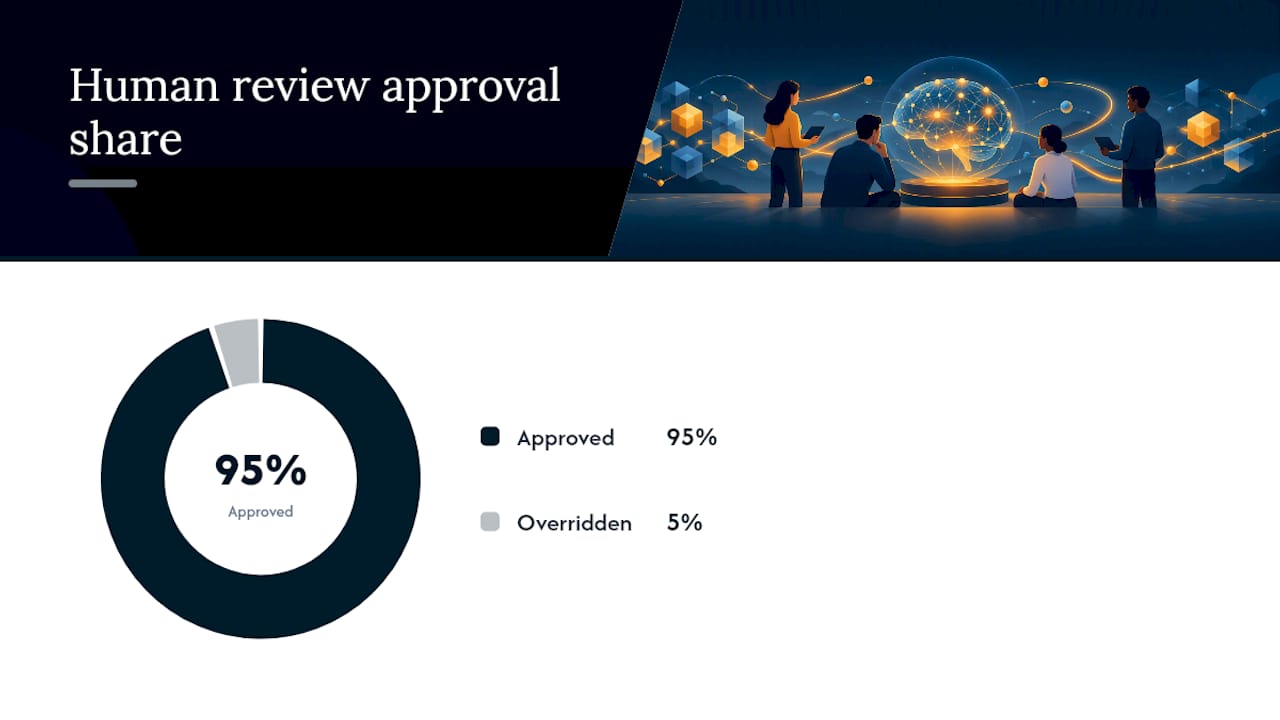
“Human review” only satisfies this requirement if it is substantive. A reviewer who rubber-stamps the model’s output without the authority or information to override it does not meet the bar. Build a review process where the human has real context, a documented basis for disagreeing with the model, and a record of every override decision.
- Treat the DPIA as a living document, reviewed whenever the model, training data, or use case changes.
- Give human reviewers explicit authority to override automated outputs, not just a rubber stamp.
- Log every override, along with the reason, to build an audit trail regulators can actually inspect.
Pro Tip: If your human reviewers approve automated recommendations more than 95% of the time, that pattern itself is a red flag regulators may point to as evidence the review isn’t meaningful.
Does the EU AI Act Replace GDPR Obligations?
No. The EU AI Act, which entered into force on August 1, 2024, supplements GDPR rather than replacing it. Every GDPR obligation you already carry, lawful basis, rights handling, security controls, stays in place. The AI Act layers on top with its own risk classification system and staged application dates, meaning higher risk AI systems face additional requirements that phase in over time.
For U.S. organizations serving EU markets, this means running two parallel compliance tracks instead of one.
- Confirm whether your AI system falls into a risk category under the AI Act, separate from your GDPR analysis.
- Keep GDPR documentation, DPIAs, and rights processes intact even after AI Act classification is complete.
- Watch the staged application timeline, since obligations for higher risk systems arrive on a different schedule than baseline rules.
- Treat AI Act compliance as additive work, not a substitute for existing GDPR records.
What U.S. Rules Actually Govern AI Data Privacy Right Now?
The United States has no single federal law that mirrors GDPR, so voluntary frameworks and enforcement actions carry more weight here than most teams expect. The Federal Trade Commission has directly warned model-as-a-service providers against ingesting customer data for model development without clear disclosure, and against quietly changing privacy terms to unlock new uses of previously collected data.
NIST’s Generative AI Profile fills much of the technical gap. It recommends training-data transparency, de-identification, privacy-enhancing technologies, adversarial extraction testing, and documented human review across the AI lifecycle, all without regulatory force but with growing influence over what “reasonable” AI governance looks like in enforcement and litigation contexts.
- The FTC treats undisclosed secondary use of customer data for training as a potential violation of enforceable privacy commitments.
- NIST’s framework, while voluntary, is increasingly cited as the practical baseline for AI privacy controls in the U.S.
- The Congressional Research Service confirms there is no comprehensive federal privacy statute equivalent to GDPR, which means contract terms and sector-specific rules do most of the work domestically.
What tekRESCUE Sees in the Field When Companies Build AI Under GDPR
Most organizations treat GDPR compliance and AI adoption as two separate projects, and that is exactly where the risk creeps in. tekRESCUE AI approaches it the other way: assessment first, then risk tiering, then a prioritized set of controls before anything goes into a pilot.
Grounding AI strategy in active cybersecurity practice, rather than treating security as an afterthought bolted onto a finished AI rollout, changes what gets caught and when. A vendor contract that quietly allows model training on your customer data is a lot easier to catch during an inventory phase than after the model is already in production.
The AI Profit and Growth Assessment exists for exactly this moment, before the pilot, when the inventory and risk tiering actually happen. Getting that sequence right the first time is cheaper than fixing it after a regulator asks questions.
— Randy Bryan
Ready to Build GDPR-Aware AI Without the Guesswork?
Most companies find out they have a GDPR problem after the AI system is already live, which is the most expensive time to find out. tekRESCUE AI’s AI Profit and Growth Assessment flips that timeline: it maps your actual AI use cases, data flows, and vendor relationships before you commit budget to a build, so you know where the real risk sits and what to fix first.
The assessment lines up directly with the checklist in this article. It covers inventory and role classification, flags where a DPIA is likely required, reviews vendor terms for undisclosed training or retention issues, and sets up the technical and monitoring controls that keep a pilot from becoming a liability. Once that groundwork is done, tekRESCUE’s STS: Strategy, Training, Systems service carries the implementation forward, and Managed AI Security keeps monitoring in place after launch. If you build AI-enabled workflows and need the underlying digital infrastructure done right from the start, Build It Right covers that groundwork too.
If you’re not sure whether your current AI project even needs this level of scrutiny, that uncertainty is the reason to start. Request the AI Profit and Growth Assessment and get a clear picture of where you stand before a regulator, a customer, or a vendor contract forces the issue.
Sources
- Data Protection Law: An Overview (Congressional Research Service)
- GDPR Article 22 (EUR-Lex)
- FTC: AI companies, uphold your privacy and confidentiality commitments
- NIST Generative AI profile
- EDPB Opinion 28/2024 on AI models and GDPR
FAQ
Does AI Have to Comply With GDPR?
An AI system must comply with GDPR whenever it processes personal data of people in the EU, regardless of where the company operating it is based. The trigger is the jurisdictional test covered earlier: establishment in the EU, offering goods or services there, or monitoring behavior there, not the technology itself.
Is GDPR Applicable to the United States?
GDPR can apply to a U.S.-based company if that company’s AI system processes data belonging to individuals located in the EU. A U.S. company with no EU customers, no EU website traffic, and no EU data in its training sets generally falls outside GDPR’s reach.
What Is the 30% Rule for AI?
There is no established “30% rule” recognized in GDPR, the EU AI Act, or U.S. AI governance guidance. If you have seen this term elsewhere, it is not a standard regulatory threshold, and treating it as one could lead to a false sense of compliance.
Is There a U.S. Equivalent to GDPR?
No single federal law in the United States mirrors GDPR’s scope, according to the Congressional Research Service. Instead, U.S. organizations rely on a patchwork of state privacy laws, sector-specific rules, and voluntary frameworks like NIST’s Generative AI Profile, alongside FTC enforcement action.
How Much Does tekRESCUE’s AI Profit and Growth Assessment Cost?
Pricing for the AI Profit and Growth Assessment is available on request through tekRESCUE’s assessment page. The engagement is scoped to each organization’s AI use cases and risk profile before any price is set.