An AI proof of concept is a time-boxed experiment, usually several weeks, that tests whether an AI approach can solve a specific business problem using real data. The single rule that determines whether one succeeds: it must produce a binary go or no-go decision, measured against success metrics everyone agreed to before the work started. Skip that discipline and you get a demo, not a decision.
TL;DR:
- A proof of concept must produce a clear pass or fail decision based on pre-agreed success metrics, not just a demo or prototype.
- Run a PoC primarily when data quality, system integration, inference costs, or regulatory risks are uncertain, especially for custom AI solutions.
- The typical PoC timeline is four to six weeks for straightforward cases, with scope creep extending this schedule without producing a decision document.
- Security, compliance, and ethical considerations should be embedded in the scope, including access controls, data masking, and documentation of potential risks.
- Focus on a single, measurable primary metric aligned with business impact, avoiding multiple metrics that can obscure the true technical or operational feasibility.
Table of Contents
- What Is an AI Proof of Concept, and When Should You Run One?
- PoC vs. Prototype vs. MVP vs. Pilot: What’s the Difference?
- How Do You Choose the Right Use Case for a PoC?
- The PoC Playbook: A Week-by-Week Approach
- Measuring Success: KPIs, Evaluation, and What This Actually Costs at Scale
- Team, Timeline, and Budget: What to Actually Expect
- tekRESCUE’s Take: Build PoCs That Are Secure, Operable, and Decision-Ready
- Legal and Ethical Considerations in AI PoCs
- Tools and Technologies Commonly Used for AI PoCs
- My Take: Decision Clarity Beats a Shiny Demo
- Run a PoC That Actually Leads Somewhere: The AI Profit and Growth Assessment
- Sources
- FAQ
What Is an AI Proof of Concept, and When Should You Run One?
A proof of concept, often shortened to PoC, is not a working product. It’s a narrow test designed to answer one question: can this specific AI approach solve this specific problem well enough to justify building it for real? The output isn’t coded you ship. It’s a decision document, a demo run on representative data, and a set of metrics that either clear the bar you set or don’t.
That distinction matters more than most teams realize going in. A PoC that produces a working prototype but no clear evaluation against pre-agreed metrics has failed at its actual job, even if the demo looks impressive in a conference room.
You need a PoC when the risk of skipping straight to a pilot is too high to justify. That risk shows up in a few recognizable patterns:
- Data quality is unknown or unverified, and nobody has confirmed the model can actually learn from what you have.
- Integration with existing systems (a CRM, a legacy database, a compliance workflow) is untested and could break things downstream.
- Inference costs at scale are uncertain, and a wrong guess on token volume or model size could blow a budget.
- The use case touches regulated data, sensitive customer information, or a compliance-heavy process where a mistake carries legal weight.
Not every AI initiative needs this step. If you’re adopting an off-the-shelf tool with a proven track record in your exact use case, a full PoC can be overkill. Skip it when the technology is well established, the vendor has verifiable case studies in your industry, and the switching cost of being wrong is low. Run one when any of those conditions aren’t true, which describes most custom AI work.
Alice Labs frames this well in its PoC methodology: the entire point of the exercise is validation before scale, not a working prototype for its own sake.
PoC vs. Prototype vs. MVP vs. Pilot: What’s the Difference?
These four terms get used interchangeably in meetings, and that’s exactly the problem. Each one answers a different question, and mixing them up is one of the fastest ways to end a project with no clear outcome at all.
- Proof of concept: Answers “can this work technically?” Tests feasibility on a narrow slice of the problem, using real or representative data, with no expectation of production readiness.
- Prototype: Answers “what would this look like?” A rough, often clickable or visual representation used to gather feedback on design and usability, not technical viability.
- MVP (minimum viable product): Answers “will customers use and pay for this?” A stripped-down but functioning product released to real users to test market demand.
- Pilot: Answers “does this work in a live operational setting?” A limited-scope deployment of a solution that has already cleared feasibility, run with real users and real consequences.
The decision rule is simple. If you don’t know whether the AI can technically do the job, run a PoC. If you know it can but you’re unsure how people should interact with it, build a prototype. If you’re validating market appetite, ship an MVP. If the concept is proven and you’re testing operational fit before full rollout, run a pilot. Confusing PoC with MVP is especially common and especially costly, because teams end up trying to validate technical feasibility and market demand in the same exercise, and neither question gets a clean answer.
How Do You Choose the Right Use Case for a PoC?
Not every AI idea deserves a proof of concept, and picking the wrong one wastes six weeks confirming something obvious. The strongest candidates concentrate value in a small, well-defined slice of a workflow rather than trying to transform an entire department at once.
Start with value concentration. An AI system that automates a repetitive document classification step buried inside a larger workflow is a better PoC candidate than a sweeping “AI for customer service” initiative, because the smaller target has a measurable before-and-after.
Run every candidate through three feasibility filters before committing resources:
- Data: Do you have enough labeled or structured data to actually train or evaluate a model, and can you access it without a six-week legal review?
- Integration: Does this use case require touching a legacy system, and if so, has anyone confirmed that’s technically possible in the timeframe you’re planning?
- Compliance: Does the data involve personal information, health records, or financial details that trigger regulatory review before you can even start testing?
Once you’ve filtered candidates, score the survivors on a simple scorecard: business impact (revenue, cost, or risk reduction), technical feasibility (data and integration readiness), cost risk (how expensive is inference likely to be at scale), and adoption likelihood (will the people who need to use this actually use it). Rank candidates by combined score, not by whichever one the loudest person in the room is excited about. Gartner’s research on AI projects stalling in infrastructure and operations found that only 28% of AI use cases fully met ROI expectations, and integration readiness was one of the strongest predictors of which ones did.
The PoC Playbook: A Week-by-Week Approach
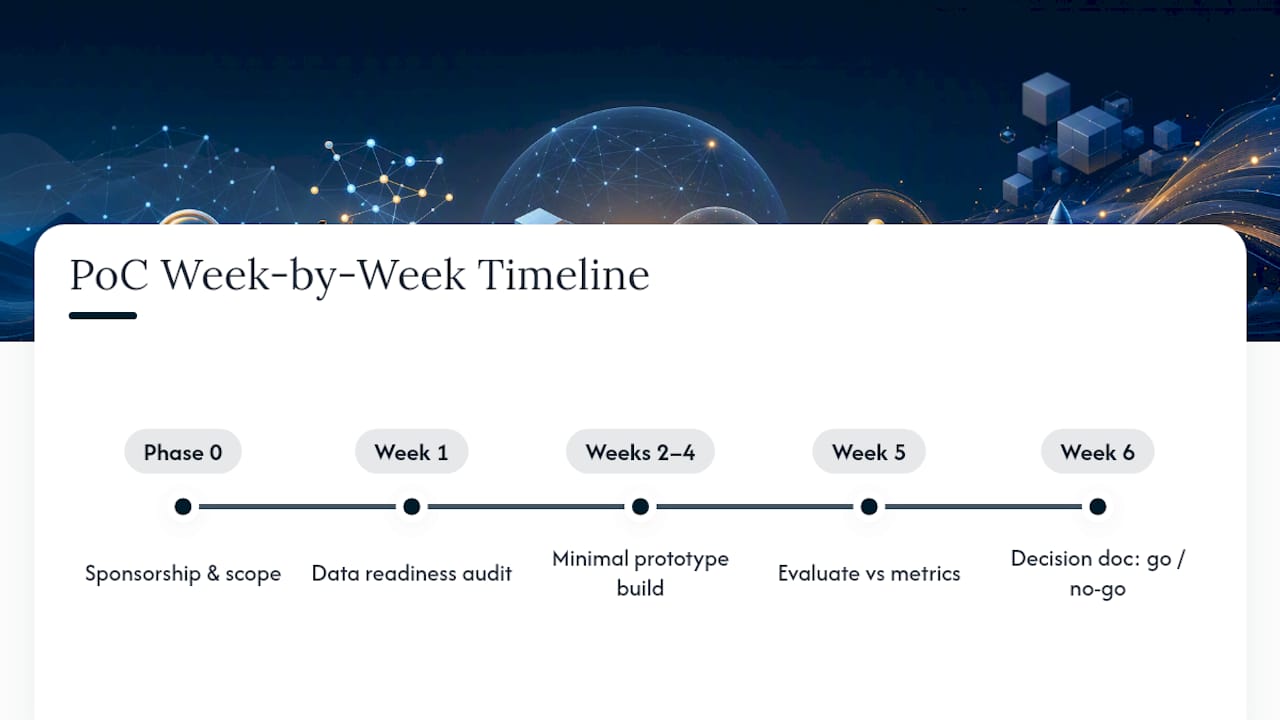
A proof of concept without a schedule turns into a science project. The teams that get a clean decision out the other end treat the calendar as part of the scope, not an afterthought. Here’s a structure that works across most AI use cases, from document automation to predictive models.
Phase 0: Sponsorship and scope, before the clock starts
Before anyone touches data or code, you need a scope document. This isn’t bureaucracy for its own sake. It’s the thing that keeps the PoC from quietly turning into a production build halfway through week four.
The scope document should nail down: the single primary success metric, a baseline for comparison (what does “good enough” look like against the current process), what test data you’ll use and where it comes from, which systems the solution needs to integrate with, and who has final authority to call the go or no-go decision. Without an executive sponsor attached to that last item, the PoC has no teeth. Gartner’s I&O survey found executive sponsorship correlated strongly with which AI use cases actually delivered ROI, which tells you sponsorship isn’t a formality, it’s a leading indicator.
Week 1: Data readiness audit
This is the week most teams try to skip, and it’s the one that determines everything else. Audit your data across three dimensions: availability (do you actually have it, or does someone need to request it from another department), quality (is it labeled, clean, and representative of what production will look like), and accessibility (do you have written permission to use it, and can your engineers technically reach it).
Alice Labs’ methodology recommends setting minimum thresholds before you start, 500 to 1,000 labeled examples for most supervised learning tasks, along with documented access approvals from data owners. If you can’t hit those thresholds by the end of week one, that’s information too. It tells you the PoC needs to wait, or needs to shrink to a smaller test.
Pro Tip: Accessibility, not model choice, is usually the real blocker in week one. A team can pick the perfect algorithm and still stall for three weeks waiting on a data governance sign off. Chase down access permissions on day one, not after the engineering team is already blocked.
Weeks 2 through 4: Build the minimal prototype
This is where the actual building happens, and the operative word is minimal. You’re not building a scalable system. You’re building the smallest thing that can generate a fair test of the primary metric, with integration stubs standing in for systems you’ll connect to later rather than full production integrations.
Include basic monitoring from day one, even if it’s just logging inputs and outputs to a spreadsheet. You’ll need that trail during evaluation, and retrofitting it after the fact is painful. If the use case touches customer or employee data, this is also the point to build in access controls and data masking rather than bolting them on later when someone asks about security.
Week 5: Evaluation against pre-agreed metrics
Run the prototype against your test dataset and measure it against the baseline and success threshold you set in Phase 0, not against a threshold someone invents after seeing how the results look. That ordering matters. Evaluating first and setting the bar second is how mediocre results get reframed as wins.
Where the sample size allows, run basic statistical checks, not just a single comparison, to confirm the improvement over baseline isn’t noise.
Week 6: Decision document and next steps
The final deliverable is a written decision document, not a working demo. It should state the metric result against the baseline, a cost projection for what full production would actually require (including the inference and integration costs a PoC doesn’t have to absorb), and a clear recommendation: go, no-go, or a scoped “go, but only for this narrower version.” Alice Labs’ framework treats this document as the actual output of the entire exercise, and that framing is worth adopting wholesale. Everything before week six exists to produce this one artifact.
If you’re at week eight and still don’t have a version of this document ready, treat that as a signal in itself. Well-run PoCs on straightforward text classification problems typically wrap in around six weeks, while more complex agentic or multi-modal tests can run 10 to 12. Anything meaningfully past that window without a decision usually means the PoC has quietly become a production build without anyone deciding that on purpose.
Measuring Success: KPIs, Evaluation, and What This Actually Costs at Scale
Pick one primary metric before you start, and resist the temptation to track a dozen. If the use case is document classification, that metric is probably F1 score. If it’s a customer-facing chatbot, it might be response latency or resolution rate. If the entire business case rests on cost savings, your primary metric should be cost per transaction, measured against what the manual process costs today.
Multiple metrics feel more rigorous, but in practice they let a struggling PoC hide behind whichever number looks best. A single, pre-agreed primary metric with a real baseline forces an honest conversation at the end.
Baselines and significance testing keep that conversation grounded:
- Establish the baseline using your current manual or legacy process, measured over a comparable time period or sample size, not an assumed “industry average.”
- Hold out a test set the model never sees during development, and evaluate only against that set at the end.
- Where sample size allows, run a basic statistical significance check rather than eyeballing a percentage difference.
- Document the confidence level of your result so the decision document doesn’t overstate what a small sample can actually tell you.
Cost per PoC pass or fail: at least 50% of generative AI projects are abandoned after proof of concept, and Gartner’s analysis points to poor data quality, weak risk controls, escalating total cost of ownership, and unclear business value as the leading causes. That figure alone justifies building cost projection into the PoC itself, rather than discovering the real price tag after the go decision has already been made.
Inference economics is where PoC budgets and production budgets diverge sharply, and it’s the piece most business leaders underestimate. A PoC running a few hundred test queries against a large model costs almost nothing. The same model serving 50,000 transactions a day is a different financial animal entirely. Project total cost of ownership by modeling your expected production volume against per-token or per-call pricing, and build in model routing (sending simple queries to smaller, cheaper models and reserving the expensive model for genuinely hard cases) and prompt caching to control repeat-query costs. Gartner recommends putting these FinOps practices in place from day one rather than retrofitting cost controls after a surprise invoice.
Team, Timeline, and Budget: What to Actually Expect
A PoC doesn’t need a large team, but it needs the right three roles at minimum: a business sponsor who owns the go or no-go call and can speak for the budget, an AI or machine learning engineer who builds and evaluates the prototype, and a data engineer who handles the unglamorous but critical work of getting clean, accessible data into the prototype’s hands. Larger or more sensitive PoCs benefit from adding a security reviewer and a subject-matter expert from the business unit who can sanity-check whether the results actually mean something operationally.
Timeline discipline is where most PoCs quietly go wrong. A well-scoped PoC runs four to eight weeks. When one drifts past that window without producing a decision document, it’s rarely because the problem was harder than expected. It’s almost always scope creep: someone added “just one more integration” or “let’s also test it on this other dataset” without revisiting the original scope document.
The common failure modes worth planning around directly:
- Data readiness gaps. Mitigate by running the data audit in week one, not week three, and setting a hard go/no-go on data quality before building anything.
- Unclear business value. Mitigate by requiring a named business sponsor and a dollar-or-percentage baseline before the PoC starts, not after.
- Rising total cost of ownership. Mitigate by projecting production-scale inference costs during the PoC itself, not after the go decision.
- Weak change management. Mitigate by involving the people who’ll actually use the tool in week five’s evaluation, not just in a rollout announcement later.
Pro Tip: If a PoC has run past eight weeks with no decision document in sight, stop and ask whether it quietly became a production build somewhere along the way. That’s usually exactly what happened, and it’s a lot cheaper to catch in week nine than in month six.
tekRESCUE’s Take: Build PoCs That Are Secure, Operable, and Decision-Ready
A PoC that produces a great demo but no security review is not a finished PoC. It’s a liability wearing a demo’s clothes. Every proof of concept scope document should include a short checklist covering access controls (who can see the test data and the outputs), a basic threat model (what happens if this data leaks or the model is manipulated), data masking for anything sensitive, and logging with a defined retention period.
- Access controls: name who can view test data and results, and revoke access when the PoC ends.
- Threat model: identify at least the two or three most obvious ways the system could be misused or the data exposed.
- Data masking: strip or tokenize personally identifiable information before it touches a test environment.
- Logging and retention: log inputs and outputs during the PoC, and set a retention window rather than leaving test data sitting indefinitely.
This is exactly where tekRESCUE’s AI Profit and Growth Assessment approach differs from a standard feasibility test. Because the practice grew out of active IT and cybersecurity work rather than general strategy work, security review isn’t a bolt-on step at the end of a PoC. It’s built into the same scope document that defines the success metric. That matters because a PoC that clears its technical bar but fails a security review after the fact has to restart the clock, which defeats the entire point of time-boxing the experiment in the first place.
Risk-mitigation patterns worth adopting regardless of who runs the PoC: mask sensitive fields before test data ever leaves its source system, limit prototype access to a named list rather than an entire department, and document the threat model alongside the metrics so the same decision document covers both feasibility and risk. Embedding that ownership early is what turns a successful PoC into a pilot people are actually willing to approve, rather than one that stalls in a security review nobody scoped for.

Legal and Ethical Considerations in AI PoCs
Regulatory exposure doesn’t wait for production. If your PoC touches personal data, health information, or financial records, the same privacy obligations that apply to a live system apply to your test environment too. An “it’s just a proof of concept” defense doesn’t hold up if test data leaks or gets used outside its approved purpose.
Get written approval from data owners before pulling data into a PoC, and document exactly what the data will be used for and for how long. This isn’t just a compliance checkbox. It’s the kind of documentation that saves weeks of back-and-forth if legal or compliance asks questions later, and it protects the individuals whose data you’re testing against.
Bias and fairness deserve attention even at PoC scale, particularly for any use case touching hiring, lending, insurance, or other decisions affecting people’s opportunities. A small test dataset that happens to underrepresent certain groups can produce a model that looks accurate overall while performing poorly for a subset of real users. Check your test data’s composition before you trust the aggregate metric.
Intellectual property questions come up more often than teams expect, especially with generative AI PoCs built on third-party models or APIs. Confirm who owns outputs generated during testing and whether the vendor’s terms restrict how you can use them, before those outputs end up in a customer-facing demo or an internal deck circulating beyond the project team. None of this needs a legal department embedded in your PoC full time, but it does need someone asking these questions in week one, not week five.
Tools and Technologies Commonly Used for AI PoCs
Most PoCs don’t need custom infrastructure. Cloud AI platforms from major providers offer pre-built models and evaluation tooling that let a small team test feasibility without standing up new servers, which is usually the fastest path for a first-time PoC. For teams testing custom models, open-source frameworks handle the machine learning side, while lightweight experiment-tracking tools log results so the week-five evaluation has clean data to compare against, rather than a folder of scattered spreadsheets.
Data preparation tools matter more than most teams budget for. Labeling platforms and data-quality checkers do the unglamorous work of confirming a dataset actually meets the readiness thresholds set in week one, and skipping this tooling is a common way teams discover data problems in week four instead of week one.
For teams testing workflow or agent-based use cases, integration and API platforms matter early, since a PoC that never tests how a solution talks to existing systems hasn’t actually tested the riskiest part of the problem. Sendmux’s guidance on enterprise email API integration is a useful reference point for teams scoping how an AI agent or workflow tool will need to connect to production systems once a PoC clears its go decision. On the security side, resources like Patterns Process Finder’s guidance on security and data privacy are worth reviewing when building out the access-control and data-masking checklist a risk-aware PoC scope requires.
My Take: Decision Clarity Beats a Shiny Demo
The single biggest mistake I see in AI proof of concept work isn’t technical. It’s that teams optimize for an impressive demo instead of a clear decision. A demo that dazzles a room full of executives but never gets measured against a pre-agreed baseline hasn’t told you anything you can act on with confidence.
The rule stated at the top of this article holds up under scrutiny for a reason: time-box it, use real data, agree on the metric before you start, and produce a document that says go or no-go. Everything else, the tooling, the team size, the specific week-by-week schedule, is negotiable. That discipline isn’t.
Leaders who internalize this stop asking “did the AI work?” and start asking “did we learn what we needed to learn, on schedule, against a number we agreed to in advance?” That’s a better question, and it’s the one that actually protects your budget.
— Randy Bryan
Run a PoC That Actually Leads Somewhere: The AI Profit and Growth Assessment
Some AI profit and growth assessments address the common gap left open by most AI proof of concept work: the technical test succeeds, but there is no scoped security review, inference costs, or production integration plan alongside it. That’s the difference this assessment makes for a business weighing its first serious AI initiative. Instead of a feasibility test that stops at “the model works,” you get a decision document that maps data readiness, inference economics, and security checks into one package, built by a team that runs cybersecurity practice alongside AI strategy rather than treating them as separate conversations.
The engagement starts with a conversation about your specific use case, the data you have, and the systems it needs to touch, then produces a scoped roadmap you can act on immediately, whether that means proceeding to a pilot, adjusting scope, or walking away with clarity you didn’t have before. If a PoC later clears its go decision, tekRESCUE’s STS: Strategy, Training, Systems service and Managed AI Security offering pick up exactly where the assessment leaves off. Start by booking the AI Profit and Growth Assessment and get a scoped plan for your next AI decision instead of another demo that goes nowhere.
Sources
FAQ
What Is the 30% Rule in AI Projects?
There’s no single agreed-upon “30% rule” in AI proof of concept methodology. If you’ve seen this figure elsewhere, it likely refers informally to a threshold some teams use for minimum performance improvement over baseline, but definitions vary widely by industry and use case, so treat any specific percentage as a project-specific target you set yourself, not an industry standard.
Which Jobs Are Least Likely to Be Replaced by AI?
Roles requiring hands-on physical dexterity in unpredictable environments, deep interpersonal trust, and complex judgment calls under ambiguity tend to be the hardest for current AI systems to replicate fully. Skilled trades, in-person caregiving, and roles requiring negotiated human judgment in high-stakes, low-precedent situations remain difficult to automate, largely because they resist the kind of clean, structured data a model needs to learn from.
What Did Bill Gates Warn About AI?
Gates has spoken publicly about AI’s potential to disrupt jobs and the importance of pairing rapid AI adoption with thoughtful policy and workforce transition planning, rather than assuming the technology alone solves problems responsibly. His broader caution echoes what shows up in enterprise AI failures too: moving fast without governance tends to create the problems it was supposed to solve.
How Long Should an AI Proof of Concept Take?
A well-scoped AI proof of concept typically runs four to eight weeks, with simple text classification tests finishing closer to six weeks and more complex agentic or multi-modal use cases taking 10 to 12. If a PoC runs meaningfully longer without producing a go/no-go decision document, that’s usually a sign of scope creep rather than genuine complexity.
What Does tekRESCUE’s AI Profit and Growth Assessment Cost?
Pricing for the AI Profit and Growth Assessment isn’t published, since the scope depends on the size and complexity of the business being assessed. Current details and next steps are available directly on the assessment page.