An AI model inventory is a living system of record that ties every AI system your organization uses to an owner, a risk tier, and audit evidence, so your governance team can answer “who owns this, what does it do, and can we prove it’s safe” without a scramble. The goal isn’t a spreadsheet for its own sake. It’s visibility, accountability, and audit readiness, the same outcomes GAO and NIST point to when they flag agencies for incomplete or misclassified records.
TL;DR:
- Most AI inventories miss hidden systems embedded in third-party software, requiring continuous discovery through procurement records, cloud telemetry, and security scans.
- Building an effective inventory demands a defined scope, assigned ownership, standardized intake, risk classification, and regular owner attestations, especially for high-risk systems.
- Combining an AI model catalog with an inventory ensures discovery remain focused on accountability and compliance, not just technical performance metrics.
- A spreadsheet might suffice initially but quickly becomes insufficient for automation, evidence management, and larger or evolving inventories requiring dedicated platforms.
- Active governance processes like quality controls, review cadences, and designated inventory leads are essential to maintain accuracy and readiness for audits.
Table of Contents
- Essential Fields Every Inventory Entry Needs
- Catalog vs Inventory: Do You Need Both?
- How Do You Find Every AI System, Including Hidden Ones?
- Building the Inventory: A Step by Step Sequence
- Governance Controls That Keep an Inventory Accurate
- How Does an Inventory Support the NIST AI RMF?
- Spreadsheet or Platform: What Format Actually Scales?
- A Copyable Starter Template for Your Inventory
- Where Should Enterprises Actually Start?
- How tekRESCUE AI Turns Inventory Gaps Into a Roadmap
- Sources
- FAQ
Essential Fields Every Inventory Entry Needs
A usable entry answers three questions instantly: what is this, who’s accountable, and what’s the proof? Skip any of those and the inventory becomes a list nobody trusts.
At minimum, capture:
- Ownership and lifecycle status: business owner, technical owner, deployment stage (pilot, production, retired).
- Technical metadata: model type, training approach, and for generative systems, the underlying foundation-model name and version.
- Data provenance and sensitivity flags: where training and inference data comes from, and whether it touches PII, PHI, or other regulated data.
- Risk tier and TEVV links: a documented risk classification tied to testing, evaluation, verification, and validation records.
- Monitoring and incident links: connections to ongoing performance monitoring and any incident history.
- Evidence attachments and attestation dates: the actual documents, plus the date an accountable owner last signed off.
The NIST Generative AI Profile specifically recommends adding fields for known issues, human oversight roles, and access modes for GAI systems, details that a generic IT asset list never captures.
Catalog vs Inventory: Do You Need Both?
A machine learning model catalog and an AI model inventory solve different problems, and confusing them is how governance programs stall. A catalog is built for discovery and reuse: data scientists browse it to find an existing model instead of building a new one. An inventory is built for accountability: risk and compliance teams use it to answer who’s responsible and whether a system meets policy.
- Catalog: technical specs, performance metrics, reuse instructions.
- Inventory: ownership, risk tier, attestation status, compliance evidence.
They can share a backend, and often should, but a catalog entry without an owner or risk tier isn’t governance ready. If your organization runs more than a handful of models, you likely need both. Smaller shops sometimes get by on inventory alone.
How Do You Find Every AI System, Including Hidden Ones?
Most inventories miss systems, not because teams are careless, but because generative AI and third-party tools hide inside software you already pay for. Discovery has to look past the AI system inventory you know about and into the vendor stack you don’t fully control.
- Pull procurement and contract records for any vendor offering AI-labeled or AI-adjacent features.
- Review cloud telemetry for API calls to model providers, including embedded calls inside SaaS platforms.
- Check software-request and IT service records for anything approved with “AI” or “machine learning” in the justification.
- Scan data science repositories for trained models, notebooks, and pipeline artifacts.
- Run security scans that flag unsanctioned model endpoints or shadow AI usage.
- Trace component lineage inside vendor applications: which foundation model powers the feature, and does it use retrieval or prompt injection from your own data?
Between 2023 and 2024, reported generative-AI use cases across 11 federal agencies jumped from 32 to 282, while total AI use cases nearly doubled from 571 to 1,110. That kind of growth is exactly why discovery has to be continuous, not a one-time sweep.
Building the Inventory: A Step by Step Sequence
Treat this as a sequence, not a checklist you can do out of order. Skipping steps is how inventories end up full of gaps that surface during an audit.
- Define scope and taxonomy: decide what counts as an “AI system” for inventory purposes and set your minimum required fields.
- Assign an inventory owner: someone accountable for the program, not just a shared inbox.
- Build the intake workflow: every new model or vendor tool routes through a standard request before deployment.
- Run discovery: use the channels above to surface existing systems.
- Ingest entries and classify by risk: apply a consistent risk tier to each one.
- Attach evidence: link testing results, data provenance documentation, and monitoring outputs.
- Require owner attestation: someone with authority confirms the entry is accurate, on a recurring schedule.
- Set review cadence and retirement rules: define when entries get re-verified and when a decommissioned model gets formally closed out.
Pro Tip: Start attestations with your highest-risk systems first. A partial inventory with verified high-risk entries beats a “complete” one nobody has checked in a year.
Governance Controls That Keep an Inventory Accurate
An inventory without quality controls decays fast. Four controls matter most: standardized intake so nothing enters undocumented, technical and business-owner review before an entry is accepted, completeness validation against your required fields, and a set refresh cadence that forces re-verification.
Federal audits show what happens without them. GAO’s review of DHS found inventory entries with misclassification and verification gaps, and recommended expanding review processes and assigning dedicated inventory leads. A separate GAO review of the IRS found more than a quarter of use cases were missing expected-benefit information entirely, which is a completeness failure, not a formatting one.
A designated challenge function, someone whose job includes questioning entries rather than rubber-stamping them, reduces that misclassification risk. Central inventory leadership matters just as much: without one accountable role, quality control becomes everyone’s job and therefore no one’s.

How Does an Inventory Support the NIST AI RMF?
Your inventory fields aren’t just record-keeping. They’re the raw material the NIST AI Risk Management Framework needs to run its Govern, Map, Measure, and Manage functions. Ownership and risk tier fields feed Govern and Map. TEVV links and monitoring outputs feed Measure. Incident links and remediation records feed Manage.

This is what makes the inventory queryable rather than decorative. A governance team should be able to ask “when was this model last tested?” and get an answer from the entry’s TEVV link, or ask “how many deployed models access PII?” and get a filtered list from the sensitivity flags. If those queries take a manual investigation instead of a filter, the inventory isn’t doing its job yet.
Spreadsheet or Platform: What Format Actually Scales?
A spreadsheet works fine for a first pass, small model counts, low change frequency, and a single owner keeping it current. It breaks down once you need automated discovery, evidence attachments, or more than a few dozen entries.
- Spreadsheets: fine for initial scoping and small inventories, poor at automation and version history.
- Dedicated platforms: worth it once you need automated intake, evidence storage, APIs, and change detection.
- Priority integrations: identity and access management, CI/CD pipelines, cloud provider logs, and procurement systems, all of which catch changes before a human would notice them.
A Copyable Starter Template for Your Inventory
If you’re starting from nothing, capture these fields first and expand later:
- Model ID and name
- Owner (business and technical)
- Purpose and deployment stage
- Risk tier
- Last attestation date
- TEVV/testing link
- Data provenance summary
- Access mode (internal, third-party API, embedded in vendor product)
If you can’t collect everything at once, triage by risk. High-risk and customer-facing systems get full fields immediately; low-risk internal tools can follow in a second pass. A reasonable starting cadence is quarterly attestations for high-risk systems and semiannual reviews for everything else.
Where Should Enterprises Actually Start?
Most inventory efforts fail because they’re treated as a one-off spreadsheet project instead of a resourced program with a named owner. Start with owner assignment, automated discovery, and attestation on your highest-risk systems, then expand.
— Randy Bryan
How tekRESCUE AI Turns Inventory Gaps Into a Roadmap
Most inventory efforts stall at the same point: someone builds the spreadsheet, then nobody assigns the risk tiers or chases down the evidence. tekRESCUE AI closes that gap directly through the AI Profit and Growth Assessment, which maps your existing AI systems, including the third-party and generative-AI tools your teams have quietly adopted, against the fields governance and audit teams actually ask for.
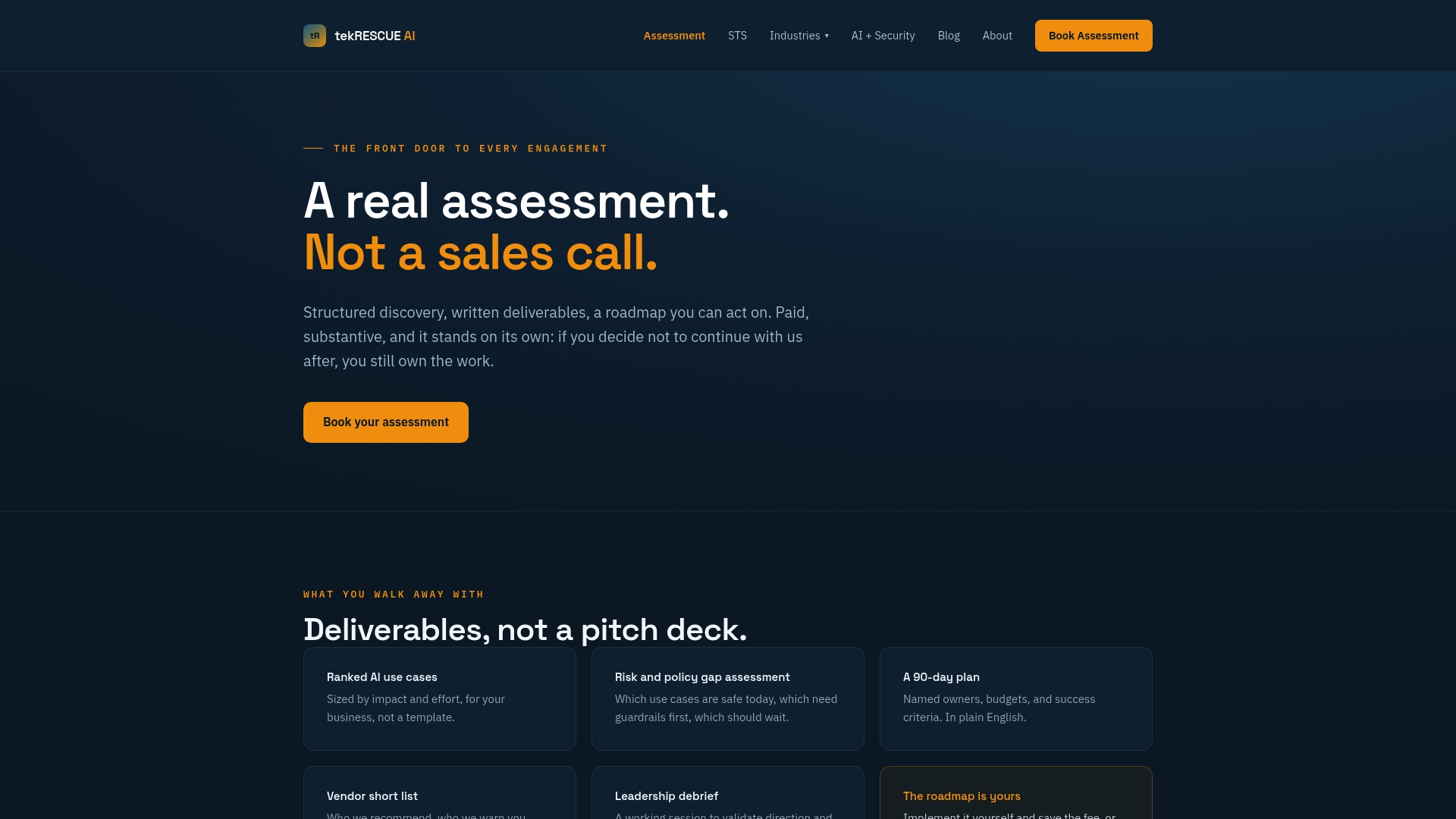
The assessment doesn’t stop at a diagnosis. It produces a prioritized roadmap that tells you which systems need risk classification first, what evidence to attach, and where a review cadence needs to start immediately rather than “eventually.” The roadmap builds every recommendation on active IT and cybersecurity practice rather than theory, providing security context rather than a generic governance template. If your inventory needs ongoing structure after that, STS: Strategy, Training, Systems and Managed AI Security pick up where the assessment leaves off. Start with the assessment and get a roadmap built around what your organization actually has running.
Sources
- Artificial Intelligence: Generative AI Use and Management at Federal Agencies | U.S. GAO
- Artificial Intelligence Risk Management Framework: Generative Artificial Intelligence Profile
FAQ
What Is an AI Model Inventory?
It’s a system of record that documents every AI system an organization uses, including who owns it, what risk tier it carries, and what evidence backs its safety and compliance status. The NIST AI RMF Generative AI Profile recommends specific fields like data provenance and foundation-model version for generative systems.
How Do You Use AI for Inventory Management?
AI itself can help by scanning cloud telemetry, procurement records, and code repositories to flag likely AI systems for review, speeding up discovery. It shouldn’t replace human classification and owner attestation, since those steps require judgment about risk and business context that automated scans can’t fully make.
Which Approach Works Best for AI Inventory Management?
There’s no single best tool. Spreadsheets work for small, low-change inventories, while dedicated platforms make sense once you need automation, evidence attachments, and integrations with identity and cloud systems. tekRESCUE AI’s AI Profit and Growth Assessment helps determine which approach fits your current scale before you invest in a platform.
What Are the Main Types of AI Models to Track?
Common categories include machine learning models trained internally, foundation models accessed through APIs, generative AI embedded in vendor software, and rule-based or statistical models still running in legacy systems. Definitions vary by organization, so your taxonomy should reflect the systems actually deployed rather than a generic industry list.
How Often Should an Inventory Be Reviewed?
A reasonable starting cadence is quarterly attestation reviews for high-risk systems and semiannual reviews for lower-risk ones. Federal audits, including GAO’s review of DHS, show that inventories left unverified for long periods accumulate misclassifications and gaps.