Three things determine whether AI pays off at your company: who owns it, whether governance and security get funded before the first pilot launches, and whether you pick 1 to 3 pilots tied to metrics finance actually trusts. Skip any one of the three and you get what most companies get: activity without impact. The sections below give you the checklist, the governance essentials, and the ROI math to run this the right way, starting now.
TL;DR:
- Selecting only one to three pilots tied to key financial metrics increases the likelihood of measurable impact and avoids spreading resources too thin.
- Establishing clear ownership, governance artifacts, and a vendor exit plan before launch ensures proper oversight and reduces operational risks.
- Most AI pilots take two to four years to fully pay back, but Tier 1 projects can show early results within a quarter if tracked properly.
- Transparent communication, ongoing training, and a 12-month reskilling plan are crucial to retain talent and prevent role disruption fears.
- Integrating cybersecurity measures from day one helps mitigate risks and ensures compliance during AI deployment.
Table of Contents
- AI for Executives: Why This Is a Leadership Issue, Not a Tech Project
- Your First 90 Days: A Prioritized Action Checklist
- What Governance Artifacts Should Executives Actually Require?
- How Do Executives Measure AI ROI Correctly?
- Protecting the Talent Pipeline While You Deploy AI
- The tekRESCUE AI Take on Risk-Aware Adoption
- Ready to Commission Your AI Profit and Growth Assessment?
- Sources
- FAQ
AI for Executives: Why This Is a Leadership Issue, Not a Tech Project
Handing AI to your IT department and asking for updates once a quarter is the single most common way to waste the investment. AI strategy for leaders has to start at the top, because the decisions that actually determine outcomes: which processes get automated, how much risk you’ll tolerate, how you’ll retrain people, aren’t technical decisions. They’re leadership decisions wearing a technical costume.
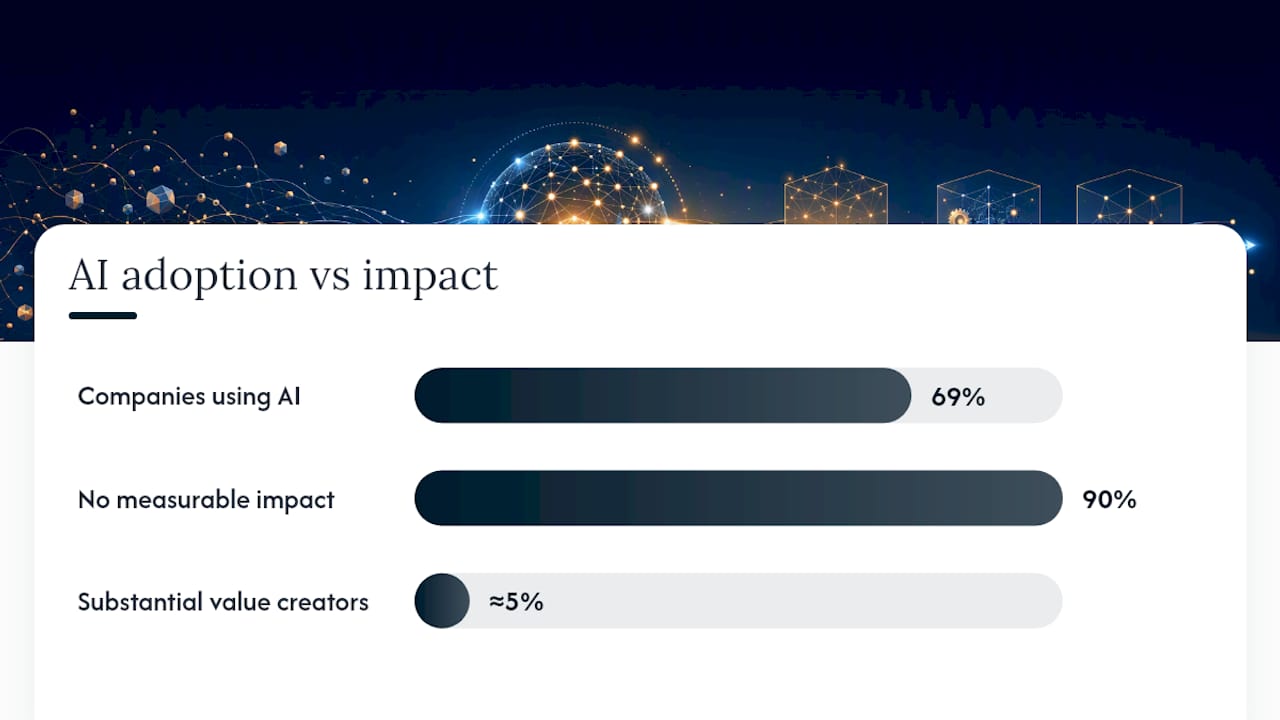
The evidence backs this up bluntly. A study of 6,000 senior executives found 69% said their companies actively use AI, yet 90% reported no measurable productivity impact from it, and IMD’s research puts the share of companies generating substantial value from AI at roughly 5%. That gap between activity and impact is almost always a governance gap, not a technology gap.
MIT Sloan frames the fix as six foundations executives need in place before scaling: clear ownership, working governance, a workforce plan, the right data architecture, honest measurement, and treatment of AI as a continuous portfolio rather than a series of one-off projects. Answering six core strategy questions around culture, talent, and data readiness before you scale anything saves you from expensive rework later.
The risks executives own directly, whether they realize it or not, include model risk (systems that drift or hallucinate in ways nobody catches), vendor dependency (your roadmap now depends on someone else’s roadmap), and data fragmentation (models trained on inconsistent or siloed information). None of that gets solved by a software purchase, it gets solved by executive decision making with AI treated as seriously as capital allocation or a major acquisition.
Your First 90 Days: A Prioritized Action Checklist
You don’t need a five-year AI strategy document. You need a sequence of decisions that gets you from “we should do something with AI” to a measurable pilot with real governance underneath it.
- Assign named owners in week one. Someone on the executive team owns AI transformation, someone owns governance, and someone owns security. Titles matter less than accountability.
- Pick 1 to 3 pilots tied to Tier 1 financial metrics. Not ten pilots. Not a hackathon. Three at most, each mapped to a number finance already tracks, following practical examples from AI for Field Service: A Manager’s Implementation Guide.
- Require a baseline measurement before anything launches. You cannot prove impact if you never recorded where you started.
- Set stage gates at 30, 60, and 90 days. Each gate needs a go, adjust, or kill decision. No pilot runs indefinitely on hope.
- Require a purpose-and-principles impact assessment as part of the approval package, not as an afterthought bolted on after launch.
- Run a short security and vendor pre-check on every tool touching customer or financial data before it goes live.
- Calendar a 90-day executive review now, before the pilots start, so it can’t quietly slip.
Pro Tip: Put the 90-day review on the board calendar before you approve a single pilot. If it’s not scheduled, it doesn’t happen, and neither does the accountability that comes with it.
What Governance Artifacts Should Executives Actually Require?
Governance sounds abstract until a pilot goes sideways and nobody can explain which model made which decision. Executive AI strategy needs four concrete artifacts, not a policy binder nobody reads: a model registry listing every AI system in production and what it touches, a risk taxonomy that ranks each use case by potential harm, audit trails that let you reconstruct a decision after the fact, and a documented exit path for every vendor you depend on.
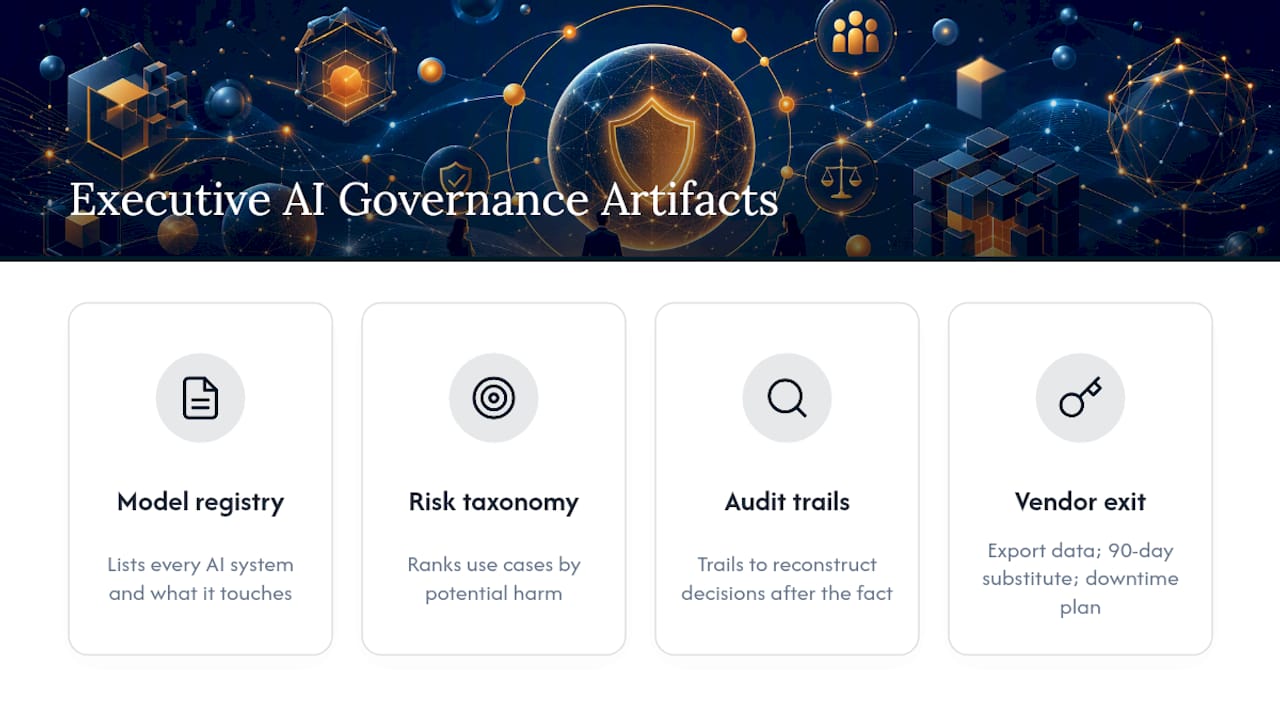
That last one deserves its own habit: an AI dependency inventory. For every vendor or model provider your operations rely on, ask three questions. Can you export your data cleanly if you leave? Is there a substitute provider you could switch to inside 90 days? What happens to active workflows the day that vendor’s service goes down?
IBM’s analysis of 2026 adoption challenges found that governance-focused roles grew 17% in 2025 as companies raced to close exactly this gap, and responsible-AI policies became far more common, though real operational readiness still lags behind the pace of AI capability itself. Governance staffed only by IT or only by legal misses half the picture. It needs a cross-functional team: someone from security, someone from the business unit deploying the tool, someone from legal or compliance, and someone from finance tracking spend.
Here’s the reframe most boards miss: governance isn’t the brake pedal. IMD’s guidance is direct on this point: no AI investment should be approved without guardrails attached, and the smartest boards fund governance out of the same innovation budget funding the pilots, not as a separate compliance tax layered on afterward. Fund it that way and governance becomes what actually lets you scale faster, not what slows you down.
How Do Executives Measure AI ROI Correctly?
Most AI ROI claims that circulate in board decks are wrong, not because anyone is lying but because they mix categories of benefit that behave differently. The AISquared ROI framework sorts benefits into three tiers, and knowing which tier you’re in changes how you should measure it.
Tier 1 covers hard financial returns: reduced labor cost, direct revenue lift, measurable cycle-time savings. This is what your CFO cares about, and it’s the only tier where a strict ROI or payback calculation makes sense. Tier 2 covers operational improvements, fewer errors, faster handoffs, that don’t convert cleanly to dollars but still matter. Tier 3 covers capability value: things like better decision quality or faster onboarding that build strategic capacity over time but resist a clean formula entirely.
Use simple ROI or payback period for Tier 1 pilots measured over a single fiscal cycle. Reserve IRR or NPV calculations for larger, multi-year AI investments where cash flow timing actually matters. And build in patience: Deloitte’s analysis found typical AI payback runs two to four years, with only a small share of deployments seeing fast returns, so don’t let a slow first quarter kill a pilot that was never designed to pay back that quickly. Assign one named owner to track ROI on a fixed monthly cadence, or nobody will.
Protecting the Talent Pipeline While You Deploy AI
The fastest way to sabotage your own AI rollout is to let people believe it’s coming for their job before you’ve told them what their job becomes instead. MIT Sloan’s guidance is consistent on this: transparency about how roles evolve, paired with real training rather than a single webinar, beats silence every time.
There’s a specific trap worth naming here. Automating entry-level work without a plan to replenish it doesn’t just cut headcount, it quietly starves your leadership pipeline five years out, because those entry-level roles are where future managers used to learn the business.
A workable 12-month reskilling plan looks like this:
- Months 1 to 3: identify which roles change and communicate it directly, don’t let rumor fill the gap.
- Months 4 to 8: pair every automated task with a training track toward higher-value work.
- Months 9 to 12: measure retention and promotion rates against your pre-AI baseline, not against a hopeful guess.
Say plainly what’s changing, why, and what support people get. Say it before the tool launches, not after someone finds out from a colleague.
The tekRESCUE AI Take on Risk-Aware Adoption
Most AI advice treats security as a phase-two problem. We don’t. Every roadmap we build for a client integrates cybersecurity into the AI plan from day one, not as an audit that shows up after deployment. That’s what 30 years in IT and security practice teaches you: policy without enforcement is just a document nobody reads. Our AI Profit and Growth Assessment exists to give executives a structured, honest starting point before they commit budget to anything bigger.
— Randy Bryan
Ready to Commission Your AI Profit and Growth Assessment?
Some AI partners will hand you a slide deck of opportunities and leave the security review as your problem to solve later. tekRESCUE builds the security review into the assessment itself, so the pilots you approve come with a governance checklist and risk map already attached, not bolted on after something breaks.
The AI Profit and Growth Assessment maps directly onto the 90 day plan above: it identifies your highest impact pilot candidates, sets ROI targets by tier, builds your governance checklist, and runs a vendor and security pre check before you spend a dollar on implementation. Some engagements move from initial assessment to a documented pilot roadmap inside a few weeks, so your 90 day clock can start on solid footing instead of guesswork. If you’re further along and need training or system build out after the assessment, Strategy, Training, Systems and Managed AI Security pick up where the assessment leaves off. Book your assessment and get the roadmap before you approve your next pilot.
Sources
- 6 questions to guide your AI strategy, MIT Sloan
- The Biggest AI Adoption Challenges for 2026, IBM
- Six new AI imperatives for every CEO and board, IMD IbyIMD
FAQ
What Is the Best AI Tool for Executives?
There’s no single best tool because executive AI strategy isn’t a software choice, it’s a governance and prioritization problem first. The right approach is choosing 1 to 3 high-value pilots tied to Tier 1 metrics and evaluating vendors against security, data governance, and exit-path criteria before picking any platform.
What Is a $900,000 AI Job?
High-compensation AI roles at that level typically belong to senior technical leaders, such as chief AI officers or heads of applied AI, who own enterprise-wide model strategy and governance. Pay at that tier reflects the scarcity of leaders who can bridge technical AI capability with the operational and risk oversight boards now expect.
Which Jobs Are Least Likely to Survive AI Disruption?
Roles built around relationship judgment, physical adaptability, and complex human negotiation, such as skilled trades, in-person client management, and executive decision making itself, tend to resist automation longest. The bigger near-term risk isn’t total job loss but role transformation, which is why MIT Sloan recommends transparency and reskilling over silence.
How Can Executives Practically Start Using AI?
Start by assigning named ownership for transformation, governance, and security, then select a small number of pilots against metrics finance already tracks. A structured starting point, such as tekRESCUE’s AI Profit and Growth Assessment, can compress this into a documented roadmap instead of months of internal debate.
How Long Does It Take to See AI ROI?
Most AI investments take two to four years to reach full payback, according to Deloitte’s analysis, though Tier 1 pilots with clear financial metrics can show early signals within a single fiscal quarter. Set expectations at the pilot’s approval stage so a slow first quarter doesn’t trigger a premature kill decision.