For U.S.-focused SaaS companies selling to enterprise buyers, SOC 2 Type II is usually the first assurance procurement teams ask for. Global or regulated buyers, especially in Europe and Asia, tend to want ISO/IEC 27001 certification instead. Most mid-size companies eventually need both, and the good news is that the underlying controls overlap heavily. Start by asking your top five prospects which document they actually require, then map controls once so the second audit costs far less than the first.
TL;DR:
- Most companies should start with SOC 2 Type II if selling mainly to U.S. enterprise SaaS buyers, but European and regulated prospects often prefer ISO 27001.
- Over 65% to 80% of controls overlap between SOC 2 and ISO 27001, making combined controls mapping a cost-effective approach.
- Certification costs differ: SOC 2 focuses on audit fees and evidence tooling, while ISO 27001 emphasizes the effort to create and maintain an ISMS.
- The choice of framework should depend on your prospects’ requirements and market focus, not internal preferences, with sequencing guided by active deal demands.
- Running both audits in parallel by building a unified control catalog minimizes duplicate effort and streamlines evidence collection.
Table of Contents
- SOC 2 vs ISO 27001: What Each Standard Actually Requires
- ISO 27001 vs SOC 2: How Certification Actually Works
- Where SOC 2 and ISO 27001 Overlap (More Than You’d Think)
- SOC 2 vs ISO 27001 Comparison: Side by Side
- Which Standard Should You Pursue First?
- Running Both Audits Without Duplicating the Work
- Where AI Adds a New Layer to SOC 2 and ISO 27001
- What Decision-Makers Get Wrong About This Choice
- Sources
SOC 2 vs ISO 27001: What Each Standard Actually Requires
SOC 2 is an attestation, not a certification. The American Institute of Certified Public Accountants governs the framework, and only licensed CPA firms are authorized to issue the report. Every SOC 2 engagement gets measured against the AICPA’s Trust Services Criteria, a set of five categories covering security, availability, processing integrity, confidentiality, and privacy. Security is the only one that’s mandatory. The other four get added based on what your customers actually care about.
Here’s where a lot of first-time buyers get tripped up: SOC 2 comes in two flavors, and they mean very different things.
- Type I checks whether your controls are designed correctly at a single point in time. It’s faster and cheaper, but it doesn’t prove those controls actually work day to day.
- Type II covers a window of time, usually several months, and tests whether the controls operated effectively the whole way through.
Enterprise buyers almost always ask for Type II. A Type I report tells them your policy document looks good on paper. Type II tells them the policy was followed. During the audit, expect the CPA firm to pull access logs, support tickets, monitoring alerts, and change records, then trace them back to your stated controls. Once the report is final, it gets shared with prospects under an NDA rather than posted publicly, since it typically contains sensitive operational detail.
ISO 27001 vs SOC 2: How Certification Actually Works
ISO/IEC 27001 works nothing like an attestation. It certifies that you run an ongoing information security management system, or ISMS, not just that specific controls passed a test. The current version, ISO/IEC 27001:2022, sets two layers of requirements you have to satisfy at once.
- Clauses 4 through 10 cover governance: leadership commitment, risk assessment methodology, internal audits, and management review meetings that have to happen on a schedule, not just before the audit.
- Annex A controls, 93 of them in the 2022 revision, cover the operational side: access management, cryptography, supplier relationships, incident handling, and more.
- The Statement of Applicability, or SoA, is the document where you justify which Annex A controls apply to your organization and which you’ve excluded, with reasoning.
- Certification audits run in two stages: an accredited registrar first reviews your documentation, then comes back to test whether the ISMS is actually operating.
- Surveillance audits happen every year for three years, with recertification at the end of that cycle.
Unlike a SOC 2 report, the ISO 27001 certificate itself is public and can be displayed as a badge, though the underlying audit findings stay confidential. The management review and continual improvement requirements are the real differentiator. ISO 27001 wants proof that leadership is actively steering the security program, not just that a checklist got completed once a year.
Where SOC 2 and ISO 27001 Overlap (More Than You’d Think)
If you’ve already built one program, you’re closer to the other than most people assume. Access control, incident response, vendor risk management, change management, and logging show up in both frameworks almost identically, just organized under different labels.
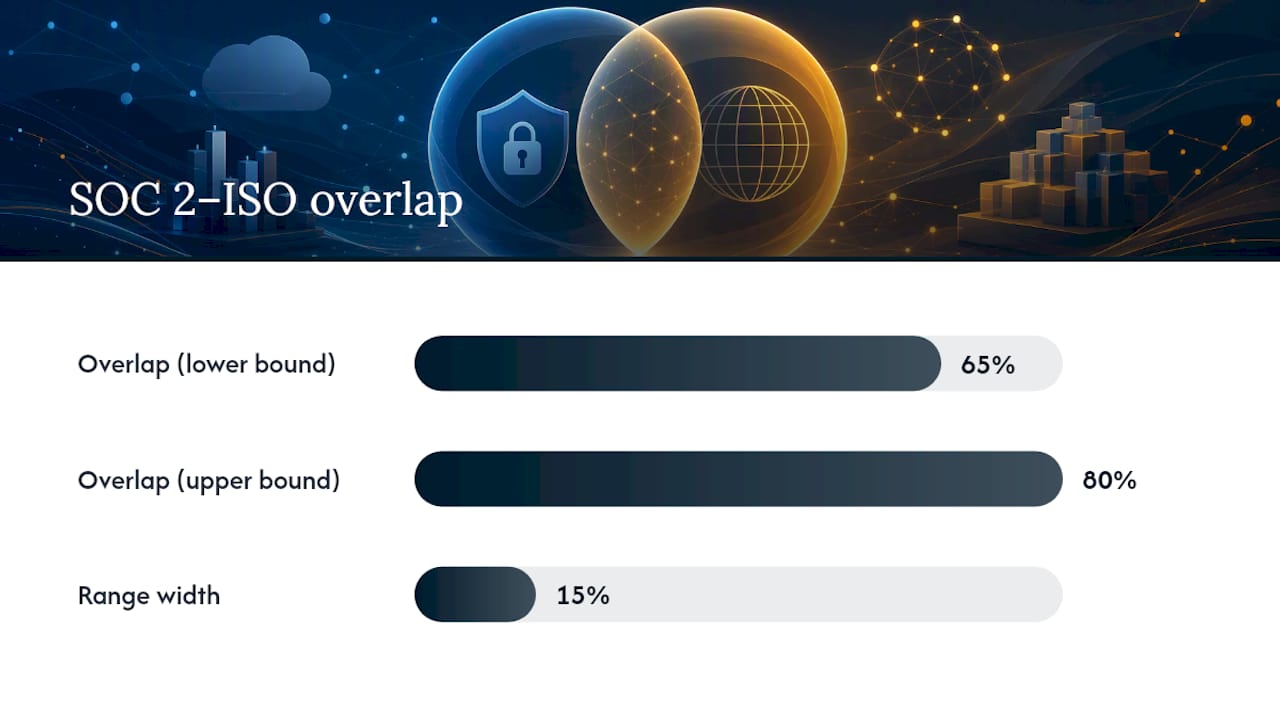
The overlap is estimated at roughly 65% to 80%, depending on how many optional SOC 2 criteria you’ve adopted. That’s a big enough chunk that treating the two audits as separate projects wastes real money.
Here’s what typically carries over without much rework:
- Access control policies and the evidence that proves they’re enforced
- Incident response plans and postmortem records
- Vendor and third-party risk assessments
- Change management logs and approval workflows
- Security monitoring and alerting configurations
The efficient path is mapping your controls once against both frameworks before you schedule either audit. Build a single control catalog, tag each control against the relevant Trust Services Criteria and Annex A reference, and reuse the same evidence folder for both auditors. The AICPA even publishes a mapping spreadsheet between the TSC and ISO 27001 controls, which saves you from building that cross-reference from scratch.
SOC 2 vs ISO 27001 Comparison: Side by Side
The two frameworks split apart most clearly when you line them up by who issues what, how long it takes, and what it costs.
| Dimension | SOC 2 | ISO 27001 |
|---|---|---|
| Audit body / issuer | Licensed CPA firm | Accredited certification body (registrar) |
| Output | Attestation report (Type I or II) | Public certificate plus confidential audit report |
| Controls basis | AICPA Trust Services Criteria | Annex A controls plus Clauses 4 to 10 |
| Timeline to first result | Type I: weeks after readiness; Type II: several months observation window | Typically several months to build the ISMS, then a two-stage certification audit process |
| Cost drivers | CPA audit fees, readiness consulting, evidence tooling | Registrar audit fees, ISMS documentation effort, internal audit resourcing |
| Validity / renewal | Refreshed roughly every year | 3-year certification cycle with annual surveillance audits |
| Market recognition | Dominant with U.S. enterprise and SaaS buyers | Preferred by global, government, and regulated buyers |
A few things in that table deserve more explanation than a cell allows.
Audit body and output. SOC 2 gives you an auditor’s opinion on your controls. ISO 27001 certifies that you run a functioning management system. Procurement teams treat these artifacts differently: a SOC 2 report gets read line by line under NDA, while an ISO certificate gets verified against the registrar’s public database and displayed as a trust badge.
Controls basis and evidence. SOC 2 evidence tends to be narrower and more technical, log files and access records tied directly to the Trust Services Criteria you selected. ISO 27001 evidence is broader, since auditors also want proof of governance activity: meeting minutes, risk register updates, and internal audit findings tied to the SoA.
Timeline and cadence. SOC 2 Type II locks you into a rolling observation window, so you’re always mid-cycle on evidence collection. ISO 27001 gives you three calendar years of breathing room between full certifications, though the annual surveillance audits mean you’re never fully off the hook either.
Cost. SOC 2 costs concentrate in CPA audit fees and the tooling you need to automate evidence collection continuously. ISO 27001 costs concentrate in the upfront ISMS build: writing policies, running risk assessments, and training staff on governance processes that didn’t exist before.
Market recognition. If your buyers are almost entirely U.S. enterprises evaluating SaaS vendors, SOC 2 Type II will satisfy most procurement requirements on its own. If you’re selling into the EU, government contracts, or industries with formal supplier security requirements, buyers will often insist on ISO 27001 specifically, sometimes regardless of whether you also hold SOC 2.
Which Standard Should You Pursue First?
The fastest way to cut through the debate is to stop treating it as abstract and start asking your own pipeline what it actually requires.
- Check where your revenue comes from. If most closed deals or active prospects are U.S. mid-market or enterprise SaaS buyers, SOC 2 Type II is the more common gatekeeper.
- Check where your growth is headed. If you’re expanding into the EU, UK, or government procurement, ISO 27001 becomes the credential buyers expect to see, sometimes as a hard requirement in the RFP.
- Ask sales and procurement directly which document they need. Don’t guess. Send a two-question survey to your account executives: “Has a prospect asked for SOC 2 or ISO 27001 by name?” and “Was a Type II report specifically required?”
- Check for NDA constraints. If your sales cycle involves a lot of self-service or public-facing trust pages, the fact that ISO certificates are public and SOC 2 reports aren’t can tip the decision.
- Decide on sequencing. Most U.S.-focused SaaS companies start with SOC 2 and layer ISO 27001 on top once international deals materialize, following the practical sequencing rule practitioners commonly recommend: build to whatever your top five active prospects are actually asking for.
For early-stage teams, resist the urge to scope either framework broadly on day one. A minimal viable scope, security only for SOC 2, or a tightly defined ISMS boundary for ISO 27001, gets you a usable artifact faster and cheaper than trying to cover every possible criterion before you’ve closed a single deal that needs it.
Pro Tip: Run a 30-minute call with your three largest active prospects before you sign an audit contract. Ask them point blank which report their security team requires. It’s the cheapest research you’ll ever do on this decision.
Running Both Audits Without Duplicating the Work
Once you’ve decided both frameworks matter, the sequencing question becomes an operations question. Build a single control catalog first, before you schedule anything with an auditor or registrar. Every control gets tagged against the relevant Trust Services Criteria and the matching Annex A reference, so evidence collected for one audit slots directly into the other.
Draft your Statement of Applicability and risk register early, even if ISO 27001 is a year away. These documents force you to think through scope and control boundaries in ways that pay off for the SOC 2 side too, since a clearly bounded environment is easier to test either way.
Schedule your SOC 2 Type II observation window to overlap with, rather than compete against, your ISO 27001 certification audit prep. Running them in parallel, staggered by a few months, means your team pulls evidence once instead of twice.
Common evidence pitfalls on audit day include:
- Screenshots without timestamps or without showing the actual user account involved
- Policies that reference a process nobody can demonstrate they followed
- Vendor risk assessments that are more than a year old with no re-review noted
- Access reviews that show the review happened but not what changed as a result
Pro Tip: Keep a shared evidence folder organized by control ID, not by audit type. When the ISO auditor asks for proof of access reviews, you want the same folder the SOC 2 auditor already approved, not a second scramble to recreate it.
Companies with regulated buyers should also look at how frameworks like 21 CFR Part 11 layer onto SOC 2 or ISO 27001 baselines, since pharmaceutical and life sciences procurement often stacks additional requirements on top of whichever core framework you hold.
Where AI Adds a New Layer to SOC 2 and ISO 27001
Neither framework was written with generative AI in mind, which means most audit-ready companies are quietly adding controls that don’t map cleanly to any existing Annex A clause or Trust Services Criterion. tekRESCUE AI works with organizations that are trying to close that gap without slowing down an active audit cycle.
A few AI-specific additions worth building into your ISMS or SOC 2 evidence set now:
- Access controls scoped specifically to who can query, fine-tune, or export data from AI models
- Data lineage records showing what training or prompt data touched which systems
- Third-party risk assessments for every AI model vendor, not just traditional SaaS subprocessors
- Logging that captures model inputs and outputs where sensitive data might pass through
The organizations that struggle most aren’t the ones adopting AI slowly. They’re the ones that bolted AI tools onto an existing SOC 2 or ISO 27001 program without ever asking whether their access controls or vendor assessments still cover what those tools actually touch.
tekRESCUE AI’s AI Profit and Growth Assessment is built to help leadership teams sequence this work: identifying which AI-related risks need control coverage first, and where that coverage should live inside an existing ISMS or SOC 2 scope rather than as a bolted-on afterthought.
What Decision-Makers Get Wrong About This Choice
Most advice on this topic treats SOC 2 and ISO 27001 as a fork in the road, pick one, defend the choice, move on. That framing has never matched how procurement actually works. Your buyers don’t care which framework has cleaner branding. They care whether the document sitting on their desk answers the specific question their own compliance team was told to ask.
The bigger mistake is sequencing based on internal preference rather than external signal. Teams gravitate toward whichever framework their existing security lead has run before, then rationalize the choice after the fact. That’s backwards. The framework choice should come from a spreadsheet of what your active deals are actually requesting, not from whoever on staff already has an ISO background.
If there’s one thing worth prioritizing above the framework debate itself, it’s building the control catalog before you pick an auditor. Organizations that map controls once and reuse them save real audit spend on the second framework. Organizations that treat each audit as a fresh project pay for that redundancy every single cycle, sometimes for years.
— Randy Bryan
Sources
Claims on Trust Services Criteria and the mandatory Security domain draw from the AICPA’s TSC document. ISO governance and Annex A details come from ISO’s official ISO/IEC 27001 page. Overlap and sequencing guidance draws on Scrut.io’s comparison.