Shadow AI is the use of AI tools, models, or agents by employees or embedded software without its knowledge or approval. It matters because the moment someone pastes a customer record or a chunk of proprietary code into a public chatbot, that data has left your enterprise, often permanently, and with no log entry pointing back to it.
Here’s the operational verdict: don’t start with a ban. Start with discovery. You can’t govern what you can’t see, and blanket prohibitions almost always push usage further underground rather than eliminating it.
Three things to act on this week:
- Inventory before you legislate. Find out what’s actually running before you write a policy about it.
- Assume prompts are a data-loss channel, not just a productivity tool.
- Treat AI agents as identities that need lifecycle management, not one-off software installs.
Key Takeaways
Shadow AI governance succeeds when discovery precedes policy and sanctioned alternatives replace unsanctioned demand rather than just prohibiting it.
| Point | Details |
|---|---|
| Discovery comes first | Inventory AI usage across network, identity, and endpoint signals before writing any policy. |
| The governance gap is measurable | Only 23% of organizations have formal AI governance despite 69% of leaders suspecting prohibited use. |
| Sanctioned alternatives cut demand | Offering an approved AI tool can reduce shadow AI usage by 60 to 80% in field deployments. |
| Agents need lifecycle management | Provision, operate, review, and decommission AI agents the same way you manage any privileged identity. |
| Get a structured assessment | tekRESCUE’s AI Profit and Growth Assessment maps current AI usage and delivers a prioritized remediation roadmap. |
Table of Contents
- What Is Shadow AI, and How Is It Different From Shadow IT?
- Where Shadow AI Actually Shows Up in Your Environment
- The Risks That Should Actually Keep You Up at Night
- Why Employees Turn to Shadow AI in the First Place
- How to Detect and Discover Shadow AI in Your Organization
- Agent Lifecycle Governance: A Model That Actually Prevents Orphaned Risk
- Five Moves That Reduce Shadow AI Risk This Quarter
- How an AI Partner Helps: What an Assessment Actually Delivers
- What the Numbers Actually Tell You About the Governance Gap
- Legal and Regulatory Implications of Unsanctioned AI Use
- How Shadow AI Changes Workplace Culture and Employee Behavior
- Where Shadow AI Collides With Your Existing IT Infrastructure
- What Real Shadow AI Incidents Look Like
- Training Employees to Use AI Responsibly
- What Most Governance Programs Get Wrong
- Book an AI Profit and Growth Assessment With tekRESCUE AI
- Frequently Asked Questions
- Sources
What Is Shadow AI, and How Is It Different From Shadow IT?
Shadow IT is unsanctioned software or hardware. Shadow AI is a subset of that problem, but it behaves differently in ways that matter to your risk model.
- The asset isn’t the only risk, the data input is. An unapproved spreadsheet tool is a liability if it stores data insecurely. An unapproved AI chatbot is a liability the instant someone types into it, because the prompt itself can be logged, retained, or used for model training by the vendor.
- AI introduces non-human identities at scale. Shadow IT usually means a person using a tool. Shadow AI increasingly means an agent, acting on someone’s behalf, making API calls, touching systems, and persisting long after the person who set it up has changed roles or left.
- Your existing controls weren’t built for this. Data loss prevention and cloud access security broker tools were designed to catch file transfers and known SaaS destinations, not a text box embedded inside an approved app or a browser extension quietly routing content to a third-party model.
That third point is the one most security teams underestimate. DLP and CASB tooling can help, but coverage gaps remain for AI features baked into approved software, browser extensions, and personal-device use. You’re not just looking for new destinations. You’re looking for new behavior inside destinations you already trust.
Where Shadow AI Actually Shows Up in Your Environment
You don’t need a hypothetical threat model. You need to know where to look. The most common vectors show up in nearly every organization we’ve assessed, regardless of size or industry:
- Employees pasting text directly into consumer-facing chatbots through a browser, no corporate account involved.
- AI features quietly turned on inside SaaS platforms your company already pays for (think auto-summarize, auto-draft, or “smart” search).
- Browser extensions that route page content or clipboard data to an external model.
- API keys for AI services purchased on a personal credit card and expensed later, invisible to procurement.
- Local model runners installed on laptops, running open-weight models with no network trace at all.
- MCP servers and agent frameworks that connect internal systems to external AI tools, often set up by a developer trying to solve a real problem fast.
Each of these vectors has a different detection signature, which is why single-tool discovery efforts tend to miss most of the picture.
The Risks That Should Actually Keep You Up at Night
Not every shadow AI risk deserves equal attention. Rank them wrong and you’ll spend a quarter fighting the wrong fire.
Data exfiltration is the headline risk, and it’s immediate. Employee-submitted prompts frequently contain proprietary code, customer PII, or internal documents, and that data can leave the enterprise the moment the prompt is submitted, often before anyone realizes a sensitive workflow touched an unapproved tool. The Samsung engineers who pasted source code into a public chatbot in 2023 didn’t set out to leak anything. They just wanted a faster way to debug.
The governance gap behind this is larger than most leadership teams assume.
Only a minority of organizations have a formal AI governance framework in place, while a large share of security leaders suspect or have direct evidence of employees using prohibited public generative AI tools, according to CSA’s research on shadow AI in the enterprise.
That gap between suspicion and formal governance is where most incidents originate. It’s not that leadership doesn’t know shadow AI exists. It’s that almost nobody has built a structure to manage it.
Beyond exfiltration, watch for:
- Compliance exposure. Data subject to HIPAA, GDPR, or contractual confidentiality clauses processed by an unvetted third-party model creates breach notification obligations you may not discover until an audit.
- Orphaned agents. An AI agent set up by an employee who has since left or changed roles, still running, still holding credentials, with no owner to shut it off.
- Credential sprawl. API keys scattered across personal accounts, shared documents, and code repositories, each one a potential entry point.
- Prompt injection and supply chain risk. Agents that ingest external content (emails, web pages, documents) can be manipulated into taking unintended actions if that content contains hidden instructions.
Why Employees Turn to Shadow AI in the First Place
Punishing shadow AI usage without understanding why it happens is a losing strategy. Most employees aren’t trying to create risk. They’re trying to hit a deadline.
- Productivity pressure outruns approval speed. If a sanctioned tool takes six weeks to get approved and a free chatbot takes six seconds, most employees will choose the fast path every time.
- Nobody owns the decision. In many organizations, AI tooling sits in a gap between IT, legal, and individual department budgets. When no one clearly owns the call, no one makes it, and employees fill the vacuum themselves.
- The sanctioned alternative doesn’t exist, or doesn’t work as well. If your approved AI tool is clunky, slow, or missing a feature employees need, they’ll route around it.
- Developers build their own workarounds. Citizen development and internal automation projects often bolt AI onto existing workflows without ever touching a formal procurement process, because the developer sees it as “just a script,” not a new system.
Understanding these drivers reframes the fix: reduce the demand for shadow AI by making the sanctioned path faster and better, not just by blocking the unsanctioned one.
How to Detect and Discover Shadow AI in Your Organization
Detection works best as layered signal collection, not a single tool deployment. Think of it as three overlapping nets:
- Network and proxy signals. Egress logs showing traffic to known AI domains reveal usage patterns even when the tool itself is unmanaged.
- Identity and SSO signals. Look for API keys tied to personal accounts, OAuth grants to AI apps, and unusual authentication patterns in your identity provider logs.
- Endpoint and configuration scanning. Local model runners, credential files, and browser extension inventories catch what network monitoring misses entirely.
For a fast baseline, run three things in parallel: pull 90 days of AI domain traffic from your proxy logs, run an anonymous employee survey asking what AI tools people actually use day to day, and do a targeted search of your code repositories for API keys tied to AI services. Combining survey data, traffic review, and repository search consistently reveals far more AI usage than security teams initially estimate.
Once you have raw findings, risk-rank them by data sensitivity touched, not by tool popularity. A niche writing assistant touching customer PII outranks a widely used chatbot touching only public marketing copy.
Pro Tip: Run the anonymous survey before the technical scan. Employees who know a survey is coming are far more candid about what they’re actually using than they’ll ever be in a follow-up interview after IT finds something on the network logs.
Agent Lifecycle Governance: A Model That Actually Prevents Orphaned Risk
Blocking tools doesn’t solve the AI agent problem, because agents aren’t tools in the traditional sense. They’re identities that act on your systems, and they need to be governed the same way you’d govern a service account, not the way you’d govern a desktop app.
Ownership fragmentation, not a lack of policy, is the structural failure that produces persistent shadow AI risk. An agent with no clear owner is an agent nobody notices when it should be shut down. Fixing that requires a lifecycle model with four distinct stages:
- Provisioning: register every agent in a central inventory, assign a named human owner, and scope permissions to the minimum needed for the task.
- Operation: monitor agent activity continuously and rotate or expire credentials rather than issuing static, long-lived keys.
- Review: recertify agent access on a fixed schedule, tied to the same access certification process you already run for human accounts.
- Decommission: trigger automatic shutdown when an owner changes roles, leaves the company, or the agent goes idle past a defined threshold.
| Lifecycle Stage | Key Control | Failure Mode Without It |
|---|---|---|
| Provisioning | Named owner and scoped permissions assigned at creation | Agents launch with broad access and no accountable party |
| Operation | Continuous monitoring, credential rotation | Static credentials accumulate and become long-term attack surface |
| Review | Quarterly recertification tied to access reviews | Agents persist long after their business justification expires |
| Decommission | Automated triggers on role change or idle time | Orphaned agents run indefinitely with no one aware they exist |
Treating agents this way isn’t overkill. Agent lifecycle governance requires identity-focused controls that give AI agents the same provisioning rigor as any other non-human identity, and skipping that rigor is exactly how orphaned agents accumulate unnoticed for months.
Five Moves That Reduce Shadow AI Risk This Quarter
Prioritize by leverage. These five moves are ordered from highest impact to supporting controls.
- Give employees a sanctioned enterprise AI option for the top three or four use cases people already have. This is the single highest-leverage move available. Providing a sanctioned alternative reduces shadow AI demand by an estimated 60 to 80 percent in field deployments, because most employees would rather use an approved tool if it’s fast and good enough.
- Publish a one-page policy mapping data classes to approved tools. Skip the 40-page document nobody reads. A single page that says “customer PII goes here, public marketing copy can go there” gets followed because it’s usable.
- Extend your DLP and CASB rules to cover AI domains explicitly, with quarantine rather than hard blocks where possible. A quarantine flow that routes a flagged prompt for review teaches you more than a silent block does.
- Enforce identity-centric controls for every agent, using short-lived credentials instead of static API keys. This closes the credential sprawl gap directly.
- Stand up continuous discovery with defined KPIs and remediation service-level agreements. Discovery isn’t a one-time audit. It’s an ongoing function with a target: time-to-detection, time-to-remediation, and percentage of AI usage covered by a sanctioned alternative.
Pro Tip: Track “percentage of AI usage covered by a sanctioned alternative” as a standing KPI, not a one-time project metric. It’s the number that tells you whether your program is actually reducing shadow AI demand or just chasing new tools as they appear.
How an AI Partner Helps: What an Assessment Actually Delivers
Governance sounds straightforward on paper. In practice, most organizations lack the internal bandwidth to run discovery, map data classes, and build agent lifecycle controls all at once, on top of daily operations.
tekRESCU’s AI Profit and Growth Assessment is built around that reality. It combines an inventory of current AI usage, a prioritized remediation roadmap, and a concrete plan for where sanctioned AI can create real efficiency without expanding your risk surface. Because tekRESCUE integrates cybersecurity thinking directly into AI strategy, the assessment addresses ownership fragmentation head-on rather than treating security and AI adoption as separate workstreams.
What you get:
- A clear inventory of AI tools and agents currently in use, sanctioned or not.
- A prioritized roadmap ranking fixes by risk and business impact.
- A remediation plan mapped to your existing infrastructure, not a generic template.
- A defined next step, whether that’s a sanctioned tool rollout, a policy draft, or an agent governance pilot.
What the Numbers Actually Tell You About the Governance Gap
The clearest measurable sign of the shadow AI problem is the distance between what security leaders believe is happening and what’s formally governed. That 23% versus 69% split, formal governance frameworks in place against suspected or confirmed prohibited tool usage, isn’t a rounding error. It’s a structural gap that shows up in nearly every organization that hasn’t run a formal discovery process.
Field reports consistently back this up: when security teams run their first proper discovery sweep, combining network traffic review, anonymous surveys, and repository searches, they find substantially more AI usage than they expected going in. That’s not because employees are being deceptive. It’s because nobody had asked the question in a way that made honest answers easy to give.
The pattern that matters most for planning purposes: organizations that measure before they legislate build policies that actually match reality. Organizations that write policy first, based on assumptions about what “probably” isn’t happening, tend to discover their policy missed entire categories of usage within the first few months. If you’re building a business case for a discovery budget, this gap is the number to lead with. It converts a vague sense of risk into a specific, defensible ask.
Legal and Regulatory Implications of Unsanctioned AI Use
Shadow AI creates legal exposure that’s easy to underestimate until an audit or a breach forces the question. Data processed by an unvetted third-party AI model can trigger breach notification obligations under regulations like GDPR or HIPAA, even if no attacker was ever involved. The mere act of sending regulated data to a vendor with unclear retention practices can itself constitute a reportable event, depending on your jurisdiction and the data class involved.
Contractual exposure compounds this. Many vendor and customer agreements include confidentiality clauses that assume data stays within named, approved systems. An employee routing that data through an unapproved AI tool can put your organization in breach of those contracts, regardless of intent. This is one area where a written AI addendum to vendor and customer contracts, spelling out where AI tools may and may not touch shared data, closes a gap most legal teams haven’t addressed yet. Formable’s contract tooling for AI addenda is a useful reference point for building that language into new agreements.
Regulators are also increasingly specific about AI risk management expectations, and frameworks like the NIST AI Risk Management Framework and ISO/IEC 42001 are becoming the reference points examiners ask about. Treat alignment with those frameworks as documentation you’ll eventually need to produce, not an optional exercise. The organizations that get caught flat-footed aren’t the ones with the most shadow AI usage. They’re the ones with no record showing they tried to manage it.
How Shadow AI Changes Workplace Culture and Employee Behavior
Shadow AI usage doesn’t just create technical risk. It reshapes how employees relate to IT and to each other. When people find a faster way to work and know leadership hasn’t sanctioned it, a quiet norm forms: ask forgiveness, not permission. That norm spreads fast in teams under deadline pressure, and it tends to normalize working around governance in other areas too, not just AI.
There’s also a trust cost that runs in both directions. Employees who feel their sanctioned tools are slower or worse than what they could get on their own start to see IT as an obstacle rather than a partner. Meanwhile, security teams who discover widespread unsanctioned usage often respond with blanket restrictions that read as punitive, which erodes trust further and pushes usage even further underground rather than into the open.
The healthier pattern shows up in organizations that treat the discovery process itself as a listening exercise. When IT asks employees what they’re actually using and why, rather than announcing new blocks, employees tend to be candid, and that candor becomes the foundation for building sanctioned alternatives people will actually adopt. Culture shifts follow behavior, not policy documents. A team that sees leadership respond to shadow AI with better tools, rather than only tighter restrictions, treats the next governance rollout as a collaboration instead of a crackdown.
Where Shadow AI Collides With Your Existing IT Infrastructure
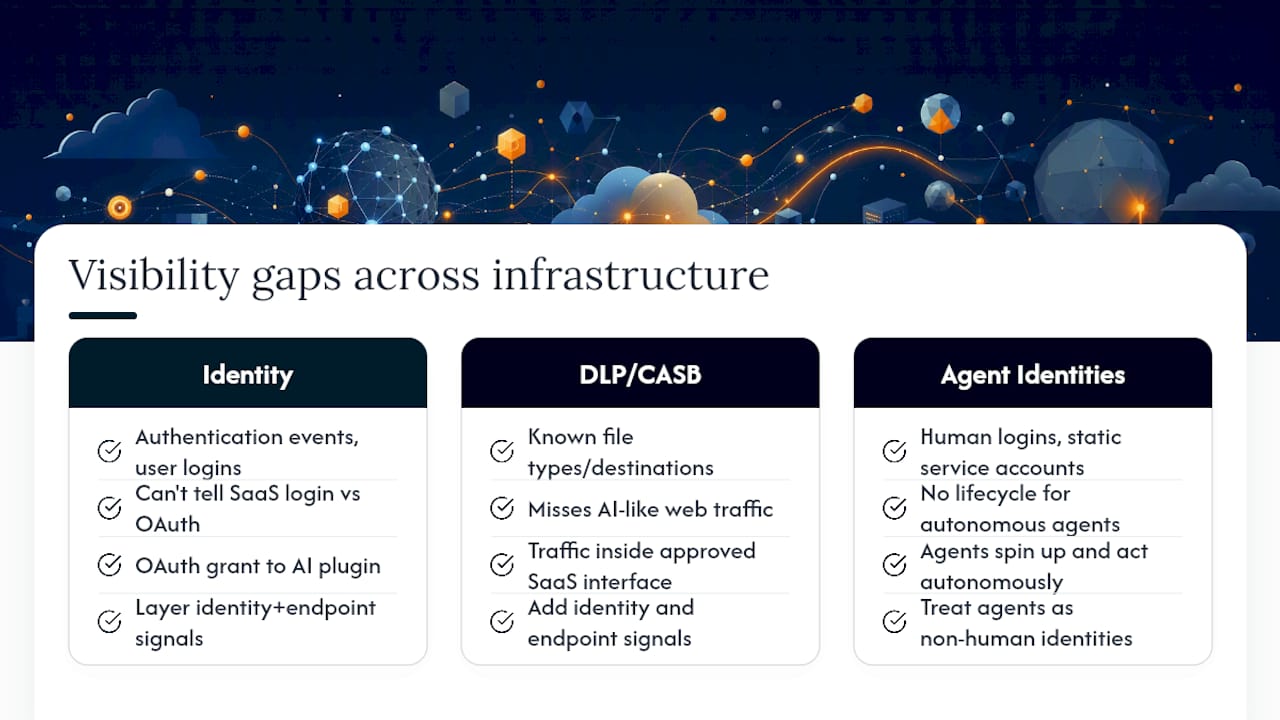
Integrating shadow AI governance with existing infrastructure runs into friction almost immediately, and most of it comes down to visibility gaps in tools that were never built with AI in mind. Your identity provider logs authentication events, but it often can’t distinguish a legitimate SaaS login from an OAuth grant handed to a third-party AI plugin with broad read access.
Your existing DLP and CASB deployments were tuned for known file types and known destinations. AI traffic frequently doesn’t look like a file transfer at all. It looks like ordinary web traffic to a domain your proxy has never flagged, or it happens entirely inside an approved SaaS platform’s own interface, invisible to network-layer tools altogether. This is exactly why DLP and CASB coverage leaves gaps for AI features embedded in approved software and personal-device use, and closing that gap usually means layering identity and endpoint signals on top of network monitoring rather than replacing existing tools.
Identity infrastructure carries its own integration challenge with agentic AI specifically. Most identity and access management systems were designed around human logins and static service accounts, not agents that spin up, act autonomously, and need to be retired on a schedule. Extending platforms like Microsoft Entra to treat agents as first-class non-human identities, with the same provisioning and review cycles as any privileged account, is a real engineering lift. Security tooling built around identity and SSO integration can help bridge that gap, but the underlying work of mapping agent permissions to existing role structures still falls to your team.
What Real Shadow AI Incidents Look Like
The Samsung engineering team’s 2023 decision to paste proprietary source code into a public chatbot remains one of the clearest illustrations of the exfiltration risk, precisely because nothing malicious was involved. Engineers were troubleshooting code and looking for a faster answer than an internal review would provide. The data left the company the moment the prompt was submitted, with no way to recall it once the vendor’s systems had processed it.

That pattern, well-intentioned employees using a fast tool for a legitimate task, repeats across nearly every documented shadow AI incident. It’s rarely a disgruntled insider deliberately leaking data. It’s a marketing employee summarizing a draft contract in a public tool, a support agent pasting a customer ticket into a chatbot for a better response, or a developer connecting an internal repository to an AI coding assistant that retains submitted code for model improvement.
The common thread across these incidents is that none of them would have shown up in a traditional security audit focused on network intrusions or malware. The “attack,” if you can call it that, was a normal employee doing normal work through an unapproved channel. That’s exactly why detection built solely around traditional threat signatures misses this category of risk entirely, and why the discovery methods covered earlier in this piece (traffic review, surveys, repository search) matter more than traditional intrusion detection for catching this pattern before it becomes a headline.
Training Employees to Use AI Responsibly
Policy documents don’t change behavior on their own. Training that works tends to share a few traits: it’s specific to real workflows, it happens close to the point of use, and it explains the “why” rather than just listing rules.
Start with the data classification piece, since it’s the single most actionable thing an employee can learn. If people understand which categories of information (customer PII, financial data, proprietary code, unreleased product plans) should never go into an unapproved AI tool, they can make the right call in the moment even without checking a policy document first. Tie this training to the same one-page data-class mapping recommended earlier in the governance playbook, so the message stays consistent everywhere it appears.
Make reporting easy and blame-free. If an employee realizes after the fact that they pasted something sensitive into a chatbot, the priority is getting that information to security fast, not disciplining the employee for coming forward. Punitive responses guarantee that the next incident goes unreported.
Finally, pair training with a visible sanctioned alternative. Telling employees “don’t use ChatGPT for this” without offering a fast, approved replacement just pushes usage underground again. The training that sticks is the training that ends with “here’s what to use instead,” not just “here’s what not to do.”
What Most Governance Programs Get Wrong
Most shadow AI programs fail for a predictable reason: they treat discovery as a project instead of a function. You run one sweep, find a pile of unsanctioned tools, write a policy, and move on. Six months later you’re surprised by usage that policy never anticipated, because nobody kept looking.
The metric that actually predicts program success isn’t “number of tools blocked.” It’s time-to-detection and the percentage of AI usage covered by something you actually sanctioned. If that second number isn’t climbing, your policy exists on paper and nowhere else.
The other common mistake is writing policy with no fast, credible approval path behind it. A rule with no usable alternative just teaches employees to hide better. Fix the ownership gap first. Everything else follows from that.
Book an AI Profit and Growth Assessment With tekRESCUE AI
If you’ve read this far, you already know the discovery-first approach beats a blanket ban, but knowing it and building it are two different projects. tekRESCUE AI runs that build for you. Where a generic policy template leaves you guessing at your own environment, the AI Profit and Growth Assessment starts with an actual inventory of what’s running in your organization, then maps a prioritized roadmap tied to your specific data classes and existing infrastructure, not a one-size-fits-all checklist.
The assessment is built for leadership teams who need both sides of the equation covered at once: where AI can create real efficiency, and where it’s quietly creating exposure right now. Because tekRESCUE integrates cybersecurity expertise directly into AI strategy rather than treating them as separate conversations, the roadmap you walk away with addresses ownership fragmentation from day one instead of leaving it for a future project.
If your organization is ready to see what’s actually running versus what’s sanctioned, book an AI Profit and Growth Assessment and get a concrete plan instead of another policy document nobody reads.
Frequently Asked Questions
What is shadow AI in simple terms? Shadow AI is any AI tool, model, or agent used within an organization without formal IT approval or oversight, from a browser-based chatbot to an AI feature quietly enabled inside approved software.
How is shadow AI different from shadow IT? Shadow IT covers any unapproved software or hardware. Shadow AI is a specific subset where the risk centers on data submitted into the tool, not just the tool’s existence, and often involves non-human agent identities that need lifecycle management.
What’s the biggest shadow AI risk? Data exfiltration through prompts is the most immediate risk, since proprietary code or customer data can leave the organization the instant it’s typed into an unapproved model.
Can DLP and CASB tools stop shadow AI on their own? Not fully. These tools miss AI features embedded in approved SaaS platforms, browser extensions, and personal-device usage, so identity and endpoint signals need to be layered on top.
What’s the fastest way to start managing shadow AI? Run a 90-day AI domain traffic review, an anonymous employee survey, and a targeted code repository search in parallel, then risk-rank findings by the sensitivity of data involved before writing any policy.
Sources
For deeper technical grounding, review the NIST AI Risk Management Framework and ISO/IEC 42001 for AI management system requirements. The Cloud Security Alliance’s shadow AI research offers the most detailed lifecycle governance guidance available today.
- Shadow AI governance and ownership fragmentation, CSA (2026)
- Acronis analysis on GenAI protection and data exfiltration risks
- CTAiO guide: Shadow AI