Secure AI implementation is a lifecycle program, not a launch checklist. It runs on four functions borrowed from the NIST AI Risk Management Framework: govern, map, measure, manage. Layer in three non-negotiable controls, data and model protection, hardened deployment, and continuous testing with live monitoring, and you have the backbone of a defensible program. Everything else adjusts based on your threat model, your infrastructure, and how much autonomy you’re handing the model.
TL;DR:
- Protecting data and models with strong artifact controls, such as signing, hashing, and encrypting, is essential for AI trustworthiness.
- Harden deployment environments by applying zero trust principles, isolating storage, and implementing strict access controls with multi-person approval.
- Ongoing testing and monitoring require adaptive red-team exercises, continuous performance verification, and alerting on anomalies like data drift or extraction attempts.
- AI security ownership must be assigned to cybersecurity leaders, with explicit risk tolerances, system inventories, and accountability for governance and deployment.
- A phased approach involving governance setup, infrastructure hardening, and continuous validation helps organizations implement secure AI systematically.
Table of Contents
- How does the NIST AI RMF map to a secure AI implementation program?
- How do you secure the data and models behind an AI system?
- What does a hardened, zero trust AI deployment look like?
- How do you test and validate AI systems before and after release?
- How do you monitor and respond to incidents in production AI systems?
- Who should own accountability for AI security?
- What’s a practical roadmap for rolling this out?
- A practitioner’s view on where secure AI implementation goes wrong
- How tekRESCUE turns this roadmap into action
- Sources
How does the NIST AI RMF map to a secure AI implementation program?
The AI RMF breaks AI risk management into four functions, and each one produces something concrete your team can point to during an audit or a board review.
- Govern: policies, accountability charts, and a documented risk appetite for AI use across the organization.
- Map: system inventories, data flow diagrams, and threat models specific to each AI deployment.
- Measure: metrics and TEVV (testing, evaluation, verification, validation) evidence that shows a model performs and behaves as expected.
- Manage: remediation plans, rollback procedures, and prioritized fixes when measurement uncovers a gap.
NIST built the framework to be voluntary and adaptable rather than a rigid compliance checklist, and its own guidance says as much. That matters for practitioners: a fraud-detection model running on-prem needs a different threat model than a customer-facing chatbot on a cloud API, even though both run through the same four functions.
How do you secure the data and models behind an AI system?
Model weights and training data are the crown jewels of any AI system, and they get far less protection than they deserve at most organizations. CISA and G7 partners now recommend a Software Bill of Materials for AI, extending the SBOM concept from traditional software supply chains into models, datasets, and third-party components. An AI SBOM should list model provenance, training data sources, dependency versions, and known vulnerabilities in any component you didn’t build yourself.
Statistic Callout: CISA’s data security guidance frames data integrity as foundational to AI trustworthiness, spanning collection, training, and operational use, not just storage.
Beyond the SBOM, build these artifact controls into your pipeline:
- Sign and hash model files so tampering is detectable before deployment.
- Store model artifacts in secure archives with HSM-backed key storage rather than general-purpose file servers.
- Encrypt data at rest and in transit, and apply differential privacy where regulatory or contractual exposure demands it.
- Restrict data access with role-based permissions tied to job function, not project convenience.
What does a hardened, zero trust AI deployment look like?
Deployment architecture is where most secure AI implementation efforts quietly fail. Teams harden the model but leave the surrounding environment loosely configured, which gives an attacker a side door. Joint federal guidance from CISA, the NSA, and the FBI treats environment hardening as inseparable from model security.
- Harden containers and virtual machines running inference workloads, and apply the same patching discipline you’d use for any production server.
- Configure allow-list firewalls rather than deny-list rules, so only explicitly approved traffic reaches the model endpoint.
- Isolate model weight storage in highly restricted zones (HRZs), separated from general application infrastructure.
- Adopt Zero Trust principles: verify every request, enforce least privilege by default, and apply RBAC or ABAC depending on how granular your access needs are.
- Require two-person control for any operation that touches raw model weights, similar to how financial institutions handle high-value wire approvals.
Key management deserves its own line item. Use HSMs for cryptographic operations, store keys separately from the artifacts they protect, and rotate keys on a fixed schedule rather than “when someone remembers.”
Pro Tip: Treat your model weight storage the way a bank treats its vault, not the way your team treats a shared drive. If two people don’t need to approve access, someone probably has more privilege than the job requires.
How do you test and validate AI systems before and after release?
Testing an AI system once before launch and calling it done is how organizations end up explaining a breach to their board. OWASP’s guidance for LLM applications recommends adaptive red-team testing that evolves alongside the model, not a one-time penetration test frozen in time.
- Run adversarial testing against known attack patterns, then rerun it as attackers develop new techniques.
- Set TEVV metrics and acceptance gates before release, so a model can’t ship on vibes alone.
- Require human approval for any privileged action an AI agent attempts, particularly ones that write to memory or change system state.
- Build automated rollback into your release pipeline, paired with human-in-the-loop sign-off for anything irreversible.
Testing cadence matters as much as testing depth. A model retrained monthly needs monthly TEVV evidence, not an annual review that’s stale by the second quarter.
How do you monitor and respond to incidents in production AI systems?
Once a model is live, the job shifts from prevention to detection. Watch for anomalies in both inputs and outputs, not just system uptime.
- Log every inference request and response, and keep those logs immutable so they can’t be altered after an incident.
- Apply user and entity behavior analytics (UEBA) to catch unusual query patterns that might signal probing or extraction attempts.
- Monitor for data drift and frequency anomalies, both of which can indicate a model degrading or being manipulated.
- Watch for oracle-style exfiltration, where an attacker queries a model repeatedly to reconstruct training data or proprietary logic.
Pro Tip: A sudden spike in near-duplicate queries against the same model endpoint is one of the clearest early signals of an extraction attempt. Alert on it the same way you’d alert on repeated failed logins.
Pair monitoring with a real incident response runbook, high availability and disaster recovery plans, and secure-delete capabilities for compromised data or model versions.
Who should own accountability for AI security?
Ownership gaps kill more secure AI implementation programs than technical failures do. IC3 and CISA guidance is direct on this point: the person accountable for enterprise cybersecurity should also own AI system cybersecurity.
- Assign a single accountable owner for AI security, aligned with your existing cybersecurity leadership rather than a separate “innovation” team with no security background.
- Document risk tolerances explicitly: what level of model error, data exposure, or agent autonomy is acceptable for each use case.
- Maintain a living system inventory with clear stakeholder roles for every model in production.
- Require documented TEVV evidence at each governance review, not verbal assurance that “testing looked fine.”
Siloed AI initiatives, run by data science teams with no security stakeholder in the room, are where governance breaks down fastest.
What’s a practical roadmap for rolling this out?
A phased approach keeps secure AI implementation from becoming an unmanageable parallel project. Structure it in three phases.
- Phase 0, Governance setup: establish accountability, build your system inventory, complete threat models, and document risk tolerances before any new model reaches production.
- Phase 1, Pipeline and deployment hardening: implement SBOMs, harden containers and VMs, and put key management and HSM-backed storage in place.
- Phase 2, Testing and operations: run TEVV and adversarial red-team testing, apply release controls with rollback capability, then transition into continuous monitoring and iterative improvement.
| Phase | Core focus | Primary outputs |
|---|---|---|
| Phase 0 | Governance and accountability | Risk tolerances, system inventory, threat models |
| Phase 1 | Infrastructure and supply chain | AI SBOM, hardened environments, HSM key management |
| Phase 2 | Validation and operations | TEVV evidence, red-team results, monitoring and rollback |
Each phase produces artifacts the next phase depends on. Skipping Phase 0 to rush into deployment hardening is the single most common mistake practitioners make.
A practitioner’s view on where secure AI implementation goes wrong
The pitfalls are rarely technical. Siloed ownership between data science and security teams, thin supply-chain controls on third-party models, and testing that stops at launch day, these three gaps show up again and again. tekRESCUE AI works as an AI partner on exactly this problem, and the AI Profit and Growth Assessment exists to map a roadmap before a team commits budget to a model it can’t fully secure. Bring in outside help when your internal team lacks a dedicated AI security owner; otherwise, allocate the internal hours now, before deployment, not after an incident.
— Randy Bryan
How tekRESCUE turns this roadmap into action
Reading the phases above is one thing. Mapping them to your actual infrastructure, your actual data, and your actual risk tolerance is another. That’s the gap tekRESCUE AI closes with the AI Profit and Growth Assessment, an engagement built specifically to translate governance, hardening, TEVV, and operational monitoring into a roadmap tailored to your organization rather than a generic template.
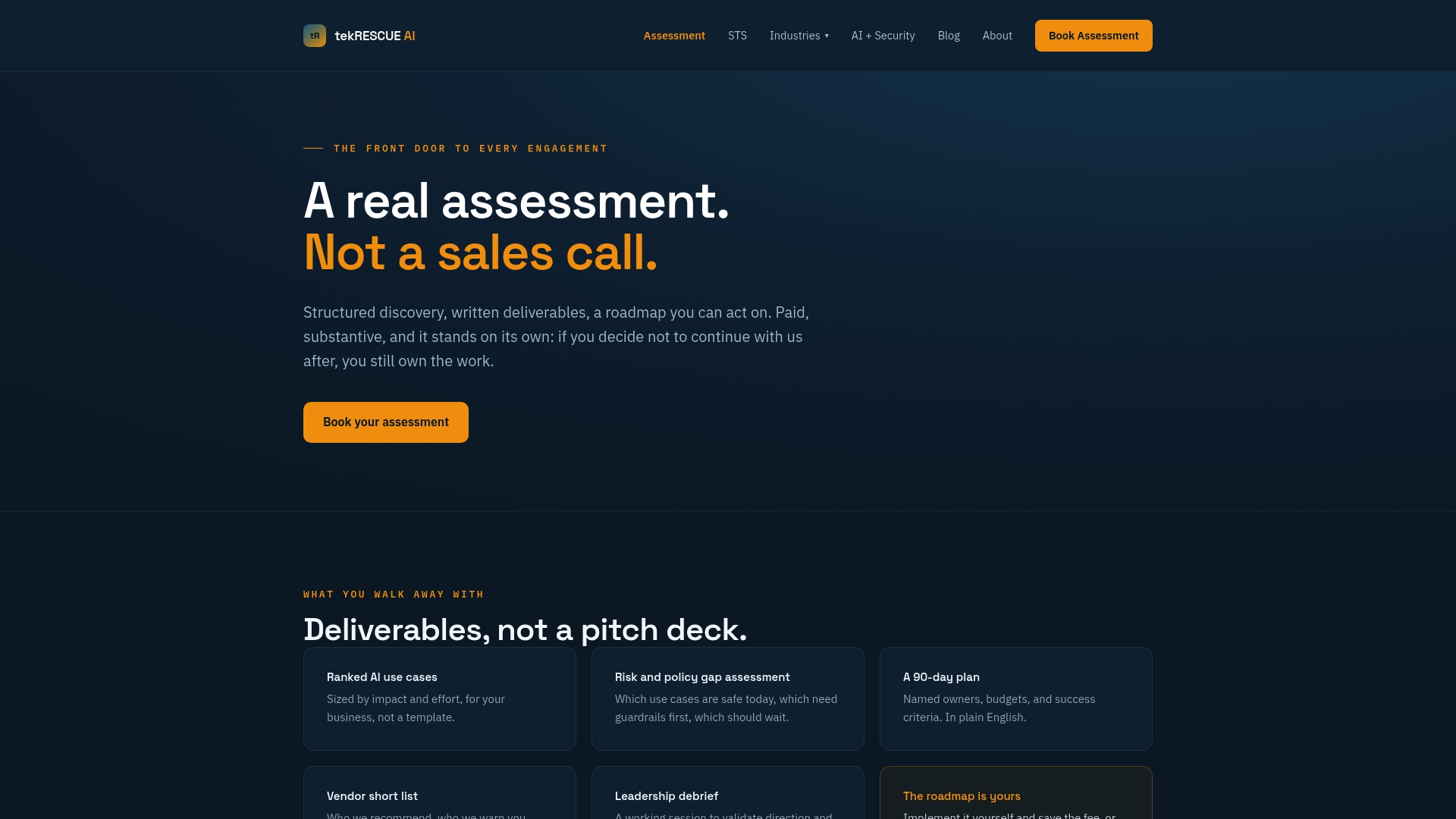
The assessment walks through where AI can create real efficiency in your operations and, just as importantly, where it introduces exposure your current security posture doesn’t cover, whether that’s data handling, model access, or deployment architecture. For organizations weighing data residency and storage decisions alongside model security, Nausika’s writing on where data actually lives is worth a read alongside your own assessment. If your team is ready to move from framework theory to a working roadmap, start with the AI Profit and Growth Assessment and get a plan built around your infrastructure, not a checklist built for someone else’s.