RAG makes LLMs genuinely useful, but it is not safe by default. Every retrieval step you add creates a new place for attackers to plant poisoned content, leak data across users, or hijack the model’s output. Fix three things first: retrieval-time access control, ingestion provenance, and treating every retrieved document as untrusted input. Map those priorities to the NIST AI RMF functions and you have the start of a real program.
TL;DR:
- Poisoned documents in the ingestion stage pose the greatest threat, especially when contributor accounts lack proper review or vetting processes.
- Retrieval authorization must be enforced before fetching candidates to prevent unauthorized context from being incorporated into the model’s input.
- Implementing retrieval-time access controls, provenance tagging, and continuous monitoring significantly reduces the risk of leakages and malicious manipulation.
- Architectures that prioritize authorization before retrieval eliminate the chance of structural leaks, unlike retrieve-then-filter approaches that expose sensitive data in over 86% of cases.
- External assessments and strict data governance practices are recommended for organizations deploying RAG systems with sensitive or regulated data.
Table of Contents
- Where RAG Security Risks Actually Live in the Pipeline
- The Top RAG Security Risks Ranked by Impact
- RAG Security Measures That Actually Reduce Risk
- Mapping RAG Security Controls to NIST AI RMF
- Architecture Patterns That Provably Reduce RAG Risk
- What to Log, Detect, and Test in Production
- Common RAG Security Mistakes We See in the Field
- Getting Outside Help With RAG Security Implementation
- Sources
Where RAG Security Risks Actually Live in the Pipeline
Retrieval-Augmented Generation strings together seven distinct stages, and each one is a place where things go wrong differently. Ingestion pulls documents into your system. Embedding generation turns those documents into vectors. The vector store holds them. Retrieval pulls candidates back out at query time. Prompt construction stitches retrieved text into the model’s context. Inference generates a response. Output handling decides what the user actually sees.
Most teams secure the model and call it done. That misses the point: the context window itself is a privileged channel. Anything that lands in it gets treated by the model with something close to the authority of a system instruction, whether it came from a vetted internal document or a poisoned PDF someone uploaded three weeks ago. Once retrieved text sits in that window, the model doesn’t reliably distinguish “trusted instruction” from “retrieved content that happens to look like an instruction.”
Persistence compounds the problem. Vector stores keep embeddings indefinitely, and if your architecture includes memory or session history, poisoned content or leaked context from one interaction can resurface in another. The OWASP RAG Security Cheat Sheet breaks controls out by exactly these pipeline stages, which is the right mental model for anyone building a threat model from scratch:
- Ingestion: who can add documents, and what gets checked before they’re indexed
- Embedding generation: what model produces the vectors and how it’s versioned
- Vector storage: isolation between tenants, namespaces, and access scopes
- Retrieval: whether authorization is checked before or after candidates are pulled
- Prompt construction: how retrieved text is delimited from instructions
- Inference: what the model does with untrusted content in context
- Output handling: whether responses are checked before reaching the user
The Top RAG Security Risks Ranked by Impact
Not every RAG vulnerability deserves equal attention. Here’s the order that actually matters when you’re deciding where to spend limited engineering time.
- Document and repository poisoning. A small number of poisoned documents can achieve outsized attack success against a large corpus, according to OWASP’s analysis of vector and embedding weaknesses. You don’t need to compromise your whole knowledge base. You need one contributor account with write access to a folder nobody reviews.
- Prompt injection via retrieved content. When multiple retrieved chunks get pooled into a single context window, one malicious chunk can carry instructions that override or redirect the model’s behavior. This is the single most cited risk in OWASP’s GenAI Top 10.
- Embedding manipulation and inversion. Attackers can craft inputs that land near sensitive vectors in embedding space, then use membership inference techniques to extract information about what’s stored, without ever querying the raw documents directly.
- Retrieval authorization failures, also called retrieve-then-filter. This is the architecture where the system fetches candidates first and checks permissions second. An empirical evaluation of this pattern found that retrieve-then-filter exposes unauthorized context in 86.1% of base queries. That’s not an edge case. That’s the default outcome of a common design pattern.
- Agentic and tool-integration blast radius. Once a RAG system feeds into an agent that can call tools, send emails, or write to a database, a poisoned retrieval doesn’t just produce a bad answer. It produces a bad action, and memory persistence means that action’s context can echo into later sessions.
It’s what happens under normal operation when authorization is bolted on after retrieval instead of built into it.
RAG Security Measures That Actually Reduce Risk
Here’s what to implement, roughly in the order it pays off.
- Enforce metadata-backed retrieval-time access control. Attach the requester’s identity and permission scope to every query before it touches the vector store, not after results come back.
- Clean up ingestion. Sanitize incoming documents, vet contributor access, and restrict which endpoints can write to your index. Tag every chunk with its source and ingestion timestamp so provenance survives downstream.
- Adopt SBOM and ML-BOM practices. Treat models, embeddings, and inference artifacts like chat templates, tokenizer configs, and adapters as code: sign them, verify them, and inventory them the same way you’d inventory a software dependency, a practice OWASP explicitly recommends.
- Add embedding-side defenses. Cross-encoder re-ranking and outlier detection on retrieved chunks catch content that’s semantically odd relative to the rest of the corpus, a combination Safeguard flags as effective but still maturing.
- Separate retrieval-only assistants from action-taking agents. If a system can both read your knowledge base and take real-world actions, require an explicit confirmation step between the two. Don’t let one compromised retrieval trigger an unsupervised action.
- Run runtime output defenses. Response classifiers, citation verification against the actual retrieved chunk IDs, and output sanitization catch what slipped past earlier controls before it reaches a user.
Pro Tip: Provenance tagging isn’t just a compliance checkbox. Recording which chunk IDs got retrieved for every query is what lets your team reconstruct exactly what happened during an incident, instead of guessing.
The highest-leverage fixes tend to be the least glamorous ones. Practitioner incident reviews consistently point to ingestion hygiene and retrieval-time metadata filters as the controls that prevent the most real-world damage, not exotic embedding-space defenses.
Mapping RAG Security Controls to NIST AI RMF
Technical controls only stick if they produce artifacts someone can audit later. The NIST AI RMF Playbook organizes this work into four functions, and RAG systems map onto them cleanly.
| RMF Function | RAG-specific artifact |
|---|---|
| Govern | Vendor risk assessments for embedding and vector-store providers, ingestion access policy |
| Map | Retrieval risk register documenting where poisoning or leakage could occur per data source |
| Measure | Document-chunk risk scoring, retrieval logging, red-team test results |
| Manage | Incident playbooks, rollout plans, metadata freshness review cadence |
A few of these deserve more than a table cell. Measurement works best when it’s continuous, not a one-time audit. Some engineering teams score retrieved chunks on a risk scale and use that score to trigger automated circuit breakers, such as routing to human review or falling back to a safer canned answer, an approach documented in enterprise RAG pattern implementations.
Governance means treating your embedding model provider and vector database vendor as part of your third-party risk management scope, the same way you’d assess any other data processor. And management isn’t a static document. It’s a red-team cadence, plus a process for catching when access tags on old documents have gone stale because someone changed roles six months ago and nobody updated the index.
Architecture Patterns That Provably Reduce RAG Risk
Some defenses just make attacks harder. Others make certain classes of attack structurally impossible, and that distinction matters when you’re deciding where to invest engineering time.
- Authorization-First Retrieval (AFR) flips the retrieve-then-filter order: authorization constrains the candidate set before any model or ranking component ever sees the content. In tested configurations, AFR achieved zero structural leaks, compared to the 86.1% exposure rate under the naive approach. It also composes across multi-agent chains, meaning the guarantee holds even when one agent’s output feeds another agent’s retrieval, though it does not replace the need for output monitoring or shared-state isolation.
- PEP/PDP separation (Policy Enforcement Point and Policy Decision Point) lets your orchestrator resolve access policy at runtime rather than baking stale permissions into the index.
- Tenant isolation via namespacing in the vector store prevents one customer’s embeddings from ever entering another customer’s candidate set, which matters enormously for multi-tenant SaaS deployments.
- Signed artifacts for both the model and the data pipeline give you a verifiable chain of custody when something goes wrong.
The trade-off is real: runtime policy resolution costs latency, and metadata tags that looked fine at launch tend to go stale as roles and permissions change. Static tags are fragile under normal operational drift in ways that runtime checks are not.
What to Log, Detect, and Test in Production
A RAG system without retrieval logging is a RAG system you can’t investigate after something goes wrong.
- Log every retrieval event, including chunk IDs, user identity, the query itself, the top-k results returned, and a timestamp. This is what makes post-incident forensics and citation verification possible at all.
- Run response classifiers before rendering output, checking that claims in the generated answer actually trace back to retrieved chunk IDs rather than model invention.
- Red-team regularly, testing for poisoning susceptibility, negation exploits, and embedding-space attacks. Experiments on retrieve-then-filter systems show leakage rates vary significantly by model, and behavioral defenses alone fail at meaningful rates, which is the core argument for architectural fixes over prompt-level patches.
- Version your data and keep a rollback path. Tools like DVC for data versioning, combined with a quarantine process for chunks flagged as suspicious, let you pull a poisoned document out of the index without rebuilding the whole corpus.
Runtime observability isn’t a one-time setup either. Continuous monitoring practices, including the kind used to catch certificate and infrastructure drift before it becomes an incident, apply the same underlying logic to RAG telemetry: things silently go stale, and only continuous checks catch it in time.
Common RAG Security Mistakes We See in the Field
The pattern shows up over and over: teams instrument monitoring only after an incident, not before one. Retrieval logging gets bolted on retroactively, right when it would have been most useful proactively.
The second mistake is trusting static metadata tags as a permanent access control layer. Roles change, projects get reorganized, and nobody goes back to re-tag six months of ingested documents. That staleness is exactly what turns a reasonable-looking access policy into a leak.

The third, and most consequential, is merging a retrieval-only assistant with an action-taking agent without a confirmation gate in between. Once retrieval and action share the same trust boundary, one poisoned document doesn’t just produce a wrong answer. It produces a wrong action.
Our advice for rollout: pilot with your highest-risk corpus first, instrument retrieval logs before you touch authorization architecture, and only then start hardening ingestion. Security teams that try to fix everything simultaneously tend to fix nothing well.
— Randy Bryan
Getting Outside Help With RAG Security Implementation
Building out retrieval-time access control, SBOM and ML-BOM processes, and a red-team cadence is a real engineering lift, and most internal teams are already stretched thin on core product work. That’s especially true if your RAG system touches regulated data or your team has never run an AI-specific risk assessment before.
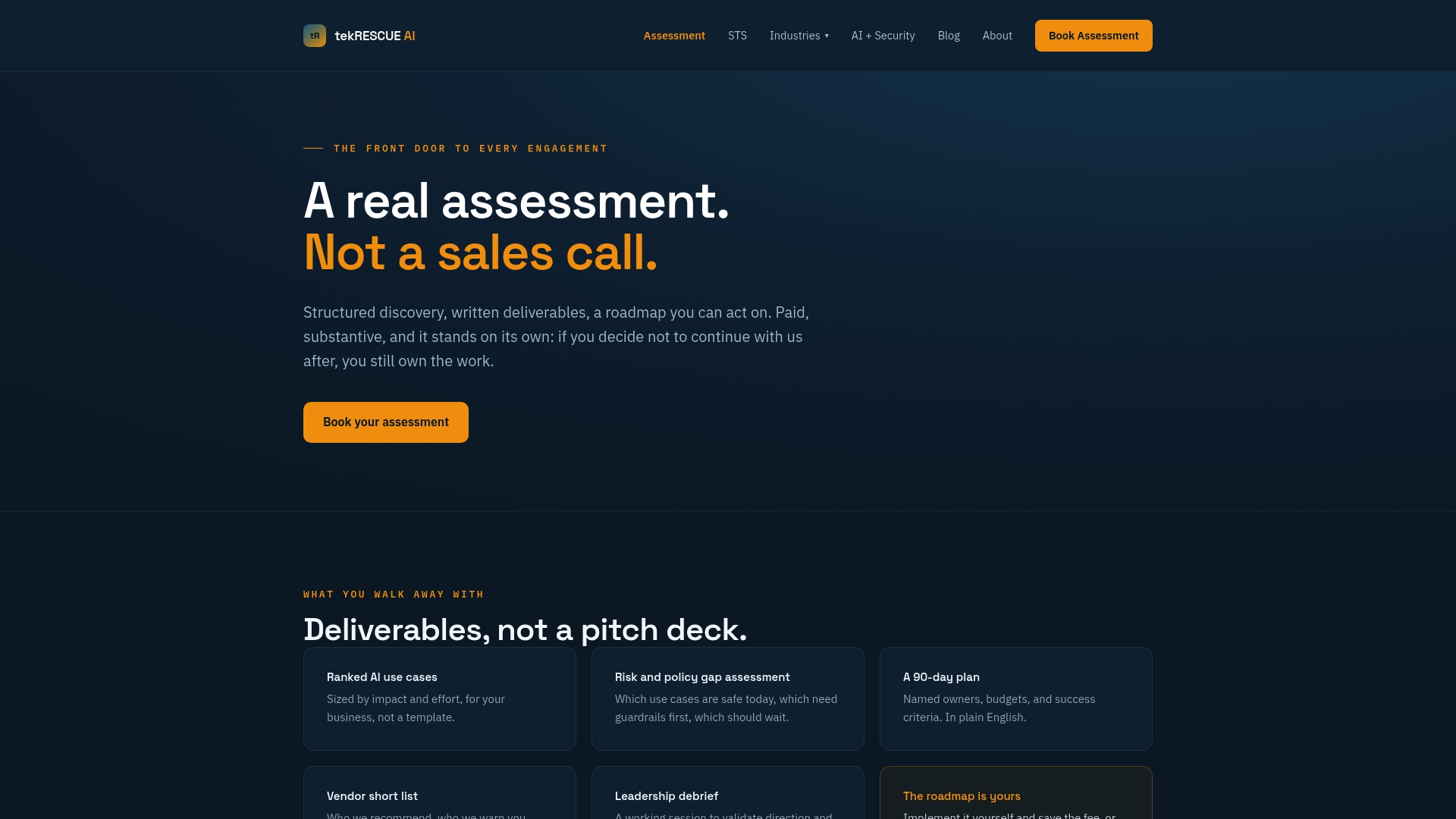
tekRESCUE AI’s AI Profit and Growth Assessment gives you a prioritized remediation roadmap built specifically around your pipeline, not a generic checklist. That includes a data and model inventory suitable for SBOM and ML-BOM creation, a red-team runbook scoped to your actual retrieval architecture, and a governance map tied to NIST AI RMF functions your compliance team can actually present internally. If your organization is deploying RAG against sensitive or regulated data and doesn’t have deep in-house RAG security expertise yet, an assessment can help close that gap. Reach out to schedule an assessment and get a roadmap built around your actual risk profile, not a generic template.