Professional services AI is no longer a question of whether to adopt it. Adoption has nearly doubled to roughly 40% of firms in 2026, yet about 61% of those firms abandoned at least one AI initiative. The technology works. What separates the winners is deployment: readiness, governance, and a prioritized workflow redesign that turns a pilot into a durable capability.
TL;DR:
- Only 40% of firms will adopt AI organization-wide by 2026, but most will struggle with change management, skills gaps, and operational readiness.
- The most valuable workflows for AI share high volume, repeatability, and quick reviewability, especially in legal, accounting, and consulting sectors.
- Deployment failures mainly stem from poor leadership buy-in, data mismatches, and unmanaged risks rather than model performance issues.
- Turning pilots into scalable solutions requires thorough readiness diagnostics, workflow redesign, vendor controls, and executive involvement before scaling.
- Most firms cannot demonstrate clear ROI from AI, but tracking cycle time, error rates, revenue per FTE, and client satisfaction can justify ongoing investments.
Table of Contents
- Executive Summary: Three Takeaways For Boards And Partners
- What Do 2026 Adoption Numbers Actually Show?
- Where Does AI For Professional Services Deliver Real Value?
- Why Do Most AI Projects In Professional Services Fail?
- How Do You Turn AI Pilots Into Production?
- How Do You Measure ROI On Professional Services AI?
- What I’ve Learned Watching Firms Deploy AI
- How tekRESCUE AI Helps You Close The Deployment Gap
- Sources
Executive Summary: Three Takeaways For Boards And Partners
If you brief your partnership on one page, make it this one.
- Adoption is broad, but measurable impact still lags. Most firms have AI running somewhere, but few can point to a P&L line it moved.
- Clients now expect cost and quality gains from AI capability, and they notice when a firm can’t deliver on that expectation.
- The fix starts with fundamentals: clean data, real governance, integrated security, and measurement built into the workflow from day one.
Firms that treat AI as a single redesigned workflow, measured step by step, tend to convert pilots into production faster than firms chasing a platform-wide rollout.
What Do 2026 Adoption Numbers Actually Show?
The headline number is adoption near 40% organization-wide, with agentic AI, systems that plan and execute multi-step tasks with limited human prompting, now running in an estimated 15% of elite firms. That’s a meaningful jump from a year earlier, and it signals that AI has moved past the experimentation phase for a large share of the market.
The adoption to value gap: Roughly 61% of firms have abandoned at least one AI initiative, most often citing change management failures and skills gaps rather than the technology itself.
The client side of the ledger tells a sharper story. 78% of corporate clients now name AI capability a critical procurement criterion, and 32% report reconsidering their provider relationships because AI integration fell short. Clients are asking for lower costs and better quality. Many firms simply aren’t delivering either yet, and that gap is starting to show up in retention conversations, not just satisfaction surveys.
Where Does AI For Professional Services Deliver Real Value?
Not every workflow deserves an AI pilot. The ones that pay off share three traits: high volume, repeatable structure, and outputs a human can verify quickly rather than rebuild from scratch.
By practice area, the clearest wins so far include:
- Legal operations: contract review and clause extraction, plus first-pass document summarization ahead of attorney review.
- Accounting firms: automated data extraction from invoices and statements, paired with reconciliation checks that used to eat junior staff hours.
- Consulting engagements: rapid scenario modeling across multiple assumptions, and first-draft report generation that a senior consultant edits rather than writes from scratch.
Before greenlighting a candidate workflow, check it against volume (does it happen often enough to matter), repeatability (does the process follow a consistent pattern), and reviewability (can a qualified person verify the output in minutes, not hours). Workflows that fail all three tend to become the abandoned pilots in next year’s survey data.
Why Do Most AI Projects In Professional Services Fail?
Deployment failures rarely trace back to the model. They trace back to how the organization prepared for it, or didn’t. Practitioner analysis of law firm deployments makes the same point across professional services broadly: the tools generally work, and the gap is operational.
- Leadership readiness gaps. When partners delegate AI entirely to IT or a junior task force, change management stalls and adoption never reaches the people doing the billable work.
- Data and workflow mismatches. A pilot built on clean sample data often breaks against messy production files, inconsistent naming conventions, or systems that were never designed to talk to each other.
- Unmanaged professional liability risk. Hallucinations, confidentiality breaches, supervision breakdowns, and weak audit trails are the specific exposures insurers and regulators are watching, and each requires its own control, not a general “be careful” policy.
Skip the diagnosis step and you inherit all three at once.
How Do You Turn AI Pilots Into Production?
Here’s the sequence that separates firms that scale from firms that keep restarting pilots every quarter.
- Run a readiness diagnostic first. Assess data quality, security posture, existing governance, and baseline KPIs before you touch a workflow. You can’t measure improvement against a baseline you never captured.
- Redesign one high-value workflow end to end. Pick a single process, map every step, decide exactly where AI acts and where a human must sign off, and build that sign-off into the process rather than treating it as an afterthought.
- Lock in vendor controls and audit trails. Require documented prompt governance, logging of inputs and outputs, and contractual data handling terms with every AI vendor you use. Integrated risk management practices treat encryption, least-privilege access, and vendor accountability as one package, not separate checkboxes.
- Train leadership before practitioners. Firms where partners personally use the redesigned workflow see faster staff adoption than firms that mandate use from the top without modeling it themselves.
- Set a 6 to 12 month scaling roadmap. Define the metrics that trigger expansion to a second workflow, and refuse to scale further until the first one hits them.
Pro Tip: Instrument your KPIs at the step level, not just the outcome level. A workflow that saves four hours overall but adds friction at the client handoff step will still generate complaints, even though the topline number looks great.
Cybersecurity and AI governance aren’t separate workstreams here. A structured assessment approach that maps readiness, redesigns one workflow, and builds in logging and vendor controls from the start tends to produce a deployment that survives contact with real client work.

How Do You Measure ROI On Professional Services AI?
Only about 18% of firms systematically track AI ROI, which means most partnerships are running on anecdote instead of a dashboard. Close that gap with a short, specific set of KPIs rather than a vague mandate to “measure impact.”
- Cycle time reduction on the specific redesigned workflow, not firm-wide averages.
- Error rate before and after AI involvement, checked against the same review standard.
- Revenue per FTE, tracked quarterly against the baseline you captured in the readiness diagnostic.
- Client satisfaction tied specifically to AI-touched deliverables.
- Realized cost savings, reported in dollars, not percentage estimates.
On the commercial side, firms are starting to test savings splits with clients, outcome-based fees tied to measured turnaround improvements, and capped retainers that adjust once AI-driven efficiency is documented. Practical guidance on connecting AI use to ROI reinforces the same principle: firms that can’t demonstrate a number in front of the client lose pricing leverage, not just goodwill.
What I’ve Learned Watching Firms Deploy AI
Every failed AI rollout I’ve studied has the same fingerprint: a partner who approved the budget but never touched the tool. The firms that actually convert pilots into production have a senior person using the workflow personally, not just sponsoring it from a slide deck.

The blind spots repeat too. Firms skip the readiness diagnostic because it feels slow. They accept a vendor’s default security terms because reading the contract feels like someone else’s job. They measure “did people use it” instead of “did the error rate drop.” None of that is a technology problem.
If you remember one checklist from this piece, make it this: run the diagnostic, pick one workflow, mandate human sign offs, and instrument the KPIs before you tell the board it worked.
— Randy Bryan
How tekRESCUE AI Helps You Close The Deployment Gap
You don’t need another AI pilot. You need a map of exactly where AI creates efficiency in your firm and exactly where it creates exposure, and most firms are trying to build that map without security expertise at the table.
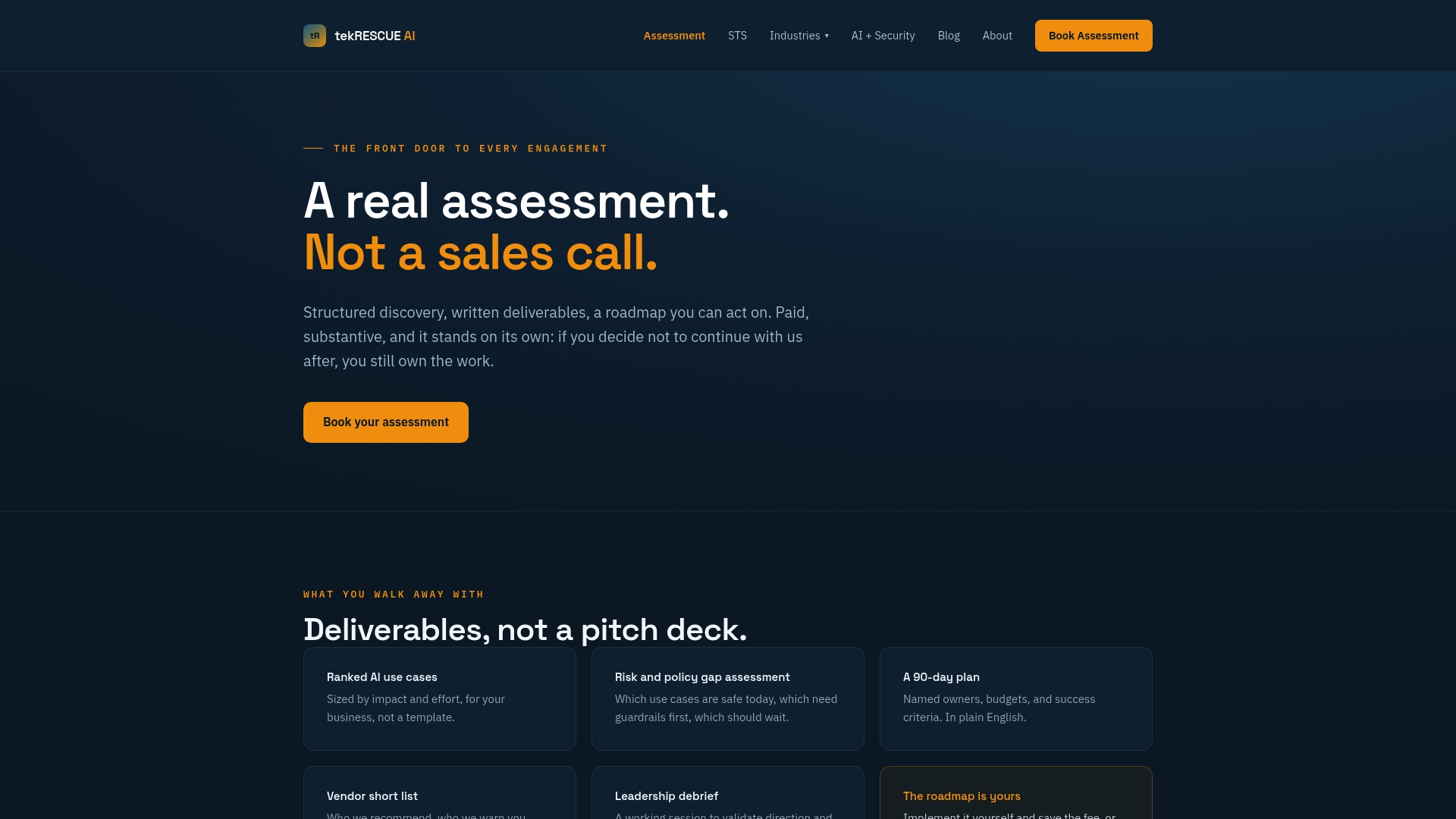
The AI Profit and Growth Assessment gives you a readiness map, a prioritized workflow roadmap, and a deployment plan with cybersecurity built in from the start, not bolted on after something goes wrong. Where most AI consultants hand you a strategy deck and disappear, tekRESCUE AI stays through the roadmap, the managed security layer, and the team training that makes the redesigned workflow stick. A typical engagement moves from assessment to a prioritized roadmap to ongoing managed AI security and leadership training, all scoped to your firm’s actual data and risk posture rather than a generic template. If your firm is ready to stop running AI pilots and start running one workflow that actually moves the numbers, request an AI Profit and Growth Assessment and get the readiness map before your next budget cycle.
Sources
- 2026 AI in Professional Services Report, Thomson Reuters Institute
- Highlights from the 2026 AI in Professional Services report, Thomson Reuters Legal blog
- Why professional services firms abandon AI initiatives, The National Law Review
- Law
- What are the biggest AI risks facing professional services firms?, Howden Group