Privacy-preserving AI relies on a small set of complementary techniques, differential privacy, federated learning, and privacy-enhancing cryptography, combined in hybrid stacks to protect individuals while keeping models useful. None of these techniques works alone at production scale. The real engineering question is always the same: how much privacy loss, latency, and compute cost can your use case absorb before the model stops being worth deploying?
TL;DR:
- Differential privacy remains the practical baseline for most deployments but must be carefully calibrated, especially when stacking multiple privacy techniques, to avoid utility loss.
- Federated learning works well for horizontally partitioned data but faces challenges with record alignment and communication overhead in vertical federation or large models.
- Cryptographic methods like homomorphic encryption and secure multi-party computation provide stronger guarantees but currently incur significant compute and latency costs.
- Hybrid privacy stacks combining techniques such as DP with secure aggregation or HE with ZKP are common but require careful planning to manage compounded utility degradation and cross-layer leaks.
- Lifecycle-aware privacy practices, including continuous monitoring, testing for attacks, and using validated libraries, are essential to prevent silent failures and maintain effective privacy protections.
Table of Contents
- What Counts as Privacy-Preserving AI?
- Differential Privacy: The Formalism, the Variants, and the Traps
- Federated Learning: Architectures and Partitioning Problems
- Homomorphic Encryption, SMPC, and Zero-Knowledge Proofs for ML
- Building Hybrid Stacks That Actually Work
- The Attacks Privacy-Preserving AI Is Actually Defending Against
- Measuring Privacy-Utility Tradeoffs Without Fooling Yourself
- Lifecycle-Aware Protection: From Collection to Post-Deployment
- Matching Techniques to Real-World Domains
- What Still Doesn’t Work Well Enough
- What Actually Matters When You Build This
- How tekRESCUE AI Helps You Operationalize This
- Sources
- FAQ
What Counts as Privacy-Preserving AI?
Privacy-preserving AI is not one tool. It is a taxonomy of techniques, each solving a different piece of the exposure problem, and each with its own attacker model. Some protect data at rest, some protect it during computation, and some protect only the final model’s outputs. Mixing them up is how teams end up with a false sense of security.
The core families you need to know:
- Differential privacy (DP): adds calibrated noise to data, gradients, or outputs so no single record can be reverse-engineered from results.
- Federated learning (FL): keeps raw data on local devices or servers and only shares model updates, reducing central data pooling.
- Homomorphic encryption (HE): allows computation directly on encrypted data, so a service provider never sees plaintext inputs.
- Secure multi-party computation (SMPC): splits a computation across parties so no single party sees the full input set.
- Zero-knowledge proofs (ZKP): let one party prove a computation was done correctly without revealing the underlying data.
- Synthetic data generation: creates artificial datasets that mimic statistical properties of real data without exposing real records.
- Anonymization and pseudonymization: strip or mask direct identifiers, useful as a first layer but weak against modern re-identification attacks on their own.
Threat models matter as much as the technique. An “honest but curious” cloud provider, a malicious insider with query access, or an external adversary probing a public API each require different defenses. A model served through an API faces extraction and inference attacks; a model trained across hospitals faces gradient leakage and membership inference during training itself.
Recent systematic surveys conclude that DP remains the practical baseline for most deployments, while cryptographic approaches deliver stronger theoretical guarantees at substantially higher cost. That single sentence explains most of the architecture decisions covered below: teams reach for DP first, then layer on cryptography only where the threat model or regulation demands it.
Differential Privacy: The Formalism, the Variants, and the Traps
Differential privacy quantifies privacy loss instead of promising anonymity. The parameter epsilon (ε) caps how much any single record can change a query’s output distribution: lower ε means stronger privacy and noisier results, higher ε means better utility and weaker guarantees. There is no universally “correct” ε. A hospital running internal research might tolerate ε values of 1 to 3; a public-facing statistical release often targets far tighter budgets.
Two variants matter in practice. Rényi differential privacy (RDP) tracks privacy loss across repeated queries more tightly than the original definition, which matters because DP-SGD (differentially private stochastic gradient descent) touches the data thousands of times during training. Gaussian differential privacy (GDP) offers a cleaner composition story for teams stacking multiple DP mechanisms in one pipeline. Composition is the trap most teams miss: every additional query or training step spends more of the privacy budget, and budgets that look generous at step one can be exhausted by step one thousand.
Three practical applications show up repeatedly:
- DP-SGD adds noise to gradients during training, protecting the model from memorizing individual training examples.
- Output privacy adds noise only to final query results or predictions, leaving training data less protected but reducing utility loss.
- DP synthetic data generates artificial records with a formal privacy guarantee baked into the generation process, useful when the goal is sharing a dataset rather than a model.
Statistic Callout: NIST’s guidance on evaluating differential privacy treats DP as a measurable privacy-loss accounting framework, not a binary anonymity guarantee, and explicitly catalogs implementation hazards that undermine the math when parameters are chosen carelessly.
Implementing DP correctly is closer to implementing cryptography than to writing standard statistics code. NIST’s own hazard analysis warns that subtle errors in randomness generation, sampling procedures, or budget composition can silently invalidate the guarantee while the system keeps running normally. That is the dangerous part: a broken DP implementation rarely crashes. It just quietly stops protecting anyone.
Pro Tip: Never hand-roll your own DP noise mechanism. Use audited libraries like OpenDP, Google’s DP library, or Opacus for PyTorch, and treat a custom implementation the way you’d treat a homemade encryption algorithm: a liability until independently reviewed.
Federated Learning: Architectures and Partitioning Problems
Federated learning keeps raw data distributed and shares only model updates, but “keeps data distributed” is doing a lot of hidden work depending on how that data is partitioned. Horizontal federation, where every participant holds the same features for different individuals (think hospitals holding similar patient records for different patients), is the easier case. Each client can add DP noise to its local update before sending it, and the math composes cleanly at the aggregation server.
Vertical federation is harder. Here, participants hold different features for overlapping individuals, a bank and a retailer looking at the same customers through different data columns. NIST’s guidance on federated learning points out that vertical partitioning complicates noise addition until after entity alignment, since you need to match records across parties before any per-record noise makes sense. That alignment step itself becomes an attack surface if not handled through secure protocols.
Design patterns that matter in production:
- Secure aggregation: cryptographic protocols ensure the central server only ever sees the sum of client updates, never any individual client’s contribution.
- Client-side DP: each participant adds noise locally before transmission, protecting against a malicious or compromised server.
- Coordination overhead: FL requires reliable communication rounds across potentially unreliable clients (mobile devices, edge servers), and stragglers or dropouts can bias the aggregated model.
Federated learning shines for horizontally partitioned consumer data, keyboard prediction, mobile health tracking, and similar cases where millions of clients each hold a thin slice of similar data. It struggles with very large models: transmitting billion-parameter gradient updates over unreliable networks is a communication bottleneck long before it’s a privacy problem. Vertical federation in finance or healthcare, where a handful of institutions collaborate on richer, deeper feature sets, usually needs cryptographic reinforcement rather than FL alone.
Homomorphic Encryption, SMPC, and Zero-Knowledge Proofs for ML
Cryptographic privacy-enhancing techniques (PECs) trade compute cost for mathematical certainty. Where DP says “we’ve bounded the risk,” HE, SMPC, and ZKP say “the adversary literally cannot see the input,” assuming the cryptography holds.
Homomorphic encryption, particularly the CKKS scheme used for approximate arithmetic, lets a model run inference directly on encrypted inputs and return an encrypted result that only the data owner can decrypt. This matters for a hospital sending patient data to a cloud model provider it doesn’t fully trust: the provider never sees plaintext, ever. The cost is real. CKKS-based encrypted inference commonly runs orders of magnitude slower than plaintext inference, and model architectures often need to be restructured to avoid operations (like arbitrary comparisons or nonlinear activations) that don’t translate cleanly into encrypted arithmetic.
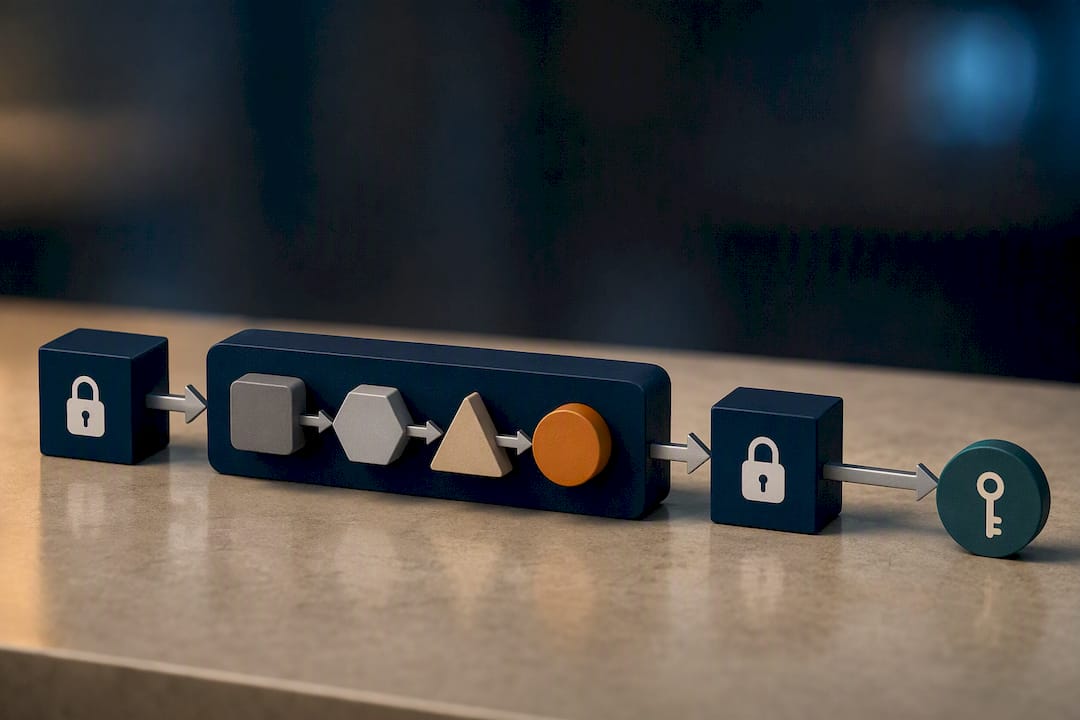
Secure multi-party computation splits a joint computation across multiple parties so no single party ever reconstructs the full input. It’s a strong fit for collaborative training across competitors, banks jointly training a fraud model without revealing customer lists to each other. The tradeoff shifts from compute to communication: SMPC protocols often require multiple rounds of message-passing between parties, so network latency and bandwidth become the bottleneck rather than raw processing power.
Zero-knowledge proofs solve a different problem entirely: not hiding data, but proving a computation happened correctly without revealing the inputs used. A model provider can prove “this prediction came from the certified model, run correctly, on your encrypted input” without exposing the model weights or your data. NIST’s Privacy-Enhancing Cryptography project identifies ZKP and fully homomorphic encryption as critical enablers specifically for situations where mutually distrustful parties need to compute together without revealing private inputs, regulatory audits, multi-bank consortiums, and cross-border data-sharing agreements among them.
Statistic Callout: NIST’s PEC guidance frames the engineering cost of ZKP and FHE, not the cryptographic theory, as the main barrier to adoption in high-assurance workflows that require mutual distrust and verifiability.
Quick reference for where each technique earns its cost:
- HE: encrypted inference where a single model owner serves untrusted or semi-trusted clients.
- SMPC: joint computation across multiple mutually distrustful organizations, no single trusted aggregator.
- ZKP: auditability and correctness proofs, pairs naturally with DP or HE to prove noise was added correctly or encryption was applied as claimed.
Building Hybrid Stacks That Actually Work
Nobody ships pure differential privacy or pure homomorphic encryption at scale for a complex production system. Real deployments combine techniques, and the combination is where most of the engineering difficulty actually lives. Recent literature describes a clear shift from isolated defenses toward these composable, lifecycle-aware hybrid designs.
Three patterns recur across production systems:
- DP plus secure aggregation: federated clients add local DP noise, then a secure aggregation protocol ensures the server can’t isolate any single client’s contribution even before the noise is considered.
- HE for inference, DP for training: a model trained with DP-SGD on internal infrastructure is later served through an encrypted inference endpoint for external or less-trusted clients.
- ZKP-audited aggregation: an SMPC or federated aggregation step is paired with a zero-knowledge proof that the aggregation followed the agreed protocol, useful for regulatory audits where a third party needs proof, not just a promise.
Composability is not free, and this is the part most architecture diagrams gloss over. Stacking DP noise on top of an already-lossy HE approximation can compound utility loss in ways that are hard to predict analytically. Noise amplification across layers, where each privacy mechanism independently degrades signal, means a system that looks fine on paper can fail utility benchmarks once every layer is turned on simultaneously. Cross-layer leakage is the other risk: a side channel in the HE implementation or a timing signal in the SMPC protocol can leak information that none of the individual techniques’ formal guarantees account for.
Choosing a stack starts with the threat model, not the technique. If your main risk is a curious internal analyst, DP alone with strict access controls is often enough. If your risk is a hostile external party with API access, you need DP plus rate limiting and monitoring. If your risk is a consortium of mutually distrustful organizations, you’re looking at SMPC or HE with ZKP-backed audits, and you should budget accordingly for both compute and engineering time.
The Attacks Privacy-Preserving AI Is Actually Defending Against
Every privacy-preserving technique exists because a specific attack works against undefended models. Understanding the attack families clarifies which defense actually matters for your system.
- Membership inference: an attacker determines whether a specific record was in the training set, dangerous for anything involving sensitive group membership (medical conditions, financial status).
- Model inversion: an attacker reconstructs approximate training inputs from model outputs or gradients, most damaging against models trained on images or biometric data.
- Gradient leakage: in federated or distributed training, raw or lightly protected gradients can be inverted to recover close approximations of the original training batch.
- Model extraction: an attacker queries a deployed model repeatedly to reconstruct a functionally equivalent copy, stealing intellectual property and creating a surrogate for further attacks.
- Property inference: an attacker infers aggregate statistical properties of the training set (like the proportion of a demographic group) without identifying specific individuals.
- Side-channel attacks: timing, memory access patterns, or power consumption during inference leak information the model’s formal privacy guarantees never accounted for.
Statistic Callout: Survey literature on privacy attacks against deep learning finds that noise-based defenses like DP provide only partial protection against this full attack taxonomy, and that many production systems remain under-benchmarked against side-channel threats specifically.
Large language models complicate this picture further. Memorization in LLMs means training-data extraction attacks can recover verbatim text sequences, not just statistical inferences, an escalation from earlier attack research on smaller classification models. Multimodal systems widen the attack surface again, since gradient leakage and inversion research has historically focused on single-modality image or text data.
Defense mapping isn’t one-to-one. DP-SGD meaningfully reduces membership inference and model inversion risk by bounding how much any single record influences the model. Secure aggregation directly blocks gradient leakage by preventing the server from ever seeing an individual client’s raw update. Rate limiting and query monitoring are your primary defense against model extraction, since it’s a behavioral attack pattern, not a data exposure. No single technique closes every gap, which is precisely the argument for hybrid, lifecycle-aware stacks over any one silver-bullet method.
Measuring Privacy-Utility Tradeoffs Without Fooling Yourself
Epsilon is a budget, not a badge. A reported ε of 1.0 means nothing on its own without knowing the composition method, the number of queries or training steps, and whether amplification techniques (like subsampling) were applied to tighten the effective bound. Two systems both claiming “ε = 2” can have meaningfully different real-world privacy depending on how that budget was spent and tracked over the system’s lifetime.
Utility measurement has the same trap in reverse. Reporting a single accuracy number for a DP or HE-protected model tells you almost nothing about deployability. Research on utility tradeoffs in privacy-preserving machine learning argues that accuracy alone hides the real costs: latency under encryption, fairness shifts across demographic subgroups when noise is added unevenly, robustness to distribution shift, and the operational cost of running encrypted or federated infrastructure at scale.
Practical benchmarking guidance for teams evaluating these systems:
- Report ε alongside the composition method used (basic composition, RDP, or GDP accounting), never ε in isolation.
- Measure utility across subgroups, not just in aggregate, since DP noise and HE approximation errors don’t always distribute evenly across a population.
- Track latency and throughput under realistic production load, not isolated benchmark conditions, especially for HE and SMPC systems where communication overhead scales with the number of parties.
- Re-run benchmarks after any pipeline change. A privacy budget or noise calibration tuned for one model version can silently degrade after a retraining cycle or architecture change.
The most common experimental pitfall is treating a privacy-utility tradeoff curve as static. It shifts every time you retrain, add a data source, or change your composition accounting method, which is exactly why lifecycle-aware measurement, not a one-time benchmark, is the emerging standard rather than the exception.
Lifecycle-Aware Protection: From Collection to Post-Deployment
Privacy protection that only covers training is protection that covers roughly a quarter of the actual risk surface. Survey conclusions on deep learning privacy attacks are explicit that threats occur across training, evaluation, deployment, and post-deployment monitoring, and that treating any single stage as “done” leaves the rest exposed.
- Secure collection and storage. Encrypt data at rest and in transit, enforce least-privilege access controls, and remember that a raw-data breach nullifies every downstream DP guarantee. No amount of noise added during training protects a dataset that leaked before training even started.
- Training-stage protections. Apply DP-SGD, federated aggregation, or cryptographic training as appropriate to the threat model, and log the privacy budget spend at every step for later auditing.
- Evaluation-stage checks. Test explicitly for membership inference and model inversion vulnerability before deployment, not just standard accuracy and fairness metrics.
- Deployment protections. Serve models behind encrypted inference endpoints where warranted, enforce access controls and rate limiting, and monitor query patterns for extraction attack signatures.
- Post-deployment auditing. Re-evaluate privacy budgets periodically, watch for data or concept drift that might change the effective privacy guarantee, and maintain an incident response playbook specifically for privacy failures, not just generic security breaches. A security monitoring practice built for production systems, rather than a one-time audit, is what actually catches this stage’s failures.
Pro Tip: Use validated libraries for every cryptographic or DP component, and resist the urge to optimize a custom implementation for your specific model architecture. The engineering hours saved by using a battle-tested library almost always outweigh the marginal performance gain of a bespoke build, and the failure mode for a broken custom implementation is silent, not loud.
Matching Techniques to Real-World Domains
Healthcare, finance, and edge computing each impose different constraints on which privacy-preserving technique is actually deployable, not just theoretically sound.
- Healthcare: federated learning combined with DP is common across hospital consortiums where data can’t leave institutional walls for regulatory reasons; HE-based solutions fit narrower cases like a single provider running encrypted inference against an external diagnostic model. HIPAA-aware design means treating de-identification as a floor, not a ceiling, since re-identification attacks against “anonymized” health data are well documented.
- Finance: MPC and HE are genuinely practical here because the counterparties, banks, insurers, payment processors, are known institutions with the budget and compliance mandate to absorb cryptographic overhead for joint fraud detection or risk scoring.
- Edge and IoT: compute and battery constraints rule out HE and SMPC in most cases. Lightweight DP applied at the device level, or simple federated aggregation with client-side noise, is usually the realistic ceiling.
- Research versus production readiness: if a technique’s published benchmarks only cover small models or synthetic datasets, treat it as research-stage. Production readiness signals include published latency numbers under realistic load and evidence of testing against the attack families covered above, not just theoretical guarantees.
Domain constraints and platform maturity vary enough that it’s worth reviewing use cases across industries and roles before committing to a specific technical stack for your own deployment.
What Still Doesn’t Work Well Enough
Several gaps in privacy-preserving AI remain genuinely unsolved, not just underfunded. LLM and multimodal leakage research is still catching up to how fast these systems are being deployed; verbatim memorization extraction and cross-modal inversion attacks don’t yet have standardized benchmarks the way image classification privacy attacks do.
- Standardized benchmarks are missing for comparing hybrid stacks against each other on equal footing, which makes vendor and research claims hard to verify independently.
- Composable guarantees remain immature. Stacking DP, HE, and SMPC rarely comes with a clean mathematical proof of the combined guarantee, most teams estimate conservatively rather than calculate precisely.
- HE and SMPC efficiency still lags plaintext computation by large margins, and closing that gap is an active systems research area rather than a solved engineering problem.
- Reproducibility gaps persist across the field: privacy claims in papers often depend on implementation details that aren’t fully specified or open-sourced, making independent verification difficult.
Anyone designing experiments or writing papers in this space should treat these four gaps as the open frontier, not settled ground, and design benchmarks that at least attempt to address them.
What Actually Matters When You Build This
Most teams treat privacy-preserving AI as a compliance checkbox: pick a technique, hit a benchmark number, ship it. That gets the sequence backward. The lifecycle matters more than the technique. A well-implemented DP-SGD pipeline with strong post-deployment monitoring beats a theoretically superior HE stack that nobody audits after launch.
Treat DP like cryptography: budget conservatively, use validated libraries, and never trust a custom implementation you haven’t had independently reviewed. Operational readiness, monitoring, drift detection, and a real incident response plan for privacy failures, is where most production systems actually fail, not in the initial technique selection.
Randy Bryan has spent years watching organizations bolt AI onto existing infrastructure without asking what happens when the privacy guarantee quietly breaks. The technical rigor covered here only pays off when it’s paired with the operational discipline to keep checking it.
— Randy Bryan
How tekRESCUE AI Helps You Operationalize This
Picking the right technique from everything above is only half the job. The harder half is mapping which threats actually apply to your systems, your data flows, and your regulatory exposure, then building the monitoring discipline to catch failures after launch. That’s the gap tekRESCUE AI closes for organizations that don’t have a dedicated privacy engineering team on staff.

The AI Profit and Growth Assessment maps where AI can create real efficiencies in your organization while flagging the specific privacy and security vulnerabilities that come with each proposed use case, whether that’s a federated learning pilot, an encrypted inference endpoint, or a simpler internal model that still touches sensitive customer data. Instead of guessing which lifecycle stage needs attention, you get a tailored roadmap built on extensive IT and cybersecurity experience, integrated directly with your AI strategy rather than bolted on afterward. If you’re ready to see where your organization’s AI plans actually stand on privacy and security, book an AI Profit and Growth Assessment with tekRESCUE AI and get a clear picture before you scale anything further.
Sources
- Guidelines for Evaluating Differential Privacy Guarantees, NIST SP 800-226
- Privacy-preserving methodologies against privacy attacks on deep learning: a survey, Knowledge and Information Systems (2026)
- NIST Privacy-Enhancing Cryptography (PEC) project
- Protecting trained models: privacy-preserving federated learning, NIST blog
FAQ
How Do I Protect My Privacy From AI?
Limit what you share with AI tools, use services that publish clear data retention policies, and favor providers that apply differential privacy or encryption to how your data is processed rather than storing it in plaintext indefinitely.
Will ChatGPT Leak My Data?
Conversations with consumer AI chatbots can be used for model training or reviewed by staff unless you opt out or use an enterprise tier with stricter data handling, so avoid entering sensitive personal, financial, or health information into general-purpose chat tools.
What Is the 30% Rule in AI?
There’s no single, universally recognized “30% rule” in AI privacy or ethics; if you’ve seen it referenced, it’s likely a specific vendor’s internal guideline rather than an industry standard, so treat it cautiously and verify the source before citing it.
Which Jobs Are Least Likely to Be Replaced by AI?
Roles built on nuanced human judgment, hands-on physical work, or high-trust relationships (skilled trades, therapy and counseling, and complex negotiation or leadership roles) tend to be harder for current AI systems to fully automate, though most jobs are being reshaped rather than eliminated outright.
Is Differential Privacy Enough on Its Own?
Differential privacy is a strong practical baseline but provides only partial protection against the full range of attacks like model extraction and side-channel leakage, which is why surveys of the field increasingly recommend hybrid, lifecycle-aware stacks instead of relying on DP alone.
How Does tekRESCUE AI Approach AI Privacy Risk?
tekRESCUE AI’s AI Profit and Growth Assessment evaluates where a business’s AI plans create privacy or security exposure across the full deployment lifecycle, then builds a tailored roadmap that pairs AI adoption with the security controls needed to manage that risk.