ISO/IEC 42001 is the first international standard for an Artificial Intelligence Management System, and it certifies your organization’s AI governance framework, not any specific model. Published in December 2023, it gives businesses a structured, auditable way to manage AI risk, and certification against it is becoming a signal that procurement teams, regulators, and boards increasingly expect to see.
TL;DR:
- Organizations must document impact assessments that evaluate potential harm to individuals, groups, and society, beyond just business risks, to meet ISO 42001 requirements.
- Human oversight policies require documented trigger points, override authority, and audit trails to demonstrate operational oversight during certification audits.
- ISO 42001 builds on ISO 27001, reducing implementation effort for certified organizations by around 30 to 50 percent, but still requires new AI-specific policies and artifacts.
- Certification efforts typically take 3 to 9 months, with success dependent on existing risk documentation, AI system inventory, and involvement of cross-functional teams.
- Common pitfalls include incomplete AI inventories, weak justification for control exclusions, and oversight policies that are never actually triggered during operations.
Table of Contents
- What ISO 42001 Covers and Who Needs to Care
- Inside the Standard: Clauses, Structure, and Annex A Controls
- The Two Requirements That Trip Up Most Organizations
- How ISO 42001 Fits With ISO 27001, NIST AI RMF, and the EU AI Act
- The Business Case for Certification
- Your Implementation Roadmap: From Gap Analysis to Certification
- What Auditors Actually Look For, and What It Costs
- Where tekRESCUE Sees Organizations Go Wrong
- Where to Read the Standard and Go Deeper
- Sources
What ISO 42001 Covers and Who Needs to Care
An Artificial Intelligence Management System, or AIMS, is the organizational scaffolding around how you build, buy, or use AI: policies, risk assessments, accountability, and monitoring. ISO/IEC 42001:2023 sets requirements for establishing, running, and improving that system. It doesn’t grade your model’s accuracy. It grades whether your organization has real oversight of what that model does.
Three groups fall in scope, often without realizing it right away:
- AI providers who build or fine-tune models for internal use or resale.
- AI deployers who integrate someone else’s AI into a product, hiring process, or customer workflow.
- Suppliers in an AI supply chain who feed data, infrastructure, or components into someone else’s AI system.
Here’s the part that catches leaders off guard: using a third-party AI tool, like an off-the-shelf chatbot or a vendor’s scoring model, still puts you in scope as a deployer. You don’t need to write code to own the risk.
Enterprise buyers are already asking vendors for AI governance documentation during procurement, the same way they ask for SOC 2 reports or ISO 27001 certificates. That shift is what makes ISO 42001 commercially relevant well before any regulator requires it.
Inside the Standard: Clauses, Structure, and Annex A Controls
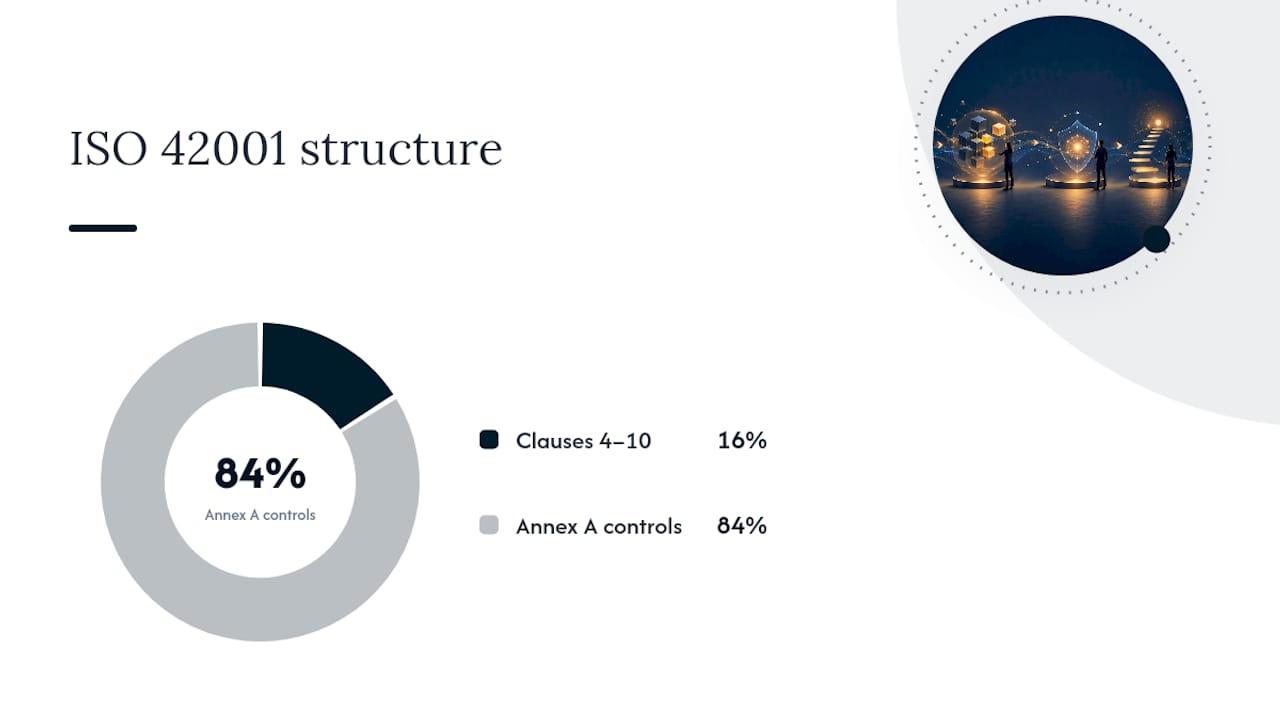
ISO 42001 follows Annex SL, the same high-level structure used by ISO 27001, ISO 9001, and other management system standards. That means it’s built on the Plan-Do-Check-Act cycle: you plan your governance approach, do the work, check it through audits, and act on what you find.
Clauses 4 through 10 lay out the requirements:
- Clause 4, context of the organization: who’s affected by your AI, internally and externally.
- Clause 5, leadership: policy ownership and accountability at the top.
- Clause 6, planning: risk assessment and objectives specific to AI.
- Clause 7, support: resources, competence, and awareness.
- Clause 8, operation: this is where the heavy lifting happens.
- Clause 9, performance evaluation: monitoring, internal audit, management review.
- Clause 10, improvement: corrective action when something goes wrong.
Clause 8 is the operational core. It requires AI system impact assessments before deployment, change control when a model or its training data shifts, and specific controls over third-party AI components you don’t fully control.
Annex A adds 38 AI-specific controls covering transparency, bias mitigation, explainability, lifecycle management, and human oversight. You don’t have to implement every one. Instead, you build a Statement of Applicability, or SoA, that documents which controls apply to your systems and justifies any exclusions.
According to ISO’s explanatory guidance, the SoA is the single document auditors scrutinize most closely, because a weak justification for excluding a control is one of the fastest ways to fail a certification audit.
The Two Requirements That Trip Up Most Organizations
Two obligations consistently surprise leadership teams who assume ISO 42001 is mostly paperwork: impact assessments and human oversight.
An AI system impact assessment can’t stop at business risk. It has to weigh harm to individuals (a rejected loan applicant, a flagged job candidate), harm to groups (disparate outcomes across demographics), and broader societal effects, like reinforcing bias at scale. A recruitment tool that screens resumes needs an assessment covering false rejections, not just processing speed.
Human oversight is where the gap between policy and practice shows up hardest. It’s not enough to write “a human reviews AI decisions.” You need documented trigger points for when review happens, who has override authority, and an audit trail proving the override actually occurred. ISO 42001 explained makes clear that operationalizing oversight, not just documenting it, is what auditors test.

Pro Tip: Build your override log before your audit, not during it. Auditors want to see real timestamped decisions, not a policy that’s never been triggered.
How ISO 42001 Fits With ISO 27001, NIST AI RMF, and the EU AI Act
ISO 42001 doesn’t replace your existing compliance work. It layers onto it, and the overlap is deliberate.
- ISO 27001: shares the same Annex SL skeleton, so if you’re already certified, your risk assessment process, internal audit cadence, and management review structure carry over directly. Organizations with ISO 27001 in place can typically cut ISO 42001 implementation effort by roughly 30 to 50 percent, though you’ll still need net-new AI policies, impact assessment templates, and an AI-specific SoA.
- NIST AI RMF: a voluntary, non-certifiable framework built around four functions (govern, map, measure, manage). It’s useful as an internal risk-mapping tool that feeds your ISO 42001 documentation, but it won’t get you a certificate.
- EU AI Act: a legal obligation, not a voluntary standard. ISO 42001’s governance requirements overlap with the Act’s provisions by roughly 40 to 50 percent, so certification can ease your compliance burden, but it’s not a legal substitute for meeting the Act’s specific obligations.
The Business Case for Certification
Certification pays off in two different ways. Defensive ROI means you don’t lose deals to a competitor who can show a certificate when yours is missing. Offensive ROI means the certificate opens doors in regulated sectors or enterprise supply chains where AI governance is now a shortlisting criterion.
Analysts covering the compliance space expect ISO 42001 to become a procurement expectation for some sectors within a few years, similar to how ISO 27001 became a baseline requirement for vendors handling sensitive data.
Who benefits most:
- Companies selling into healthcare, finance, or government, where AI risk scrutiny is already high.
- Enterprise software vendors whose customers require governance proof before signing.
- Any business acting as a link in a larger AI supply chain.
Cost and timeline depend mostly on how many AI systems you’re certifying, whether you already hold ISO 27001, and how mature your current risk documentation is.
Your Implementation Roadmap: From Gap Analysis to Certification
Getting certified isn’t a single project; it’s a sequence. Here’s the order that works.
- Inventory your AI systems and define scope. List every AI system in use, including third-party tools, and decide which ones the certificate will cover. Scope creep here is the most common early mistake.
- Run a gap analysis against Clauses 4 through 10 and Annex A. Identify what you already have (often from ISO 27001) versus what’s missing, then build a prioritized remediation plan.
- Develop your core artifacts. This means AI policies, impact assessment templates, a model inventory, and your Statement of Applicability.
- Conduct internal audits and management reviews. Fix what the internal audit finds, document corrective actions, then schedule an external readiness audit.
Timelines commonly run 3 to 9 months, depending on how mature your AI governance already is and how many systems fall in scope. Expect to pull in your compliance lead, IT security team, and at least one business owner from each AI-using department. This isn’t a project IT can run alone.
Pro Tip: Start your model inventory before you start anything else. Teams almost always discover shadow AI tools, like a marketing team’s unapproved chatbot subscription, that widen the scope once you look.
What Auditors Actually Look For, and What It Costs
Certification follows a two-stage audit process, similar to ISO 27001. Stage one reviews your documentation: policies, your Statement of Applicability, internal audit records, and management review minutes. Stage two tests whether you’re actually following what you documented, often through interviews and sampled evidence.
- Choose an accredited certification body; accreditation matters because an unaccredited certificate carries little weight with enterprise buyers.
- If you’re ISO 27001 certified, expect your certification body to reuse parts of that audit trail, which shortens stage one significantly.
- Cost and time scale with the number of AI systems in scope and how much remediation your gap analysis surfaces.
- Being audit-ready means having real evidence, not policy drafts. Auditors want logs, sign-offs, and dated records, not intentions.
Where tekRESCUE Sees Organizations Go Wrong
The pitfalls we see repeat themselves: incomplete AI inventories that surface midway through certification, Statements of Applicability with thin justifications for excluded controls, and human oversight policies that exist on paper but were never actually triggered.
An AI Profit and Growth Assessment reframes ISO 42001 around business outcomes rather than treating it as a checklist. Where it matters most is the intersection of Annex A’s operational controls and your existing cybersecurity posture: monitoring, access control, and incident response all need to work together, not sit in separate binders. That integration is where most gap analyses fall short.
— Randy Bryan
Where to Read the Standard and Go Deeper
The primary source is ISO/IEC 42001:2023 itself, available through ISO’s official store, along with ISO’s own explanatory overview covering clause structure and practical scope questions.
For mapping work against existing frameworks, NIST’s AI resource hub covers the AI Risk Management Framework in detail, and ISOCentral’s ISO 42001 guide walks through overlap with ISO 27001 and the EU AI Act. If you want a grounded view of why procurement teams are moving fast on this, A-LIGN’s analysis on certification becoming table stakes is worth the ten minutes it takes to read.