Yes, the EU AI Act can reach your U.S. company, and it already does if your output lands in front of EU users. Article 2’s output-based scope test doesn’t care where your servers sit. Right now, two obligations are live and non-negotiable: Article 50 transparency duties and, if you build or fine-tune large models, general-purpose AI (GPAI) rules. If your system is high-risk, start your fundamental rights impact assessment (FRIA) and documentation work now, before staged deadlines catch up to you.
TL;DR:
- U.S. companies can fall under the EU AI Act simply by providing AI output to EU users, even without a physical presence or local servers.
- High-risk AI developers must start their fundamental rights impact assessments and documentation efforts before the deadlines in 2027 and 2028.
- The obligations differ based on roles, with providers facing heavier requirements like risk management and conformity assessments, while deployers mainly oversee ongoing monitoring.
- Mandatory disclosures about AI interaction and marking AI-generated content as such become binding by December 2026, requiring clear user notifications upfront.
- Non-compliance risks include severe fines and liability for additional partners, making documented remediation and proactive inventory crucial for avoidance.
Table of Contents
- Does eu ai act compliance Apply to U.S. Companies? The Scope Test
- When Do EU AI Act Deadlines Actually Take Effect?
- Provider vs. Deployer: Whose Obligations Are They?
- What Does Article 50 Require for AI-Generated Content?
- How Do You Know if Your System Is High-Risk?
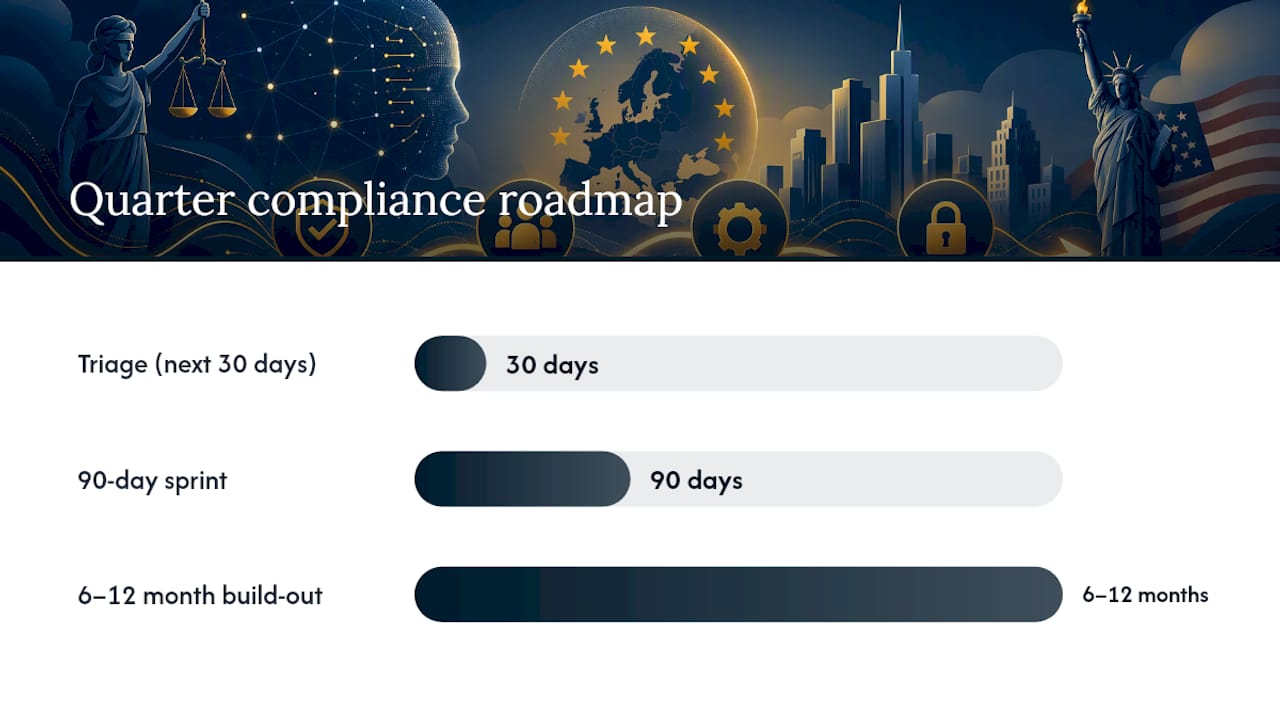
- Building a Compliance Roadmap: What to Do This Quarter
- When Do You Need an Authorised Representative?
- What Happens if You Don’t Comply?
- How an AI partner Helps Operationalize EU AI Act Readiness
- Compliance Is a Sales Asset, Not Just a Legal Cost
- Get Hands-On Help With Your AI Compliance Roadmap
- Sources
Does eu ai act compliance Apply to U.S. Companies? The Scope Test
The regulation doesn’t ask where your company is incorporated. It asks where your AI’s output gets used. Under Article 2, scope hinges on three overlapping tests: whether you place an AI system on the EU market (2(1)(a)), whether you deploy one with your place of establishment or use inside the EU (2(1)(b)), or whether the output your system produces gets used by anyone in the EU (2(1)©). That third test is the one that surprises American companies. A European Commission overview confirms providers and deployers in third countries fall under the Act the moment EU users consume their AI’s output, regardless of where the processing happens.
Think about a Texas SaaS company running a customer support chatbot. If a French customer of an EU-based client interacts with that bot, the output test can pull the Texas company into scope even without a European office, subsidiary, or sales team.
Run this quick internal reach test before you assume you’re clear:
- Do EU-based users, customers, or contractors ever see, receive, or act on your AI’s output?
- Does your product get distributed, resold, or embedded by a partner who sells into the EU?
- Do any contracts obligate you to support EU end users, even indirectly?
- Do you have a subsidiary, branch, or long-term contractor presence inside the EU?
Check the carve-outs too. Personal, non-commercial use by an individual is excluded. So are systems used exclusively for national security or military purposes, and certain narrow scientific research activities. Don’t assume you qualify for these without documenting why.
When Do EU AI Act Deadlines Actually Take Effect?
Some obligations are already law. Others got pushed back by the Digital Omnibus and are still waiting on formal Official Journal publication, which means they’re not yet locked in but shouldn’t be ignored either. Here’s the timeline that matters for planning purposes.
The Digital Omnibus deferral_10_EN.pdf) bought high-risk providers extra runway, but it left Article 50 completely alone. Pending status means the dates aren’t formally binding until published in the Official Journal, but treating them as soft targets is a mistake. Finish your transparency labeling and GPAI documentation before August 2026. Stage your FRIA drafting and conformity assessment planning across 2027 and 2028 instead of rushing them.
Provider vs. Deployer: Whose Obligations Are They?
The Act splits duties by role, and getting your role wrong is one of the most common compliance mistakes. A provider develops or substantially modifies an AI system and places it on the EU market under its own name. A deployer uses an AI system in a professional context without developing it. The gap between the two is significant.
Providers of high-risk systems carry the heavier load under Article 16 and related provisions: building a risk management system, maintaining technical documentation, completing a FRIA, undergoing conformity assessment, and registering the system in the EU public database before it goes to market.
Deployers face lighter but still real duties starting around Article 26: exercising human oversight, monitoring the system in actual use, and reporting serious incidents to authorities. Both roles share some baseline obligations regardless of which side you’re on:
- Maintaining audit logs the system generates automatically.
- Ensuring input data quality where you control it.
- Contributing to post-market monitoring.
- Building AI literacy among staff who operate or oversee the system.
Pro Tip: If you customize, fine-tune, or rebrand a third-party model under your own name, you may have just become a provider without realizing it. That single decision can double your compliance workload, so review any vendor agreement that lets you modify or white-label a model before you sign it.
What Does Article 50 Require for AI-Generated Content?
Article 50 splits into two distinct disclosure tracks, and both are already binding as of August 2, 2026.
- Human-facing disclosure (Article 50(1)): if a person interacts with an AI system, they need to know it, clearly and before the interaction goes far. Chatbots, voice assistants, and automated support tools all qualify.
- Machine-readable watermarking (Article 50(2)): AI-generated or manipulated content, including synthetic audio, image, video, and text, needs machine-readable markers identifying it as AI-generated. The grace period for this piece runs until December 2, 2026.
- Implementation pattern for chatbots: add a persistent, visible disclosure at the start of any AI conversation rather than burying it in terms of service.
- Implementation pattern for content pipelines: embed metadata tags (C2PA-style provenance signals are a common approach referenced in Commission guidance) at the point of generation, not after the fact.
Test your labeling the way an auditor would: strip your product down to what a first-time EU user actually sees, and confirm the AI disclosure survives that view.
How Do You Know if Your System Is High-Risk?
Annex III lists specific high-risk use cases: biometric identification, employment screening, credit scoring, critical infrastructure management, and law enforcement tools among them. Annex I covers AI embedded inside already-regulated products, like medical devices or machinery, where the AI component inherits the product’s existing conformity requirements.
If your system lands in either category, your FRIA needs five real sections, not a checkbox exercise:
- Context: what the system does and who it affects.
- Stakeholders: everyone touched by the system’s decisions, including people who never opted in.
- Rights at risk: specific fundamental rights implicated, not a generic privacy statement.
- Mitigation measures: concrete technical and procedural controls you’ve actually built, not ones you plan to build someday.
- Residual risk and monitoring: what’s left after mitigation, and how you’ll keep watching it.
Pair the FRIA with technical controls auditors will expect to see evidence of: dataset quality checks, documented bias mitigation, traceability logging, and cybersecurity robustness testing. Conformity assessment can be self-assessed for many Annex III categories or require a notified body for higher-stakes use cases; either route ends in CE marking before the system reaches the EU market.
Building a Compliance Roadmap: What to Do This Quarter
Compliance work collapses into three phases, and skipping the first one is why most programs stall.
- Triage (next 30 days): inventory every AI system your company builds, buys, or resells. Run the reach test from earlier against each one. Flag anything touching GPAI models or Annex III use cases immediately. Industry analysis consistently points to this scoping step as the one companies skip, then regret.
- 90-day sprint: draft FRIAs for anything flagged high-risk. Fix transparency labeling to meet Article 50 before the deadline pressure builds. Amend vendor contracts to require compliance documentation from third-party model providers. Tighten logging so it captures what auditors will ask for.
- 6 to 12 month build-out: plan conformity assessment routes for any Annex III or Annex I system. Appoint an authorised representative if you need one. Write governance and data retention policies that survive a regulator’s second question, not just the first.
Assign real owners to each phase. Legal owns the FRIA and contract language. Engineering owns logging, documentation, and technical controls. Leadership owns the AI literacy training every operator and overseer needs, because that requirement isn’t optional window dressing, it’s baked into the shared obligations every provider and deployer carries.
Pro Tip: Don’t wait for a legal opinion to start your inventory. Cataloging your AI systems costs you a spreadsheet and a week. Waiting six months for outside counsel to tell you what you already suspected costs you the runway you needed to fix it.
When Do You Need an Authorised Representative?
If you’re a non-EU provider placing a high-risk system or GPAI model on the EU market, appointing an authorised representative under Article 22 or Article 54 becomes mandatory, not optional. Their duties include:
- Keeping your technical documentation and conformity records accessible to authorities.
- Cooperating directly with market surveillance requests, often on short notice.
- Handling EU registration and recordkeeping on your behalf.
Choose the mandate structure carefully. A vague or overly broad representation agreement creates friction the moment a national authority comes asking for documents your representative can’t locate fast enough. Build response timelines and document-access terms into the contract itself, not into a side conversation you’ll have later.
What Happens if You Don’t Comply?
Article 99 penalties scale with severity. Enforcement runs through national market surveillance authorities in each member state, coordinated by the AI Office, which holds direct authority over GPAI model providers.
- Violations of prohibited AI practices carry the steepest fine tier.
- High-risk and transparency violations sit in a lower but still meaningful tier.
- Providing false or misleading information to authorities triggers its own penalty category.
Beyond direct fines, authorised representatives and distribution partners face their own liability exposure, and private litigation risk grows alongside regulatory attention. The single most effective mitigation isn’t a legal argument, it’s documented remediation: showing you identified a gap, disclosed it, and fixed it before an authority had to ask twice.
How an AI partner Helps Operationalize EU AI Act Readiness
Reading the regulation is one thing. Turning it into a working inventory, a defensible FRIA, and a remediation timeline your leadership can act on is another. That gap is where tekRESCUE AI’s AI Profit and Growth Assessment does its work, mapping your actual AI footprint against the obligations that apply to your specific systems.
The assessment covers:
- A full inventory of AI systems in production, procurement, or pilot.
- A FRIA scaffold built around your actual use cases, not a generic template.
- A prioritized risk and controls roadmap tied to real deadlines.
- Integration with your existing cybersecurity posture, since tekRESCUE treats AI risk and security risk as one conversation, not two.
Pro Tip: An AI Profit and Growth Assessment isn’t a substitute for outside counsel on binding legal determinations. It is the operational groundwork that makes your counsel’s job faster and your conformity assessment cheaper.
Compliance Is a Sales Asset, Not Just a Legal Cost
Most companies treat EU AI Act work as pure overhead. That’s a mistake. A documented FRIA and clean Article 50 disclosures become a credential the moment you’re competing for an EU-facing enterprise contract, because procurement teams increasingly ask for exactly that paperwork before they’ll sign.
Prioritize transparency and FRIA work first, not last. Then tell your customers and board about it in plain terms: what you inventoried, what you fixed, what’s still in progress. Silence reads as risk. A short, honest compliance update reads as a company that already knows where its exposure is, and that’s worth more in a sales cycle than most companies realize.
— Randy Bryan
Get Hands-On Help With Your AI Compliance Roadmap
Most compliance guides stop at explaining the law. tekRESCUE AI is built for the part that comes after: turning Article 2 scope questions, FRIA drafts, and vendor contract gaps into a roadmap your team can actually execute this quarter.
The AI Profit and Growth Assessment gives you a prioritized inventory of your AI systems, a risk and controls roadmap tied to real deadlines, and a governance checklist that hands off cleanly to your legal counsel for binding determinations. It’s built by a team that’s spent three decades in IT and cybersecurity, so the security side of your AI deployment gets the same scrutiny as the compliance side. If your company touches GPAI models, high-risk use cases, or cross-border EU distribution, request an assessment and schedule a 30-minute scoping call to find out exactly where your exposure sits.
This article is general information, not a substitute for advice from a qualified lawyer. Consult a qualified legal professional about your own circumstances before acting on anything here.