Enterprise AI delivers measurable value when three things happen at once: data is actually ready to feed a model, a governance body owns the decisions, and leaders track KPIs tied to dollars, not demos. Skip any one of these and you get what most large organizations already have: a pile of pilots and a flat P&L. The surveys back this up, and so does the pattern of who actually breaks through.
TL;DR:
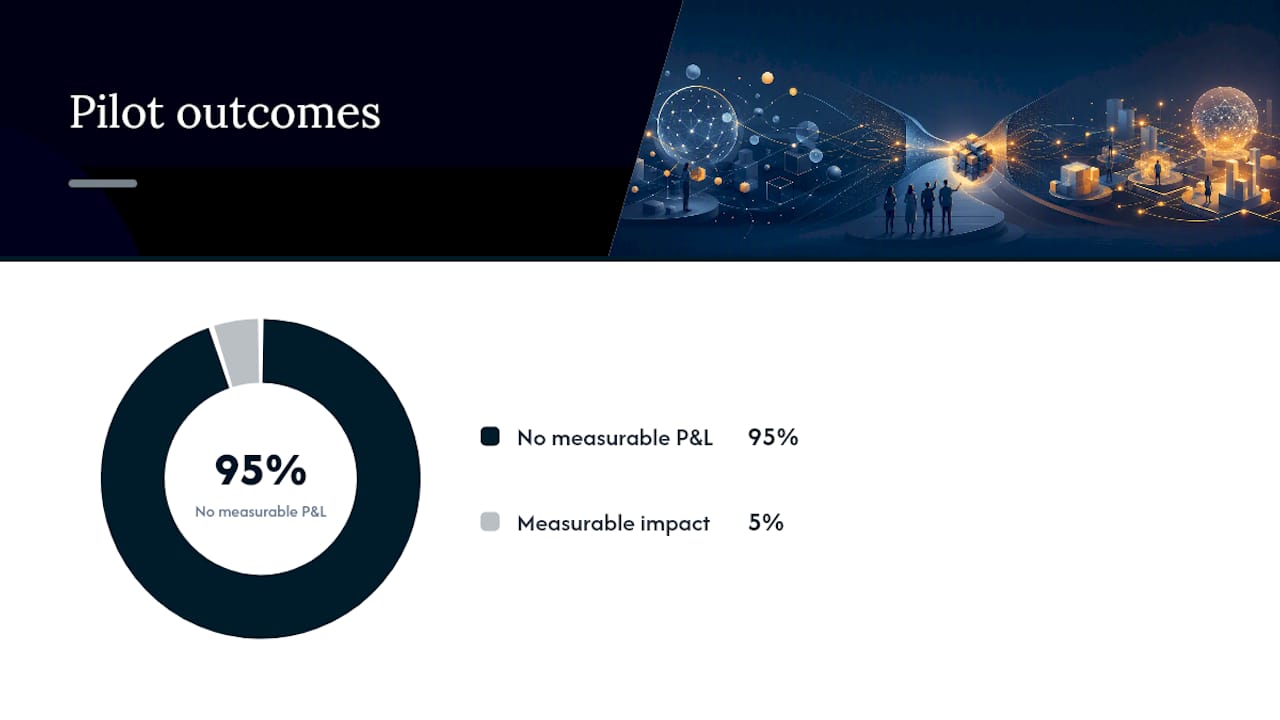
- Most pilots fail to scale because of organizational and systemic barriers, not model performance issues, with 95% producing no measurable P&L impact.
- Building a scalable AI infrastructure requires addressing data quality, integration, governance, trust, and measurement seams to prevent leakage of value.
- Effective governance includes provenance tracking, human oversight, bias testing, and incident response plans to manage hallucinations and bias risks.
- Organizing for scale benefits from a hybrid model combining central standards with decentralized ownership, supported by cross-functional decision-making cadences.
- Prioritizing AI use cases by business value, data readiness, and adoption fit, along with measuring outcomes from day one, is critical to avoid wasting resources on ineffective pilots.
Table of Contents
- What Is the Current State of Enterprise AI Adoption?
- Why Do Most AI Pilots Fail to Scale?
- How Should Enterprises Organize to Scale AI?
- What Data and Architecture Does Reliable GenAI Require?
- How Do You Measure ROI for GenAI Initiatives?
- How Should Executives Prioritize AI Use Cases?
- What Governance Controls Prevent AI Risk and Compliance Failures?
- An 8-Step Playbook to Move From Pilot to Production
- What Executives Should Actually Do Next
- Your Next Move on Enterprise AI
- Sources
What Is the Current State of Enterprise AI Adoption?
The honest answer is that it depends which survey you’re reading, and the gap between them tells you something important. Firm-level data from the Federal Reserve put U.S. business adoption at roughly 18% by the end of 2025, while workforce-level surveys measuring individual generative AI use came in around 41% for the same period. Employment-weighted estimates pushed even higher, showing about 78% of workers sit inside firms that use AI in some form, with 54% touching large language models directly.
Why such a spread? Firm-level counts ask whether a company has a formal AI initiative on the books. Workforce surveys ask whether an employee opened ChatGPT or a similar tool this month. Both are true. A single analyst quietly using an AI assistant to draft reports doesn’t show up in a firm-level adoption count, but it absolutely shows up in productivity data.
At the enterprise tier, the picture sharpens. According to Halkwinds Research, Most large enterprises with substantial revenue reported at least one AI system running in production in 2026, and a strong majority of adopters had generative AI applications live. That’s a different world from the 18% firm-wide figure. Scale and budget matter. So does industry: financial services, technology, and professional services firms lead, largely because they have cleaner digital records and executive teams already comfortable making software bets.
Three trends define the next 18 months:
- Agentic AI is moving from demo to deployment. Multi-step agents that can execute tasks, not just answer questions, are showing up in customer service, procurement, and internal IT support workflows, a shift Deloitte’s enterprise generative AI research tracks closely.
- Retrieval-augmented generation (RAG) has become the default architecture for knowledge applications, because it grounds model output in company data instead of relying on what a model memorized during training.
- Investment cycles are compressing. Pilots that used to run for a year now get a go or no-go decision inside a single quarter, which raises the stakes on picking the right first use cases.
Statistic to remember: the difference between lower firm-level adoption estimates and higher enterprise-tier production deployment is a reflection of where investments and infrastructure exist. It’s a map of where the money and the infrastructure already exist.
Why Do Most AI Pilots Fail to Scale?
Pilots don’t fail because the model is bad. They fail because of what researchers now call the Deployment Wall, a term from a diagnostic framework published on arXiv that found roughly 95% of generative AI pilots never produce a measurable profit-and-loss impact. The model works fine in the demo. It’s everything around the model that breaks.
The framework identifies six “seams,” points in the journey from pilot to production where friction accumulates and value quietly leaks out:
- The data seam. Training or retrieval data looks fine in a sandbox but doesn’t match the messy, inconsistent records living in production systems.
- The integration seam. The AI output has nowhere to go. It can’t write back into the CRM, the ERP, or the case management tool people actually use.
- The workflow seam. Employees have to leave their normal tool to use the AI tool, so they stop using it within weeks.
- The governance seam. No one has signed off on who approves a new use case, so promising pilots sit in limbo for months.
- The trust seam. Outputs aren’t explainable enough for a manager to stake their name on, so they get quietly ignored.
- The measurement seam. Nobody defined what “success” looks like beyond “the demo went well,” so there’s no evidence to justify scaling.
IBM’s analysis of stalled enterprise AI projects reaches a similar conclusion from a different angle: fragmented data, governance gaps, and an inability to plug AI outputs into systems of record, not model limitations, are what actually kill scale. A model that’s 95% accurate is worthless if the output lands in a spreadsheet nobody opens.
Here’s the diagnostic signal to watch for: deployment debt. If your organization has more AI pilots launched than AI systems retired or graduated to production over the same period, you’re accumulating debt, not building capability. Every unfinished pilot still costs licensing fees, occupies a data science team’s attention, and erodes executive patience for the next request.
Pro Tip: Before greenlighting a new pilot, ask which existing pilot it will replace or retire. If the answer is none, you’re adding to the pile, not clearing it.
The managerial takeaway is blunt: deployment is not a technical afterthought you hand to IT once the model works. It’s an organizational capability that has to be built, staffed, and funded with the same seriousness as the model development itself.
How Should Enterprises Organize to Scale AI?
Structure determines speed here more than talent does. Three operating models dominate, and each trades off differently.
A Center of Excellence (CoE) centralizes AI expertise, data science talent, and governance under one roof. According to Halkwinds Research, CoE models have become the dominant operating structure among large enterprises in 2026, mainly because they cut duplicated effort and give the organization one place to enforce standards. The tradeoff: a CoE can become a bottleneck if every business unit has to wait in line for its attention.
A federated model pushes AI ownership out to individual business units, each running its own experiments with its own budget. This moves faster on the ground but risks five different departments building five incompatible chatbots that all need the same customer data.
A hybrid model, a small central team setting standards and infrastructure while business units own their own use cases, tends to outperform both extremes once an organization passes a certain size, because it keeps the speed of federation without losing the consistency of central governance.
Whichever model you pick, the connective tissue that actually moves work forward is a cross-functional cadence, sometimes called a GenAI Stream: a recurring meeting where legal, IT security, data, and the business sponsor sit in the same room and make a go/no-go call on pilots in real time, instead of routing decisions through six separate approval chains.
Roles and decision rights to staff before you scale:
- An executive sponsor with budget authority who can kill a pilot without political fallout.
- A data steward who owns data quality and access decisions for AI use cases specifically, not general IT data governance.
- A model risk owner who signs off on hallucination and bias testing before anything touches a customer.
- A workflow owner from the business unit who ensures the AI output lands inside the tool people already use.
- A measurement lead who defines success metrics before the pilot starts, not after it “goes well.”
Monday on moving from pilot to production makes a point worth repeating here: layering AI on top of an unchanged workflow, rather than redesigning the workflow around it, is one of the most common reasons adoption stays low even after a technically successful launch. Organizing for scale means organizing for change, not just organizing for oversight.
What Data and Architecture Does Reliable GenAI Require?
Retrieval-augmented generation, RAG, has become the default enterprise pattern for a reason: it grounds a model’s answers in your actual documents, databases, and records at the moment of the query, instead of relying on whatever the model absorbed during training. That distinction matters when a customer asks about a policy that changed last month. A model trained on old data will confidently give you the old answer. A RAG system retrieves the current policy document first, then generates a response from it.
Getting RAG right requires infrastructure most enterprises underestimate:
- Clean data pipelines that pull from systems of record in near real time, not quarterly exports someone remembers to run.
- Data lineage tracking, so when a model gives a wrong answer, someone can trace it back to the source document and fix it at the root.
- A vector database to store document embeddings for fast semantic retrieval, paired with access controls so the retrieval layer respects the same permissions as the underlying system.
- Governance at the point of use, meaning access rules apply when the AI queries the data, not just when a human does.
Integration is where most of the real engineering work lives. APIs connecting the AI layer to CRM, ERP, and case management systems have to handle authentication, rate limits, and error states gracefully, because a broken integration doesn’t just fail quietly, it produces wrong answers with total confidence. OpenAI’s enterprise guidance emphasizes the same point from the vendor side: customizing and training models matters less than the surrounding integration and governance work needed to make outputs trustworthy in production.
MLOps discipline, the practice of monitoring, retraining, and versioning models continuously rather than deploying once and walking away, is what separates a system that stays accurate for years from one that quietly degrades within months as your data drifts. Budget for this ongoing work explicitly. It’s not a one-time project cost.
How Do You Measure ROI for GenAI Initiatives?
Most enterprises measure AI wrong: they track usage (how many people opened the tool) instead of outcomes (what changed because they did). Fix that gap first, before worrying about anything more sophisticated.
A working measurement framework has three layers:
- Leading indicators: adoption rate within the target workflow, time-to-first-value for new users, and query volume against retrieval accuracy.
- Outcome KPIs: cycle time reduction, error rate change, case resolution speed, or whatever operational metric the use case was built to move.
- Economic metrics: cost per resolved case, revenue per AI-assisted transaction, or labor hours reallocated to higher-value work.
The measurement techniques matter as much as the metrics. Human rating panels, where domain experts score a sample of AI outputs for accuracy and tone, catch problems that automated metrics miss entirely. Semantic similarity scoring compares AI-generated answers against a verified ground truth to flag drift automatically. Production monitoring, tracking real-world outputs continuously rather than testing once at launch, is what catches quality decay before customers do.
Research from the California Management Review found that companies successfully scaling generative AI share a common thread: they measure performance with contextual metrics tied to the specific business process, not generic accuracy scores, and they treat every pilot as a structured experiment designed to produce evidence, not just a demo designed to impress a steering committee.
Statistic worth internalizing: the Deployment Wall research found that roughly 95% of pilots produce no measurable P&L impact.
How Should Executives Prioritize AI Use Cases?
Not every AI opportunity deserves the same urgency, and treating them all equally is how organizations end up with twelve pilots and zero scaled systems. A working prioritization framework scores each candidate use case on five criteria:
- Business value: does this move a metric leadership already tracks, or does it create a new metric nobody asked for?
- Technical complexity: does this require custom model development, or can it run on retrieval against existing data?
- Data readiness: is the underlying data clean, accessible, and governed today, or does it need a six-month cleanup first?
- Compliance risk: does this touch regulated data, customer-facing decisions, or anything requiring an audit trail?
- Adoption friction: will this fit inside an existing workflow, or does it ask employees to change how they work entirely?
Score candidates against those five factors and three natural buckets tend to emerge. Internal knowledge applications, things like an AI assistant that answers employee questions against company policy documents, usually score high on value and low on complexity, making them ideal first bets. Process automation, handling repetitive back-office tasks like invoice matching or claims triage, scores well on value but needs stronger data governance before launch. Client-facing augmentation, AI tools that touch customers directly, carries the highest compliance risk and should launch last, after the organization has proven it can govern the earlier two categories well.
On build versus buy: build only where the use case touches a genuine competitive differentiator specific to your business. Buy or partner for everything else. Custom-building a document retrieval system when mature commercial options exist wastes engineering time your team needs for the harder integration work upstream.
Size your first pilots to run 60 to 90 days with a defined kill criterion. If a pilot hasn’t shown a measurable KPI movement by day 90, that’s a decision point, not a reason to extend it another quarter.
What Governance Controls Prevent AI Risk and Compliance Failures?
Hallucinations, biased outputs, and untracked decisions are not edge cases you’ll get lucky avoiding. They’re predictable failure modes that require specific controls before anything reaches production.
Grounding and provenance address hallucinations directly. Every AI-generated claim that reaches a customer or regulator should trace back to a specific source document, with that citation visible to whoever reviews the output. A system that can’t show its work shouldn’t be making decisions that matter.
Governance controls to require before launch:
- Audit trails that log every AI decision and the data it drew from, retained long enough to satisfy your industry’s record-keeping rules.
- Human-in-the-loop checkpoints on any decision affecting customer outcomes, pricing, or employment, so a person reviews before action, not after complaint.
- Bias testing run against protected classes and edge cases before launch, repeated periodically as data drifts.
- An incident response plan specific to AI failures, separate from your general IT incident process, because an AI error often looks different from a system outage.
Regulatory watchpoints shift quickly enough that your governance body needs a standing agenda item just for tracking new rules, rather than reacting after an incident forces the issue. The Halkwinds Research findings on RAG combined with strong provenance and human oversight point to the same conclusion: this pairing is currently the most repeatable pattern for producing outputs that are both reliable and auditable, which matters as much to your legal team as it does to your data science team.
Pro Tip: Assign one person, not a committee, to own the “kill switch” decision for any AI system showing early signs of drift or bias. Committees are slow. Bad outputs compound fast.
An 8-Step Playbook to Move From Pilot to Production
Here’s the sequence that actually works, mapped to what tekRESCUE builds into its AI Profit and Growth Assessment.
1. Readiness assessment (Weeks 1 to 3). Audit your current data infrastructure, existing pilots, and governance gaps before committing to anything new. This is precisely where tekRESCUE’s AI Profit and Growth Assessment starts: mapping which of your systems are actually ready for AI integration and which carry hidden security exposure that would surface the moment you connect an AI tool to production data.

2. Use-case selection (Weeks 3 to 5). Score candidate projects against the five prioritization criteria above. Pick two, not ten, for your first wave.
3. Governance setup (Weeks 4 to 6, run in parallel with step 2). Staff the roles: executive sponsor, data steward, model risk owner, workflow owner, measurement lead. Establish the cross-functional cadence before the first pilot launches, not after.
4. Data and architecture preparation (Weeks 6 to 10). Clean the specific data pipelines your chosen use cases will draw on. Stand up retrieval infrastructure. Don’t try to fix all enterprise data at once, just what these two use cases need.
5. Pilot design (Weeks 8 to 10, overlapping step 4). Define success metrics, kill criteria, and the 60 to 90 day timeline before writing a line of code. A pilot without a defined end date rarely ends.
6. Controlled deployment (Weeks 10 to 18). Launch to a limited user group. Monitor closely with the human rating and production monitoring techniques described earlier. Adjust weekly, not quarterly.
7. Measurement and go/no-go decision (Week 18 to 20). Compare outcome KPIs against the baseline you set in step 5. This is a real decision point: scale, iterate, or kill. All three are legitimate outcomes.
8. Scale and continuous improvement (Ongoing). For pilots that graduate, build the MLOps discipline to monitor and retrain continuously. Feed lessons back into use-case selection for the next wave.
Pro Tip: Run steps 1 through 3 with an outside partner who has no stake in defending your current IT architecture. Internal teams often can’t see their own seams because they built them.
The full engagement typically runs 18 to 22 weeks from readiness assessment through the first go/no-go decision, though organizations with cleaner existing data infrastructure move faster through steps 4 and 5. What tekRESCUE’s assessment produces at the outset, a prioritized roadmap and a risk map specific to your systems, is designed to shortcut steps 1 and 2 so leadership spends its energy on governance and execution rather than months of internal discovery. For deeper reading on operationalizing this handoff from advisory diagnosis to sustained deployment, Byram Advisory Group’s insights cover complementary approaches worth comparing against your own plan.
What Executives Should Actually Do Next
Three things matter more than anything else in this article. Second, put a single executive sponsor in charge of kill decisions before you launch anything, not after a pilot has become politically expensive to end. Second, measure business outcomes from day one of any pilot, never usage alone. Organizations that get these three things right consistently outperform the adoption statistics you’ll read everywhere else.
— Randy Bryan
Your Next Move on Enterprise AI
Most organizations spend six months and a six-figure budget discovering, on their own, exactly which of the six seams is blocking their pilots, usually after the pilot has already failed quietly. tekRESCUE AI compresses that discovery into a single structured engagement: the AI Profit and Growth Assessment maps your actual data readiness, governance gaps, and security exposure before you commit budget to a use case that was never going to reach production.
What you get is not a generic report. It’s a prioritized roadmap tied to your specific systems, a risk map showing exactly where cybersecurity and AI deployment intersect in your environment, and a sequenced plan that lines up with the eight-step playbook above, so you walk into governance setup and pilot design already knowing where the real friction sits. tekRESCUE built this by combining 30 years of IT and cybersecurity work with hands-on AI strategy, which means the roadmap accounts for the vulnerabilities most AI-only advisors never think to check. If you’re ready to see exactly where your organization stands before you spend another quarter on a pilot that might not scale, book an AI Profit and Growth Assessment and get a plan built around your systems, not a template.
Sources
- Monitoring AI adoption in the U.S. economy — Federal Reserve
- The Deployment Wall: A Diagnostic Framework and Instrument for Enterprise AI in the Deployment Era — arXiv
- How to scale the black box: Realizing generative AI’s business potential — California Management Review
- Why most enterprise AI projects stall before they scale — IBM
- Enterprise AI Adoption Trends 2026 — Halkwinds Research