AI vendor risk is the exposure your organization inherits when a third party processes, models, or acts on your data using artificial intelligence, and it behaves nothing like the vendor risk your TPRM program was built to catch. Three moves matter right now, before you read another paragraph of theory: inventory every vendor touching your data with an AI feature, tier them by data sensitivity and business criticality, and bolt an AI-specific supplement onto your existing screening questionnaires.
That urgency isn’t hypothetical. NIST’s AI Risk Management Framework exists precisely because AI systems don’t fit neatly into legacy governance models, and ISO/IEC 42001 now gives vendors a certifiable way to prove they’ve built actual AI management systems, not just marketing claims. Gartner has put a number on the stakes: it projects that 40 percent of AI-related data breaches will stem from cross-border GenAI misuse by 2027, a forecast that should reframe how you think about vendor data residency and subprocessor sprawl.
Here’s what you’re going to walk away with:
- A working definition of AI vendor risk that separates it from standard third-party risk
- A risk taxonomy you can map directly onto your existing risk register
- A step-by-step assessment framework, complete with a scoring matrix
- Copy-paste questionnaire language, contract clauses, and monitoring triggers
Immediate action list:
- Inventory every vendor with an AI feature, including “AI-enabled” add-ons buried inside tools you already approved
- Tier vendors by data sensitivity and business criticality, not just contract size
- Add an AI-specific supplement to your standard due diligence questionnaire before your next renewal cycle
Key Takeaways
Managing AI vendor risk successfully requires treating it as a continuous, cross-functional discipline that extends existing TPRM programs rather than replacing them.
| Point | Details |
|---|---|
| Define the risk correctly | AI vendor risk is inherited exposure from third parties processing or acting on your data with AI, distinct from static software risk. |
| Score by two axes | Use data sensitivity and business criticality together to set inherent risk tiers and prioritize technical reviews. |
| Demand artifacts, not claims | Require model cards, AIBOMs, and ISO 42001 certificates rather than accepting verbal vendor assurances. |
| Monitor continuously | Track model provider swaps, subprocessor changes, and error-rate spikes as ongoing triggers for reassessment. |
| Use tekRESCUE for structured review | tekRESCUE’s AI Profit and Growth Assessment maps AI vendor exposure and delivers a prioritized 30/60/90 day remediation roadmap. |
Table of Contents
- What Makes AI Vendor Risk Different From Traditional Third-Party Risk?
- Key AI-Specific Risk Categories to Evaluate
- How Do You Build a Step-by-Step AI Vendor Risk Assessment Framework?
- AI Vendor Questionnaire and Controls Checklist You Can Use Today
- Contract Clauses and Negotiation Priorities for AI Vendors
- How Do You Monitor AI Vendors After the Contract Is Signed?
- Who Owns AI Vendor Risk Inside Your Organization?
- Which Standards and Tools Should Guide Your AI Vendor Reviews?
- What Do Risk Teams Consistently Get Wrong About AI Vendors?
- How tekRESCUE AI Helps You Get Ahead of Vendor Risk
- Frequently Asked Questions
- Sources
What Makes AI Vendor Risk Different From Traditional Third-Party Risk?
Traditional vendor risk assumes a relationship you can pin down: fixed features, a defined data flow, a SOC 2 report that stays accurate until the next audit cycle. AI vendors break that assumption. Models retrain, providers swap out foundation models without telling you, and the same prompt can produce different outputs on different days. Metis Strategy notes that AI vendors erode the static relationships and fixed risk boundaries TPRM programs were designed around, since subprocessors and model dependencies shift constantly and often go undisclosed unless your contract demands it.
Several characteristics set AI vendor risk apart:
- Non-deterministic outputs. The same input can generate different results, which makes traditional “test once, trust forever” validation useless.
- Model drift. A vendor’s model can degrade or change behavior over months without any code deployment you’d normally track.
- Training-data reuse. Your customer data can end up shaping a model that serves other clients, sometimes competitors, unless the contract explicitly forbids it.
- Prompt injection. Malicious inputs can manipulate an AI system into leaking data or taking unintended actions, a vulnerability that barely existed in pre-AI software.
- Fourth-party dependency. Nearly every AI vendor sits on top of a foundation model provider (OpenAI, Anthropic, Google, Meta), meaning your risk exposure now runs two or three layers deep.
- Opaque decision logic. Many vendors can’t fully explain why their model produced a specific output, which complicates audit and appeals processes.
Picture a vendor that quietly swaps its underlying model provider to cut costs. The interface looks identical, the contract terms haven’t changed, but the outputs your team relies on for underwriting decisions or customer communications shift overnight. Nobody flagged it because nothing in the change management process was designed to catch it.
This is why point-in-time attestations like SOC 2 or ISO 27001 remain necessary but stop short of sufficient. They tell you a vendor had adequate security controls on the day of the audit. They say nothing about whether the model behind that vendor’s product changed last Tuesday. KPMG argues that AI third-party risk is becoming functionally inseparable from third-party risk generally, and recommends moving past binary “does this vendor use AI, yes or no” scoping toward evaluating how deeply AI is embedded in what you’re actually buying.
Key AI-Specific Risk Categories to Evaluate
Building a usable AI vendor risk management program starts with a taxonomy, not a gut check. Here’s the structure worth mapping onto your risk register:
- Data privacy and security. Does the vendor train on your data, and can you get a contractual zero-retention commitment with audit rights to verify it?
- Model governance and drift. Is there a documented process for retraining, versioning, and notifying customers when model behavior changes?
- Bias and fairness. Has the vendor run fairness testing on outputs that affect hiring, lending, or other regulated decisions, and will they share results?
- Explainability and auditability. Can the vendor produce a rationale for a specific output if you need to defend a decision to a regulator or a customer?
- Intellectual property and licensing. Who owns outputs generated by the model, and does the vendor indemnify you against IP infringement claims tied to training data?
- Operational and resilience risk. What happens to your workflow if the vendor’s AI service goes down, especially where autonomous agents are executing actions without human review?
- Fourth-party and supply-chain risk. Which foundation model, cloud infrastructure, and subprocessors sit behind the vendor’s product, and are they disclosed in writing?
- Regulatory and compliance exposure. Does the vendor’s use of AI trigger obligations under sector rules (HIPAA, GLBA) or emerging AI-specific regulation in your operating jurisdictions?
Some of these categories cascade fast. A biased hiring-screening output doesn’t stay a technical footnote. It becomes a discrimination claim, then a headline, then a board-level conversation about why nobody caught it during vendor selection. Practitioner guidance from BeyondScale recommends behavioral testing and adversarial reviews as standard technical due diligence, specifically because prompt-injection and model-level vulnerabilities have already produced enterprise-scale exposure in documented incidents. Treat any vendor touching regulated decisions, customer-facing communications, or sensitive data as a candidate for the deeper end of your review process, not the checkbox end.
How Do You Build a Step-by-Step AI Vendor Risk Assessment Framework?
A workable framework mirrors the procurement lifecycle you already run, with AI-specific checkpoints layered in.
- Discovery and inventory. Catalog every vendor, including shadow AI tools individual teams adopted without procurement’s knowledge. Most organizations underestimate this number badly.
- AI-scoping questions. Ask directly: does this product use AI or machine learning in any capacity that touches our data? Vague answers here are themselves a red flag.
- Inherent risk scoring. Score based on data sensitivity (public, internal, confidential, regulated) multiplied by business criticality (nice-to-have versus mission-critical).
- Trigger criteria for technical review. Any vendor scoring high on both axes, or any vendor processing regulated data through a generative model, escalates automatically.
- Evidence checklist. Require SOC 2 scope documents, ISO 42001 alignment statements, model cards, and red-team summaries before the technical review begins.
- Acceptance or remediation decision. Document whether findings get remediated, accepted with compensating controls, or the vendor gets rejected.
- Ongoing monitoring enrollment. Every approved vendor enters continuous monitoring, not a one-time gate.
A simple impact times likelihood matrix works well here. A vendor processing regulated health data through an unvetted third-party model sits in the high-impact, high-likelihood quadrant, demanding a full technical review before signature. A vendor using AI only for internal ticket routing on non-sensitive data can often clear with a lighter questionnaire-only pass.
Pro Tip: Tie your inherent risk score to two variables only, data sensitivity and business criticality, and resist the urge to add five more weighting factors. Complex scoring models collapse under their own weight during a busy renewal season, and a simple two-axis matrix gets used consistently, which matters more than theoretical precision.
Review depth and cost scale with what you’re buying. A light review, questionnaire plus document check, typically runs a few hours of analyst time. A medium review adding technical validation of claims might run several days across security and privacy stakeholders. A deep review involving model behavior testing, adversarial red-teaming, and legal negotiation on contract language can stretch into weeks and involve outside specialists, particularly for vendors touching regulated decisioning.
Escalate to a full technical or forensic review when a vendor handles regulated data through a model you can’t independently verify, when the vendor refuses to disclose foundation-model dependencies, or when a prior incident has already occurred. Contractual and operational controls, monitoring clauses, retention limits, notification SLAs, are usually sufficient for lower-tier vendors where the worst-case impact is contained and reversible.
Gartner’s cross-border GenAI breach forecast is worth revisiting at this stage of your framework design: any vendor whose inference happens outside your data’s home jurisdiction deserves an automatic bump up in scoring, regardless of how clean their other answers look.
AI Vendor Questionnaire and Controls Checklist You Can Use Today
Your existing due diligence questionnaire probably asks about encryption at rest and breach notification. It almost certainly doesn’t ask whether the vendor’s model was trained on your prior submissions. Here’s a starting supplement, organized for direct copy into your intake process.
Screening questions (yes/no, intake stage):
- Does this product use AI, machine learning, or generative models in any function touching our data?
- Does the vendor train, fine-tune, or otherwise improve any model using our data?
- Does the vendor rely on a third-party foundation model provider?
- Has the vendor experienced any AI-related security incident in the past 24 months?
Expanded due diligence, grouped by domain:
| Domain | Sample question | Evidence requested |
|---|---|---|
| Data | Do you retain our prompts and outputs, and for how long? | Zero-retention contract clause or documented retention policy |
| Model | Which foundation model or models power this feature? | Model card or provenance documentation |
| Security | Have you tested for prompt injection and adversarial manipulation? | Red-team summary or penetration test excerpt |
| Governance | Are you certified or aligned to ISO/IEC 42001? | Certificate or gap-assessment summary |
| Supply chain | Can you provide an AI bill of materials (AIBOM) listing subprocessors? | AIBOM or subprocessor disclosure list |
A zero-retention claim only counts as acceptable when it’s backed by a contract clause with audit rights attached, not a sales rep’s verbal assurance. Treat a vendor’s self-reported ISO 42001 “alignment” as a starting point for questions, not a finished answer, unless they can produce the actual certificate.
Score each response on a simple three-point scale: fully satisfactory, satisfactory with conditions, or unsatisfactory. Feed the aggregate score directly into your existing risk register alongside the inherent risk tier from the assessment framework above, so AI-specific findings live in the same system your auditors already know how to read.
Contract Clauses and Negotiation Priorities for AI Vendors
Your legal team doesn’t need a rewritten master services agreement. They need a short list of AI-specific riders that close the gaps standard vendor contracts leave open. Practitioner guidance from Kovrr identifies the core protections worth prioritizing: explicit prohibition on training with customer data, advance notification of model changes, audit rights covering bias and test results, and tight incident-notification SLAs specific to AI events.
Sample clause concepts to adapt with counsel, not legal advice as written:
- Training prohibition: “Vendor shall not use Customer Data to train, fine-tune, or otherwise improve any model without Customer’s prior written consent.”
- Model change notification: “Vendor shall notify Customer at least 30 days prior to any material change in the underlying model or foundation-model provider.”
- Subprocessor and AIBOM disclosure: “Vendor shall maintain and provide upon request a current list of subprocessors and AI components material to the Services.”
- Audit rights: “Customer shall have the right to request bias testing results, red-team summaries, and relevant model documentation on an annual basis.”
- Incident notification SLA: “Vendor shall notify Customer within 24 hours of discovering any AI-specific security incident, including prompt injection or data leakage events.”
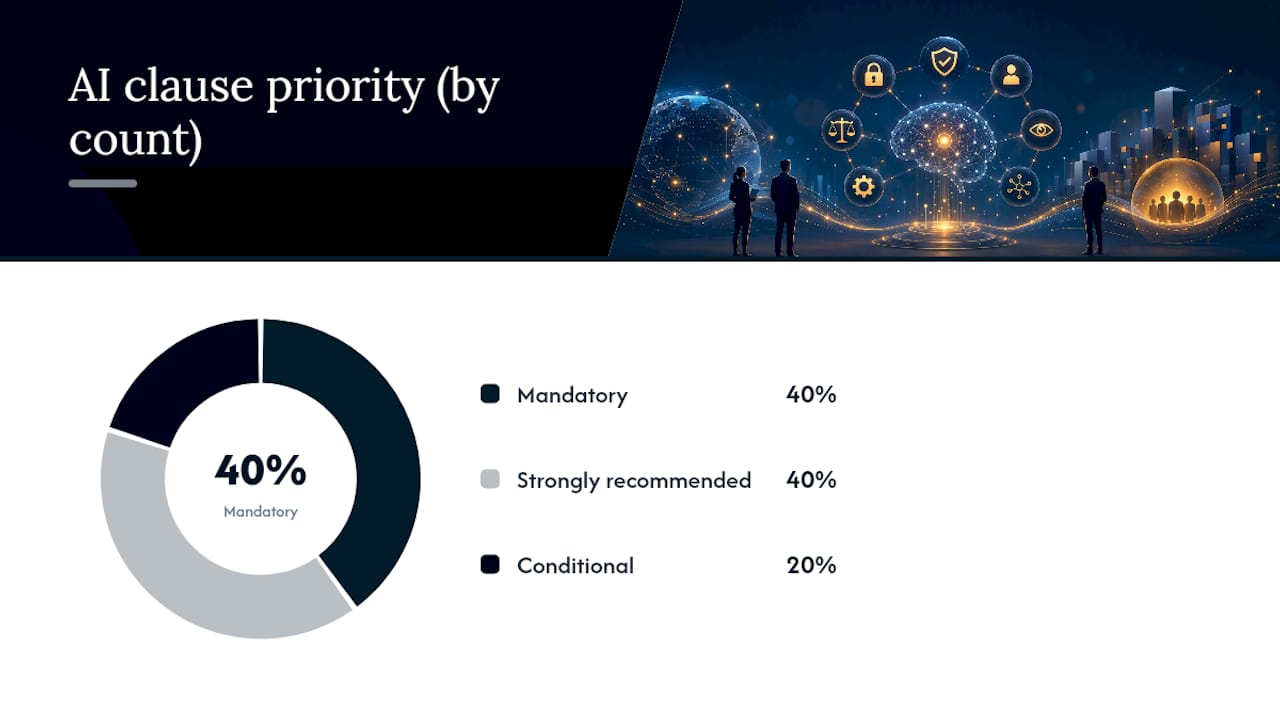
Not every clause deserves equal fight time. Training prohibition and incident SLAs should be mandatory for any vendor touching sensitive or regulated data. Model change notification and AIBOM disclosure are strongly recommended across the board but negotiable in scope for lower-tier vendors. Bias audit rights become mandatory specifically where the vendor’s output influences a decision about a person, hiring, lending, insurance pricing, or similar.
Pro Tip: Vendors will push back hardest on the training prohibition clause, often claiming “aggregate, de-identified” data is exempt. Push for a defined, narrow carve-out in writing rather than accepting a vague exemption, since “de-identified” means different things to different data science teams.
Escalate to legal immediately when a vendor refuses AIBOM disclosure outright, when the vendor’s standard terms include a broad training-use grant buried in an appendix, or when the vendor can’t commit to any incident notification timeline for AI-specific events.
How Do You Monitor AI Vendors After the Contract Is Signed?
Approval isn’t the finish line. AI vendor risk management only works as a living process, because the thing you approved in January can be materially different by June.
Track these indicators on an ongoing basis:
- Announced changes to the vendor’s underlying model or foundation-model provider
- New subprocessors added to the vendor’s disclosed supply chain
- Retraining or fine-tuning events, especially any involving customer data
- Anomalies in output quality, including spikes in hallucination or error rates
- Changes to inference region or data residency
- Increases in retained inference logs beyond originally agreed terms
Set concrete thresholds that trigger reassessment rather than relying on annual reviews alone. A model provider swap, any change in data retention policy, or a measurable spike in error rate should each independently trigger an off-cycle review, not wait for the next renewal date.
Operational playbook for change detection:
- Alerts route to the vendor’s assigned business owner and the AI governance lead simultaneously.
- Triage within five business days: is this a documentation update or a substantive risk change?
- Apply temporary mitigations if needed, restricting data flow to the vendor while review is pending.
- Complete a full reassessment within 30 days of a confirmed material change.
- Update the risk register and notify the original approving stakeholders of the outcome.
Security ratings services, AI usage discovery platforms, and vendor telemetry feeds all help here, but none of them substitute for reading the contract’s own notification clause. KPMG’s guidance on third-party AI risk specifically recommends prioritizing continuous monitoring over static, point-in-time scoping, precisely because vendor claims made at signing routinely drift from reality within months. Validate vendor self-attestations independently where you can, through documented test results or third-party ratings, rather than taking a renewal questionnaire’s answers at face value a second time.
Who Owns AI Vendor Risk Inside Your Organization?
AI vendor risk fails quietly when everyone assumes someone else owns it. A working RACI structure closes that gap:
- Procurement owns intake and initial vendor scoping questions.
- Information security owns technical review, evidence validation, and monitoring tooling.
- Data privacy owns retention, training-use, and data flow assessment.
- Legal owns contract language, clause negotiation, and escalation on refusals.
- Business owner (the internal team requesting the vendor) owns the use case justification and accepts operational risk within their authority.
- AI governance lead, where the role exists, owns cross-functional coordination and policy consistency.
For high-risk findings, a clear escalation timeline prevents drift: initial triage within a week, a documented business decision on remediation or acceptance within 30 days, mandatory legal review before any contract renewal if findings remain open, and board-level notification for any finding tied to regulated decisioning or a confirmed incident.
Policy and risk appetite belong at the governance or enterprise risk level. Day-to-day execution, running questionnaires, tracking monitoring alerts, coordinating technical reviews, belongs with whoever already owns your broader TPRM operations. Don’t create a parallel AI-only process; extend the one you have.
Which Standards and Tools Should Guide Your AI Vendor Reviews?
Mapping your controls to recognized frameworks gives your program credibility with auditors, regulators, and your own board. The NIST AI Risk Management Framework organizes activity across governance, mapping, measuring, and managing functions, and works well as the backbone for structuring your questionnaire categories. ISO/IEC 42001 gives vendors a certifiable AI management system standard worth requesting directly. The OWASP LLM Top 10 catalogs common large language model vulnerabilities useful for scoping technical reviews, while sector rules like the EU AI Act or DORA apply depending on your industry and jurisdiction.
Beyond frameworks, four tooling categories matter: AI discovery and inventory platforms that surface shadow AI usage, external security ratings services that flag vendor posture changes, model behavior testing and red-teaming tools for technical validation, and continuous monitoring platforms that watch for the drift indicators covered above. ISACA’s AI resources and the Partnership on AI’s toolkits offer additional governance guidance worth folding into board-level reporting.
When a vendor claims alignment to any of these standards, ask for the artifact, not the assertion: a certificate number, an audit scope document, or a named third-party assessor. A claim without an artifact is a marketing sentence.
What Do Risk Teams Consistently Get Wrong About AI Vendors?
The programs that struggle share a pattern: they treat AI vendor risk as a software problem wearing a new label. It isn’t. The same governance checklist that worked for a payroll SaaS tool misses model drift, training-data reuse, and fourth-party model dependencies entirely, because those risks simply didn’t exist in the vendors that checklist was built for.

Shadow AI is the recurring blind spot. Individual teams adopt AI features inside tools that were approved years before those features existed, and nobody re-screens the tool because the contract hasn’t technically changed. Overreliance on vendor attestations is the second trap: a SOC 2 report tells you nothing about whether the vendor’s foundation model provider changed last month. And missing fourth-party mapping means organizations discover, usually after an incident, that their “vetted” vendor was quietly routing data through a subprocessor nobody approved.
Do require an AI bill of materials for any high-risk vendor. Don’t accept a vague “we may use anonymized data to improve our services” clause without demanding a defined, narrow scope in writing. Do treat model change notification as a floor requirement, not a nice-to-have. Don’t assume a vendor’s AI use is static just because it looked that way during initial due diligence.
Getting AI vendor risk right takes structured technical review, exactly the kind of work that sits at the intersection of cybersecurity and AI strategy, which is where organizations serious about responsible AI adoption tend to need outside help most.
How tekRESCUE AI Helps You Get Ahead of Vendor Risk
Most compliance teams don’t need another framework document. They need someone to sit down with their actual vendor list and tell them which ones are quietly exposing them right now. tekRESCUE brings 30 years of cybersecurity background directly into AI adoption work, which means the AI Profit and Growth Assessment doesn’t stop at “here’s where AI could save you time.” It maps your existing AI vendor footprint, flags the ones creating the most exposure, and hands you a prioritized path forward instead of a generic checklist.
The engagement itself produces things you can actually use Monday morning: a vendor inventory and risk tiering specific to your organization, contract language recommendations for the highest-risk relationships, and a 30/60/90 day roadmap that sequences remediation instead of dumping every finding on your desk at once. tekRESCUE AI builds this around your operations, not around a template built for a different industry.
If your team is staring at a vendor list with more AI features than you have current visibility into, that’s exactly the gap the AI Profit and Growth Assessment is built to close. Reach out through tekRESCUE to schedule your assessment and get a clear, prioritized view of where your AI vendor exposure actually sits.
Frequently Asked Questions
What is AI vendor risk in simple terms? AI vendor risk is the exposure your organization takes on when a third-party vendor uses artificial intelligence to process, analyze, or act on your data, introducing risks like model drift, training-data reuse, and opaque decision logic that traditional vendor risk assessments don’t capture.
How is AI vendor risk different from regular third-party risk? Regular vendor risk assumes a relatively stable relationship with fixed features and periodic audits. AI vendor risk involves non-deterministic outputs, models that change behavior over time, and dependencies on foundation-model providers several layers removed from your direct contract, requiring continuous rather than periodic oversight.
What questions should be on an AI vendor risk assessment questionnaire? Core questions should cover whether the vendor trains on your data, which foundation model powers their product, whether they’ve conducted adversarial or red-team testing, what subprocessors handle your data, and whether they hold certifications like ISO/IEC 42001.
How often should AI vendors be reassessed? High-risk AI vendors touching sensitive or regulated data should be reassessed whenever a material change occurs, a model provider swap, a retention policy change, or a measurable error-rate spike, rather than waiting for an annual renewal cycle alone.
What contract clauses matter most for managing AI vendor risk? Prioritize a training-data prohibition clause, model change notification requirements, subprocessor and AIBOM disclosure, audit rights covering bias testing results, and a tight incident-notification SLA specific to AI-related security events.
Do I need a separate AI vendor risk program, or can I extend my existing TPRM process? Extend your existing TPRM process rather than building a parallel one. Add an AI-specific supplement to your intake questionnaire, adjust your risk scoring to account for AI-specific factors, and route monitoring alerts through the governance structure you already have.
Sources
Map your questionnaire items and evidence requests to these sources when building or auditing your program:
- NIST AI Risk Management Framework
- ISO/IEC 42001
- Gartner press release, 2025 forecast on AI data breaches