An AI roadmap is a timebound plan that sequences prioritized AI initiatives, ties each one to measurable business value, and builds in the security and governance checks that keep the whole thing from blowing up later. The single biggest takeaway: sequencing beats speed. Organizations that pick a handful of well scored use cases, pilot them with risk controls in place, and reinvest early wins before scaling tend to outpace teams that chase every AI idea at once.
TL;DR:
- Prioritize AI use cases based on a clear value versus risk score, pilot only the top projects, and re-evaluate quarterly to adapt to changing data and platform maturity.
- Ensure data readiness and security are integrated into the roadmap from the start, as neglecting them leads to stalled initiatives or hidden risks during scaling.
- Assign a dedicated owner for the entire AI rollout, maintain a realistic timeline, and connect initiatives directly to existing business goals to prevent scope creep and siloed efforts.
- Budget for ongoing platform, data management, talent, and security operations, recognizing that scaling costs significantly more than pilot investments.
- Conduct threat modeling and implement security controls early to embed responsible AI practices and avoid vulnerabilities that could derail implementation later.
Table of Contents
- What Is an AI Roadmap and Who Needs One?
- Core Components of an Effective AI Roadmap
- How Do You Prioritize and Sequence AI Use Cases?
- How Do You Assess AI Maturity and Measure Progress?
- Why Security Has to Be Built In From Day One
- A 60 to 90 Day Starter Roadmap You Can Copy
- Getting People to Actually Adopt the Change
- Connecting the AI Roadmap to the Rest of the Business
- Where AI Roadmaps Usually Go Wrong
- What Should the Budget Actually Cover?
- The Blind Spots We See Most Often
- Build a Roadmap With Security Built In, Not Bolted On
- Sources
- FAQ
What Is an AI Roadmap and Who Needs One?
An AI roadmap is the document, and the discipline, that turns “we should use AI more” into a schedule of initiatives with owners, timelines, and success criteria. Gartner frames it as the mechanism that sequences initiatives, timelines, and responsibilities so organizations can implement and scale AI rather than run isolated experiments.
There are really two versions of this document, and mixing them up causes confusion. A learning roadmap helps an individual or small team build skills, module by module, toward AI competence. An organizational roadmap is a strategic plan that a leadership team owns, funds, and revisits quarterly. This article focuses mostly on the second kind, though the maturity thinking applies to both.
You need one the moment more than one department starts asking for AI budget, or the moment a single pilot succeeds and everyone wants “more of that.” Common outcomes include a prioritized backlog of use cases, a maturity baseline, and a governance framework that does not slow teams down. Without a roadmap, most companies end up with five disconnected AI tools and no way to explain what any of them are actually worth.
Core Components of an Effective AI Roadmap
Microsoft’s research identifies five drivers behind successful AI transformation: business strategy, technology and data strategy, AI strategy and experience, organization and culture, and AI governance and security. That framework maps cleanly onto the components a working roadmap needs to spell out.
- Strategy and business alignment. Every initiative should trace back to a specific business goal, not a general enthusiasm for AI.
- Value management and KPIs. Define what success looks like in dollars, hours saved, or error reduction before the pilot starts, not after.
- Organization, roles, and resourcing. Someone owns the roadmap. Someone else owns each initiative. Without named owners, initiatives drift.
- Engineering and platform foundations. Model hosting, integration points, and monitoring need to exist before you scale past a pilot.
- Data readiness and pipelines. Clean, accessible, well governed data is the difference between a model that helps and one that quietly makes things worse.
- Governance, responsible AI, and compliance. Rules for approval, monitoring, and shutdown belong in the roadmap itself, not in a separate document nobody reads.
Skip any one of these and the roadmap becomes a wish list. Skip data readiness specifically, and even a well funded initiative stalls the moment it touches real production systems. Skip governance, and you inherit risk you cannot see until it surfaces in an audit or a customer complaint.
How Do You Prioritize and Sequence AI Use Cases?
Most teams have more candidate use cases than they have budget or attention, so the roadmap needs a scoring method, not a gut check. A simple value versus risk matrix works well: plot each use case by expected business value on one axis and implementation or security risk on the other. High value, low risk projects go first.
- Score every candidate use case on expected value (revenue, cost savings, time saved) and risk (data sensitivity, regulatory exposure, integration complexity).
- Pilot the top two or three for 30 to 60 days with a clear success metric agreed upfront.
- Validate results against that metric, not against enthusiasm in the room.
- Scale what works, reinvesting the value it created into platform, governance, and talent before adding the next wave.
- Re-prioritize quarterly, since a use case that scored low six months ago may score higher once your data or platform foundation improves.
Gartner’s guidance recommends exactly this kind of continuous re-evaluation as maturity and business context shift. Expect the first pilot cycle to take six to ten weeks and the first scaled rollout to take another quarter. Anyone promising enterprise-wide AI transformation in 30 days is selling something.
How Do You Assess AI Maturity and Measure Progress?
A maturity assessment is a quick scoring exercise across the same pillars that show up in the roadmap itself: strategy, data, governance, engineering, organization, and value realization. Score each pillar from “ad hoc” to “optimized,” and you get an honest picture of where the next dollar should go.
The scoring itself matters less than what you do with it. A low data readiness score should redirect budget toward pipelines and access controls before another pilot launches. A low governance score should slow down scaling, even when a pilot looks promising, because scaling an ungoverned process just multiplies the risk.
Dashboards should track a small set of concrete numbers rather than vanity metrics:
- Time to value for each initiative, from kickoff to measurable business impact
- Cost per use case versus projected return
- Adoption rate among intended users, not just deployment count
- Incident count tied to AI systems, including near misses
- Data quality scores feeding the highest priority models
Microsoft’s five driver framework treats this kind of readiness assessment as the starting point for prioritizing investment, not a one-time checkbox.
Why Security Has to Be Built In From Day One
Security gaps are one of the leading reasons AI projects stall before they ever scale, according to the Practical DevSecOps security-first framework. A model trained on sensitive customer data, deployed without access controls, is not a future risk. It is an active one the day it goes live.
Start with an inventory: what AI systems exist, what data they touch, and who can access them. Classify that data by sensitivity, then threat model each system before deployment, the same way you would a new piece of production software. Layer in Zero Trust controls so no AI workload gets implicit trust just because it is internal, and add data loss prevention rules around anything that touches customer or financial data.
Operationally, that means logging every model interaction, treating MLOps pipelines with the same observability and change control you would apply to CI/CD, and giving security operations visibility into AI systems, not just IT systems. Someone needs to own AI security specifically, even if that person wears three other hats.
Pro Tip: Run a lightweight threat model on your very first pilot, even if it feels like overkill for something small. The habit is what matters. Teams that skip it on the “harmless” pilot skip it again on the system that actually holds sensitive data.
This is the exact gap tekRESCUE built the AI Profit and Growth Assessment to close: a tailored roadmap that treats security as a design input, not an afterthought bolted on before launch.
A 60 to 90 Day Starter Roadmap You Can Copy
You do not need a finished five-year strategy to start. You need the next twelve weeks mapped out with owners and checkpoints.
- Weeks 1 to 2, discovery and inventory. Catalog existing AI tools, data sources, and any shadow AI already in use. Interview department heads about pain points AI might solve.
- Weeks 3 to 6, prioritize and pilot. Score candidate use cases with the value versus risk matrix, pick the top two, and launch pilots with a named owner and a defined success metric each.
- Weeks 7 to 10, validate and harden governance. Measure pilot results against the agreed metric, threat model each pilot, and draft the approval workflow future initiatives will follow.
- Weeks 11 to 12, plan for scale. Decide what graduates to a scaled rollout, what gets cut, and what the next quarter’s roadmap should include.
Put checkpoints on the calendar now, not after week 4 when momentum has already stalled. A roadmap without dates is a set of good intentions.
Getting People to Actually Adopt the Change
The best roadmap fails if the people expected to use the new tools quietly route around them. Change management for AI initiatives is not a training slide deck. It is a deliberate effort to show people what changes in their actual workflow, and to give them a way to raise concerns before frustration turns into resistance.
Start with the people closest to the process being changed, not just the executives who approved the budget. A customer service team asked to use an AI drafting tool needs to see, early, that it saves them time rather than adding a review step they did not ask for. Skip that conversation and adoption numbers stay flat no matter how good the model is.
Communicate in stages: what is changing, why, what stays the same, and what support exists if something goes wrong. Identify a few respected people inside each affected team to pilot the change first and speak to it honestly, including the rough edges. Peer credibility moves adoption faster than a mandate from leadership ever will.
Build a feedback loop that actually closes. If a pilot user flags that the AI tool produces wrong answers in a specific scenario, that feedback needs to reach the team that owns the model, and the fix needs to be visible. Nothing kills adoption faster than reporting a problem into a void.

Expect resistance to concentrate around roles where AI visibly changes what “good work” looks like. Rules-based, predictable tasks see the most disruption, while roles built on relational trust or high-stakes judgment tend to shift more slowly, a pattern Stanford’s research on AI and employment confirms at the task level rather than the job level. Naming that pattern honestly, instead of promising nobody’s role changes, builds more trust than false reassurance.
Connecting the AI Roadmap to the Rest of the Business
An AI roadmap that lives in its own silo, disconnected from the company’s broader digital transformation plan, tends to produce impressive pilots that never earn a renewal budget. The fix is structural: every AI initiative on the roadmap should map to a business goal that already exists on someone else’s scorecard, whether that is revenue growth, cost reduction, customer retention, or regulatory compliance.
This is where sponsorship matters more than most teams expect. An AI roadmap owned entirely by IT, with no business unit leader accountable for the outcomes, rarely survives its first budget review. Partnering with teams that already own business strategy and project management helps make sure AI investments are framed in the same language as every other capital decision the company makes, rather than treated as a separate, experimental line item.
The practical move is to build the AI roadmap alongside, not after, whatever digital transformation or modernization plan already exists. If the company is migrating systems to the cloud, upgrading its data platform, or restructuring customer service, those initiatives create the foundation AI needs to work well. Bolting AI onto brittle legacy systems produces exactly the kind of fragile pilots that never scale.
Revisit the alignment at least twice a year. Business priorities shift, budgets get reallocated, and an AI roadmap that made sense in January can look disconnected by the third quarter if nobody checks it against the company’s current direction.
Where AI Roadmaps Usually Go Wrong
The most common failure is not technical. It is ownership. A roadmap with no single accountable owner turns into a shared document everyone edits and nobody drives, and initiatives stall in committee while competitors ship.
The second most common failure is treating data readiness as someone else’s problem. Teams pick an ambitious use case, discover mid-pilot that the underlying data is inconsistent, poorly labeled, or scattered across five systems, and burn the pilot budget fixing plumbing instead of testing the model. Partners focused specifically on AI-ready data and platform engineering exist precisely because this gap shows up so often.
A third pitfall is adding security and governance after a pilot succeeds instead of before it starts. It feels efficient to move fast and secure things later, but retrofitting access controls and audit trails onto a system already touching production data is slower and riskier than building them in from the start.
Scope creep kills momentum too. A pilot meant to prove one narrow use case slowly expands to “solve AI for the whole department,” loses its clear success metric, and never actually gets validated. Keep pilots narrow on purpose.
Finally, plenty of roadmaps die from unrealistic timelines set by whoever is most excited in the room, not by anyone who has actually run an AI pilot. Padding in a realistic validation and hardening phase, rather than jumping straight from pilot to full rollout, prevents the kind of scramble that erodes trust in the whole initiative.
What Should the Budget Actually Cover?
AI budgets that only fund model licensing or a one-time pilot almost always undercount the real cost. A realistic budget spans four categories: platform and engineering (hosting, integration, monitoring tools), data work (cleanup, pipeline building, access governance), talent (whether that is new hires, contractors, or training existing staff), and ongoing security and governance operations that do not stop once the pilot ends.
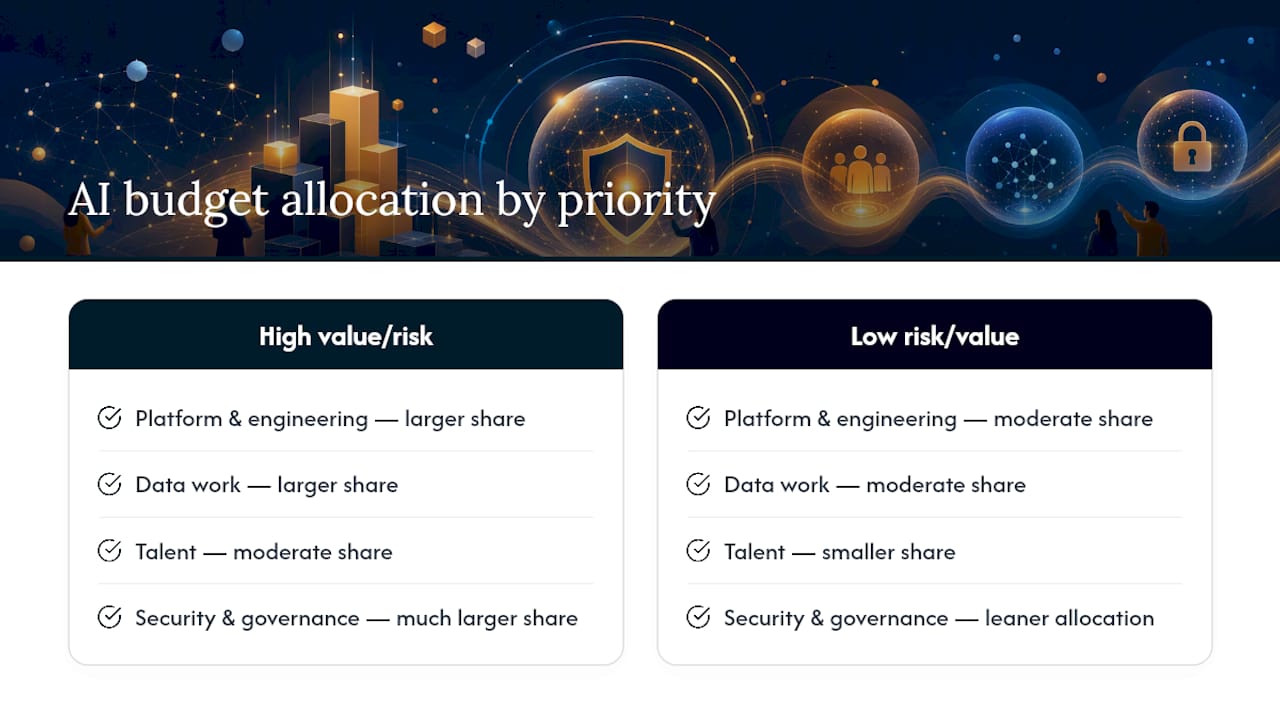
Resource allocation should follow the same value versus risk logic used to prioritize use cases. High value, high risk initiatives deserve a bigger share of the security and governance budget specifically, not just a bigger overall number. Low risk, high value pilots can move faster with a leaner allocation.
A common budgeting mistake is front-loading spend on flashy pilots and starving the maintenance budget that keeps a scaled system running safely. Models drift, data sources change, and threat models age. Building a maintenance and monitoring line item into the roadmap from the start avoids the unpleasant surprise of a system that worked great at launch and quietly degraded eighteen months later.
Expect the ratio of pilot cost to scale cost to shift heavily toward scale. A successful pilot might cost a few weeks of a small team’s time. Scaling that same use case company-wide usually requires real investment in the platform and data foundations that make it reliable at volume, plus the ongoing security operations that keep it safe once more people depend on it.
The Blind Spots We See Most Often
Three gaps show up again and again in organizations building their first AI roadmap: nobody owns it end to end, data readiness gets assumed rather than checked, and security gets bolted on after a pilot already succeeds. Each is fixable early and expensive to fix late. Name one accountable owner before the first pilot launches. Audit your data before you pick your first use case, not after. Threat model every pilot, even the small ones, because the habit you build on a low stakes project is the habit you will rely on when the stakes go up.
— Randy Bryan
Build a Roadmap With Security Built In, Not Bolted On
Most AI roadmaps get written by a single department, tested against a single use case, and handed to leadership without anyone checking whether the underlying data or security posture can actually support scale. tekRESCUE AI takes a different starting point: the AI Profit and Growth Assessment maps your specific business against the value versus risk sequencing this article walks through, then builds security and governance into the plan from the first page rather than as a follow-up project six months later.
The assessment delivers a prioritized set of use cases scored for business value and risk, a maturity baseline across strategy, data, and governance, and a set of concrete security checks tied to each recommended initiative, not a generic template. It fits organizations anywhere from a small professional services firm running its first pilot to a construction or real estate company scaling AI across multiple sites. If your team has more AI ideas than a clear way to sequence them, request an AI Profit and Growth Assessment and get a roadmap built around your actual data, risk profile, and business goals.
Sources
- AI Roadmap: How to Build and Scale AI | Gartner
- The AI Strategy Roadmap: Five drivers of successful AI transformation | The Microsoft Cloud Blog
- Secure AI adoption using Zero Trust principles | Microsoft
- What’s Really Happening to Jobs? Separating AI Hype from Reality | Stanford
- Build an effective AI strategy: A Security-first Framework | Practical DevSecOps
FAQ
What Is an AI Roadmap?
An AI roadmap is a timebound plan that sequences prioritized AI initiatives, ties each to measurable business value, and builds in governance and security controls, so an organization can move from isolated pilots to scaled, managed AI adoption.
Which Jobs Are Least Likely to Survive AI?
Predictable, rules-based roles built on repetitive, well-defined tasks face the most disruption, while jobs requiring relational trust or high-stakes judgment tend to remain more resistant, according to Stanford’s research on AI and employment. The shift happens at the task level within jobs more often than through wholesale job elimination.
What Is the 30 Percent Rule in AI?
There is no single, widely recognized “30 percent rule” tied to a specific standard or authority; definitions vary depending on the source, so treat any specific percentage cited for AI adoption or automation with caution unless it comes from a named study.
How Do I Start a Career in AI?
Build foundational skills in data, statistics, and at least one programming language, then apply them to a real project or roadmap exercise rather than studying theory alone. Many people accelerate this by working alongside teams that already run AI initiatives, since practical exposure to prioritization, data readiness, and governance teaches lessons a course alone cannot.
How Often Should an AI Roadmap Be Updated?
Revisit the roadmap at least quarterly, since Gartner recommends continuous re-evaluation as maturity, budget, and business priorities shift. A roadmap that goes untouched for a year is almost always out of step with the organization it is supposed to guide.