An AI risk register is a living, auditable record that links every AI system your organization uses to its named risk owner, the controls in place, and a review date. It only works if someone maintains it. The first move isn’t picking software: it’s building a short inventory of every AI system in use, then piloting the register on just one of them before rolling it out further. NIST’s AI RMF gives you the functional backbone; Specialized AI partners can help you turn that pilot into a full remediation roadmap once the entries start piling up.
TL;DR:
- Most AI risk registers fail to stay current because they depend on consistent updates from team assessments and inventory feeds.
- Setting clear ownership with named individuals and scheduling quarterly reviews prevents risk entry abandonment and scoring drift.
- Automating assessment data entry and mapping it directly into the register improves reliability and audit readiness.
- Aligning the register with recognized standards like NIST AI RMF and ISO/IEC 42001 simplifies compliance and traceability for regulators and board members.
- A structured remediation plan based on business impact helps prioritize high-risk issues and accelerates effective mitigation efforts.
Table of Contents
- What Fields Belong in an AI Risk Register Template?
- How Do You Populate the Register From Your AI Inventory?
- How Do You Score and Prioritize AI Risks?
- Why Should the Register Align With NIST AI RMF and Other Standards?
- Who Owns the Register and How Often Should It Be Reviewed?
- What Does Research From NIST and MIT Recommend?
- What Do Real-World Uses of AI Risk Registers Look Like?
- What Are the Best Strategies for Mitigating High-Priority AI Risks?
- What Makes an AI Risk Register Hard to Keep Current?
- What tekRESCUE Sees in AI Risk Assessments
- How tekRESCUE Turns Your Register Into a Roadmap
- Sources
- FAQ
What Fields Belong in an AI Risk Register Template?
A register earns its keep only when every row answers the same question: what could go wrong, who’s responsible, and how will we know if it’s under control? Practitioner guides converge on a consistent set of fields, and Aicura’s AI risk register guide recommends pulling entries from actual assessments rather than typing them from memory.
Here’s the core field list:
- Risk ID: a unique tag so the same risk isn’t logged twice under different names
- System / use case: the specific AI tool or workflow, not “AI” as a category
- Risk description: written as cause, leading to event, leading to harm (not a vague label)
- Category: bias, security, privacy, reliability, third party, or similar
- Likelihood (1 to 5) and Impact (1 to 5)
- Inherent risk score: likelihood times impact, before controls
- Controls applied: the specific safeguard, not “we’re working on it”
- Residual risk score: the score after controls
- Owner: a named person, never a department
- Status: open, mitigating, accepted, closed
- Review date: the next scheduled check
- Linked evidence: the assessment, test, or audit that backs the entry
A vague entry reads “AI might make mistakes.” A usable one reads “Vendor chatbot may hallucinate pricing terms (cause), leading to a customer quoting an incorrect discount (event), resulting in revenue loss and complaint escalation (harm).” Named owners and hard review dates are what make a register defensible in an audit. Without both, it’s a spreadsheet nobody trusts.
How Do You Populate the Register From Your AI Inventory?
Most registers fail not because the fields are wrong, but because nobody feeds them consistently. Start with the inventory, then run it through actual assessments instead of guessing.
- Build or reuse an AI system inventory. Include obvious tools plus shadow AI: browser extensions, embedded copilot features in existing software, and anything procurement didn’t formally approve.
- Run system-level assessments for each entry: threat modeling, bias and fairness checks, security testing, and privacy impact assessments where personal data is involved.
- Push assessment findings straight into register rows. Don’t summarize from memory weeks later. If a bias test flags a disparity, that becomes the risk description verbatim.
- Automate the handoff where you can. CSV exports, webhook triggers from testing tools, or a simple mapping between your assessment template and the register cuts drift dramatically.
Entries sourced from real assessments hold up under scrutiny; entries drafted from a workshop brainstorm rarely do. Tools built for developer workflows, like AmmarAI’s code generation tooling, can also surface technical risk detail worth logging when AI is writing or reviewing code.
Pro Tip: Treat the register as an output of your assessment process, not a parallel document. If someone can update the register without touching an assessment, the register will drift within a quarter.
How Do You Score and Prioritize AI Risks?
Scoring only works if the numbers mean the same thing to everyone using them. Set 1 to 5 anchors for both likelihood (1 = rare, 5 = near certain) and impact (1 = negligible, 5 = severe, regulatory, or safety related). Multiply the two for your inherent risk score, then apply the same formula after controls to get residual risk.
Priority bands typically break down like this:
- Green (1 to 6): accept the risk, monitor at standard cadence
- Yellow (8 to 15): mitigate or transfer, assign a control owner and deadline
- Red (16 to 25): urgent mitigation, escalate to leadership, or avoid the use case entirely
Document control effectiveness with a before and after score, not just a final number. An agentic AI tool with unrestricted data access might score inherent risk at 20 (likelihood 4, impact 5). Add provenance checks, an allowlist restricting what it can touch, and audit logging, and residual risk might drop to 8, likelihood 2, impact 4. Worked examples from systemprompt.io show this kind of before/after scoring with named controls, which is exactly what auditors look for: evidence that a specific control, not general good intentions, moved the number.
Why Should the Register Align With NIST AI RMF and Other Standards?
A register that maps cleanly to recognized frameworks survives audits and procurement reviews with far less friction than one built from scratch. NIST’s AI RMF 1.0 organizes everything around four functions, and each one has a natural home in your register:
- Govern: your ownership fields, policies, and escalation paths
- Map: the system inventory and risk categories
- Measure: likelihood, impact, and monitoring data
- Manage: controls applied, residual risk, and review status
Teams operating internationally should also treat ISO/IEC 42001 and the EU AI Act as compliance context worth tracking, not something to ignore just because your operations are US based. Article 9 of the EU AI Act requires continuous risk management for high-risk systems, which is a stricter version of what NIST recommends voluntarily. Mapping your fields this way means a board member or third-party reviewer can trace any entry back to a recognized standard instead of taking your word for it.
Who Owns the Register and How Often Should It Be Reviewed?
Ownership fails the moment it’s assigned to a department instead of a person. Every entry needs a named individual with a clear escalation path, someone who can be asked directly why a risk is still open.
- Assign named owners, not teams. “IT Security” isn’t accountable. A named director is.
- Set a quarterly baseline review, with triggered reviews any time there’s an incident, a vendor model update, or a material change in use case.
- Record review evidence. A date change alone proves nothing; log what was checked and what changed.
Board summaries should stay short: top five risks by score, a snapshot of regulatory exposure, an incident log, and next-quarter actions. Rework’s board-ready framework recommends tying monitoring output directly back into the register so incidents generate new rows automatically instead of waiting for the next quarterly meeting.
Pro Tip: If a risk has sat in “mitigating” status for two review cycles with no score change, that’s a governance failure, not a risk problem. Escalate the owner conversation, not the risk score.
What Does Research From NIST and MIT Recommend?
The NIST AI RMF Playbook maps suggested actions to each subcategory of the framework, and inventories, defined roles, and review cadences show up repeatedly as the practical backbone underneath all four functions. That’s not abstract guidance: it’s a checklist for exactly what your register needs to do.
- Use the Playbook’s suggested actions as a starting checklist rather than building your own from zero
- Pull real-world examples from the MIT AI Risk Initiative, which maintains a living repository of documented AI incidents useful for seeding entries with evidence instead of hypotheticals
- Tie monitoring and post-market data feeds directly into register updates so an incident automatically creates or revises a row, rather than sitting in someone’s inbox
Evidence-driven entries hold up better in front of a board or a regulator than entries built purely from internal speculation.
What Do Real-World Uses of AI Risk Registers Look Like?
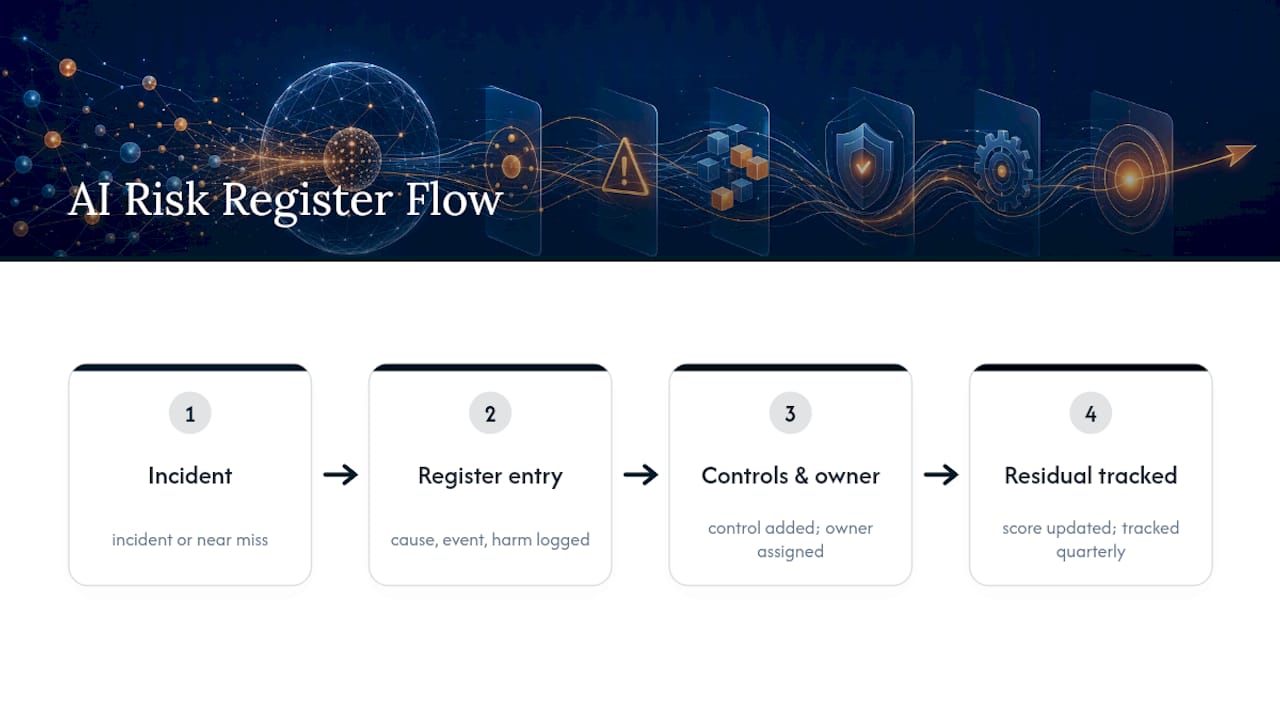
A mid-size professional services firm rolling out an AI drafting tool for client contracts is a useful illustration of how this plays out in practice. Before the register existed, the firm’s only risk conversation happened informally, after a junior associate flagged that the tool had inserted an outdated liability clause into a signed document. That single incident became the first register entry: cause (model trained on older templates), event (outdated clause inserted without flag), harm (potential client dispute). The inherent score landed in the red band. After adding a mandatory human review step and a clause version checker, residual risk dropped to yellow within one review cycle.
Construction firms deploying AI for bid estimation face a similar pattern: risk of underestimating material costs due to stale pricing data ends up scored, assigned an owner in procurement, and tied to a quarterly data refresh control. The value isn’t the software doing the estimating. It’s that the risk of a bad estimate is now visible, owned, and tracked instead of discovered after a bid is already submitted.
Nonprofits using AI for donor communications have logged similar entries around data privacy, particularly when donor lists get uploaded into third-party AI tools without a clear data processing agreement. In each case, the pattern is the same: an incident or a near miss becomes a register entry, a control gets attached, and the residual score becomes something leadership can actually track quarter over quarter instead of hearing about only when something breaks.
What Are the Best Strategies for Mitigating High-Priority AI Risks?
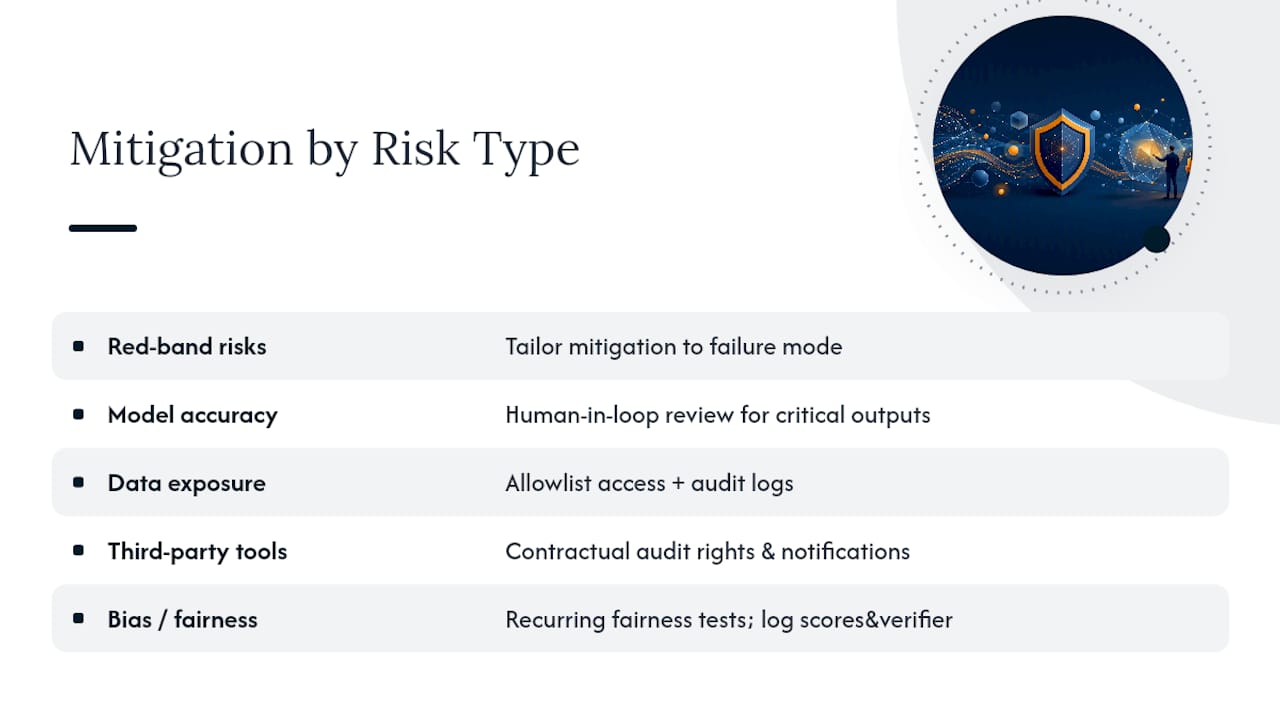
Red-band risks demand a different response than a general “we’ll monitor it” note. The mitigation strategy has to match the actual failure mode, not a generic security checklist.
For risks tied to model accuracy or hallucination, the most reliable control is a human-in-the-loop review step for any output that touches money, legal terms, or customer-facing commitments. It’s not glamorous, but it consistently drops residual scores faster than trying to fine-tune a model into perfect behavior.
For risks tied to data exposure, an allowlist approach works better than a blocklist. Define exactly what data a tool can access rather than trying to enumerate everything it shouldn’t touch. Audit logging paired with that allowlist gives you the evidence trail auditors want to see when they ask how a residual score was justified.
For risks tied to vendor or third-party AI tools, the strongest lever is contractual: data processing terms, model update notifications, and a right to audit written into the vendor agreement before the tool goes live, not after an incident. Automation and integration platforms, such as RevRing’s AI and automation tooling, are also worth logging at the control layer, since the access permissions a tool has often determine whether a risk stays yellow or escalates to red.
For risks tied to bias or fairness, the mitigation usually isn’t a single fix but a recurring test cycle: rerun the fairness check every time the model or training data changes, and log the result as new evidence rather than assuming the original test still holds. Whatever the mitigation, the register entry needs the before and after score and the name of the person who verified the fix worked, not just that it was attempted.
What Makes an AI Risk Register Hard to Keep Current?
The most common failure isn’t a bad template. It’s abandonment. Teams build a thorough register during a compliance push, then let it sit untouched for two quarters while new AI tools quietly enter the business through procurement side doors or a manager’s personal subscription to a chatbot tool.
Shadow AI is the biggest source of drift. An employee adopts a new AI writing assistant or a browser plugin, nobody tells IT or compliance, and the register stays blind to a live risk. The fix isn’t more policy documents; it’s a lightweight, recurring inventory sweep, quarterly at minimum, that specifically asks teams what new AI tools they’ve started using since the last check.
Another recurring challenge is scoring drift, where different departments interpret the 1 to 5 likelihood and impact scale inconsistently. One team’s “3” is another team’s “5.” The best practice here is a short, shared scoring rubric with concrete examples for each number, reviewed once a year so new hires score the same way as everyone else.
The third challenge is ownership decay: a named owner leaves the company, and their open risk entries sit orphaned for months. Building a rule that reassigns ownership automatically whenever someone leaves, tied into offboarding checklists, closes that gap before it becomes a governance failure. A register that survives staff turnover and tool sprawl is one that gets checked on a fixed calendar, not one that only gets attention when a regulator or a new client asks to see it.
What tekRESCUE Sees in AI Risk Assessments
Most AI risk registers we come across started strong and then stalled, usually right after the initial rollout, when the entries stopped getting new evidence and started collecting dust. What actually moves a register from paperwork to protection is treating it as one input into a broader remediation roadmap, not the finish line.
A strong approach integrates cybersecurity findings directly into the risk picture, because an AI system’s biggest exposure is often a security gap nobody labeled as an “AI risk” in the first place. Prioritizing controls means looking at both the model and the infrastructure around it, together, not as separate reviews with separate owners.
— Randy Bryan
How tekRESCUE Turns Your Register Into a Roadmap
A register tells you what’s wrong. It doesn’t tell you what to fix first or how much runway you have to fix it. That’s the gap tekRESCUE closes with the AI Profit and Growth Assessment: a structured review that takes your register’s red and yellow entries and maps them to an actual sequence of fixes, tied to where AI is creating the most value and the most exposure at the same time.
Years of IT and cybersecurity experience shape a different approach than a generic AI rollout plan. The assessment doesn’t just flag risks, it ranks them against business impact, so a construction firm, a nonprofit, or a professional services practice walks away with a roadmap that says which control to fund first and why. If your register already has red-band entries sitting without a named remediation plan, that’s the moment to bring in an AI partner instead of letting the entries age another quarter. Book an AI Profit and Growth Assessment and get a prioritized plan built around the risks your own register already surfaced.
Sources
Keep these close when you’re building out the framework side of your register. The NIST AI RMF Playbook maps suggested actions to each function, useful when you’re deciding what a “Manage” entry should actually contain. The official AI RMF 1.0 text is the primary source if a reviewer ever questions your framework alignment. The MIT AI Risk Initiative is the best place to pull real incident examples when you need evidence-backed entries instead of hypothetical ones.
FAQ
What Is an AI Risk Register Used For?
It tracks every AI system an organization uses alongside its risks, controls, named owner, and review date, so risk exposure stays visible instead of scattered across emails and meeting notes.
How Is an AI Risk Register Different From a General Risk Register?
An AI risk register adds AI-specific categories like model bias, hallucination, and data provenance, and it typically ties entries to technical assessments like fairness testing rather than only financial or operational review.
Does NIST Require Companies to Use an AI Risk Register?
No. The NIST AI RMF is voluntary and sector-neutral, and a register is the most practical way to operationalize its Govern, Map, Measure, and Manage functions.
How Often Should an AI Risk Register Be Reviewed?
Quarterly at minimum, with additional triggered reviews any time there’s an incident, a model update, or a material change to how a system is used.
Can tekRESCUE Help Build or Review Our AI Risk Register?
Yes. The AI Profit and Growth Assessment from tekRESCUE reviews existing register entries and builds a prioritized remediation roadmap around the risks and controls already identified.