AI red teaming is structured adversarial testing that hunts down behavioral and system-level weaknesses in AI systems before an attacker or an ordinary user finds them by accident. Run it when your system is high-impact, agentic, or exposed to the outside world. That’s the threshold. Below it, lighter testing might do; above it, you need a real program.
Two authority signals anchor this practice. NIST’s AI Risk Management Framework maps governance functions directly to testing activities, including red teaming, across the AI lifecycle. MITRE ATLAS catalogs the actual tactics attackers use against machine learning systems, giving teams a shared vocabulary instead of guesswork. tekRESCUE works with organizations across construction, professional services, and nonprofits to translate these frameworks into something a leadership team can act on.
Who should prioritize this work right now?
- Any organization deploying a customer-facing chatbot or agent that can take real-world actions
- Teams building retrieval-augmented systems that touch sensitive internal data
- Businesses in regulated industries facing new adversarial-testing mandates
Quick fact: NIST AI 600-1 specifically recommends red teaming as part of measurement and validation at multiple points in the AI lifecycle, not just before launch.
Key Takeaways
AI red teaming succeeds when organizations match testing depth to system risk, assign remediation ownership before testing starts, and repeat the cycle continuously rather than treating one exercise as proof of safety.
| Point | Details |
|---|---|
| Scope by risk, not habit | Use a four-tier framework tied to impact, autonomy, and regulation to size the testing effort. |
| Threat model comes first | Map assets, personas, and entry points before selecting attack tactics. |
| Hybrid testing wins | Combine manual expert testing with automated fuzzing for both nuance and scale. |
| Findings need owners | Name a remediation owner before testing begins, or issues sit unresolved. |
| tekRESCUE offers a starting point | The AI Assessment maps threats and produces a board-ready remediation roadmap. |
Table of Contents
- What Does AI Red Teaming Actually Cover?
- How Do You Build a Threat Model for AI Systems?
- Which Testing Tier Fits Your AI System?
- How Do You Design and Run an AI Red Team Test?
- What Tools and Frameworks Support AI Red Teaming?
- What Do Real AI Red Teaming Findings Look Like?
- Why Do Red Team Results Get Misread So Often?
- How Do You Start or Scale an AI Red Teaming Program?
- How Does tekRESCUE Approach AI Red Teaming for Clients?
- Why the “One Test and Done” Mindset Fails Security Teams
- Get an AI Risk Assessment Built for How Your Business Actually Works
- Sources
What Does AI Red Teaming Actually Cover?
Traditional red teaming targets networks, endpoints, and applications with mostly deterministic behavior. AI red teaming targets something messier: models, agents, tool-calling chains, and retrieval pipelines that produce different answers to the same prompt depending on context, temperature, and sheer luck.
That unpredictability changes the job. A traditional pen test finds a fixed vulnerability once and it stays found. An AI system might leak sensitive data on one run and refuse the exact same prompt on the next, so testers need repeated trials, varied personas, and enough sample size to know if a failure is a pattern or a fluke.
The scope also widens. You’re not just testing “the model.” You’re testing:
- The base model’s raw behavior under adversarial prompts
- The application layer wrapped around it, including guardrails and filters
- Any agents or tools the system can invoke on its own
- The retrieval or database layer feeding it context
Microsoft’s own red team has found that model-level and application-level testing surface different failure modes, and skipping either one leaves gaps. This is also why AI red teaming leans on socio-technical expertise, not just security skills. Understanding how a support agent might misuse an internal tool, or how a vulnerable user might be manipulated by a chatbot, takes people who understand behavior, not just exploits.
How Do You Build a Threat Model for AI Systems?
Before you test anything, you need to know what you’re defending and against whom. A workable threat model for AI systems covers five elements, adapted from guidance that Microsoft and NIST both echo in their own frameworks:
- Assets: which models, agents, data stores, and tools are in scope
- Attacker personas: who’s likely to target this system and why
- Capabilities: what access or tooling an attacker realistically has
- Entry points: prompts, APIs, uploaded files, plugin calls, memory stores
- Impact: what happens if a given attack succeeds
Attacker personas vary widely. A curious employee testing boundaries looks nothing like a competitor trying to extract your system prompt, and neither resembles a fraud ring probing your customer service bot for account takeover paths. Concrete TTPs include prompt injection hidden inside a PDF upload, memory poisoning across sessions, or chained tool calls that escalate a low-privilege request into a high-privilege action.
Once personas are set, map them against MITRE ATLAS tactics and OWASP’s LLM and agentic risk categories to pick which techniques actually apply to your architecture.
Pro Tip: Don’t threat-model in a vacuum. Pull in someone from customer support or operations who knows how real users misuse the system today. They’ll surface attack paths your security team never thought to test.
Which Testing Tier Fits Your AI System?
Not every chatbot needs the same scrutiny as an autonomous agent with database write access. A four-tier framework, drawn from practitioner guidance that synthesizes NIST, OWASP, and MITRE, matches testing depth to actual risk instead of treating every deployment the same way.
The tiers scale along four dimensions: deployment impact, autonomy, threat exposure, and regulatory obligation. A risk-proportionate approach keeps low-risk projects from drowning in process while making sure high-risk ones get real scrutiny.
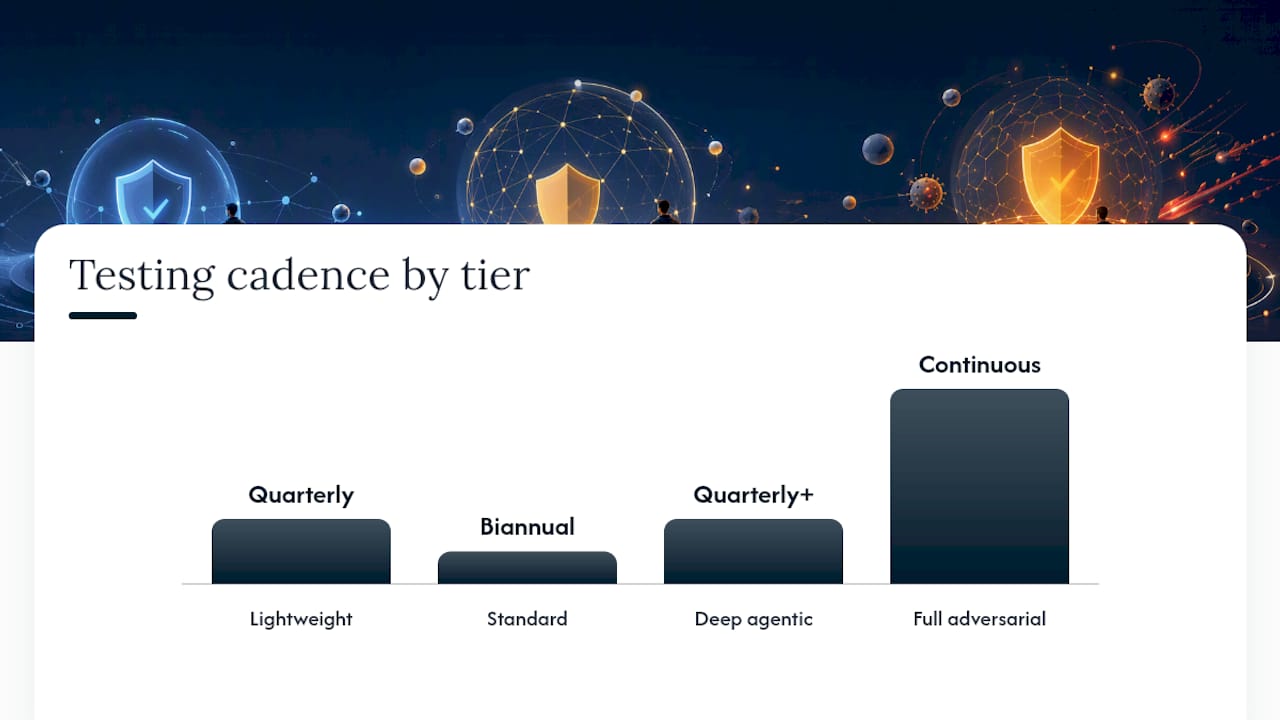
- Lightweight: internal tools with limited data access. A short adversarial prompt set, run quarterly, checking for obvious jailbreaks and data leakage.
- Standard: customer-facing assistants without transaction authority. Broader prompt libraries, persona-based testing, and application-layer guardrail checks, run twice a year.
- Deep agentic: systems that can call tools, write to databases, or take multi-step actions. Full threat-model mapping, chained exploit attempts, and manual expert review, run quarterly or after any capability change.
- Full adversarial: regulated, high-impact, or safety-critical deployments. Continuous testing, external red teams, board-level reporting, and mandatory retesting after every material change.
Quick fact: Regulatory pressure is already pushing some organizations toward the top tiers. The EU AI Act and related executive guidance treat adversarial testing as a compliance requirement for certain high-risk systems, not an optional best practice.
Out-of-cycle triggers matter more than the calendar. A new tool integration, a model swap, or a public incident involving a similar system should all trigger an off-schedule test regardless of tier.
How Do You Design and Run an AI Red Team Test?
Good tests follow a sequence, not an improvisation. Skip a step and your findings get harder to trust or reproduce.
- Scope the test to specific assets, personas, and success criteria before anyone writes a single adversarial prompt.
- Map the threat model you built earlier onto the actual system architecture, marking which entry points get tested.
- Select tactics from your ATLAS and OWASP mapping rather than improvising attacks from scratch.
- Execute using both manual testers and automated tools, logging every prompt, response, and system state change.
- Triage findings by exploitability, business impact, reproducibility, and blast radius.
Manual testing catches nuance: a subtle social-engineering angle, a culturally specific manipulation, a business-logic flaw automation would never think to try. Automated fuzzing catches volume: thousands of prompt variations run overnight that no human team could replicate manually. Most credible programs run both, since Microsoft’s own documentation treats hybrid manual and automated methods as standard practice rather than a nice-to-have.
Severity triage decides what gets fixed first. A jailbreak that requires expert-level prompt engineering and only leaks harmless trivia ranks low. A prompt injection that any customer could trigger, that leaks account data, ranks urgent regardless of how “sophisticated” the attack looked.

What Tools and Frameworks Support AI Red Teaming?
You don’t need to build a testing library from scratch. Three reference sets act as the backbone for most programs: MITRE ATLAS for tactic inventories, NIST’s AI RMF for governance mapping, and OWASP’s LLM and agentic Top 10 for concrete risk categories like prompt injection and memory poisoning.
On the tooling side, categories break down into a few useful buckets:
- Prompt fuzzers that automatically generate and mutate adversarial inputs at scale
- Attacker-model frameworks that use one AI model to probe another for weaknesses
- Orchestration and logging tools that track test runs, responses, and system state for later triage
Automation earns its place at volume: running thousands of prompt variants overnight, or continuously monitoring a production system for drift. Expert human teams earn their place on nuance: social engineering angles, business-logic exploits, and judgment calls about what actually constitutes harm in your specific context. Research from CMU’s Software Engineering Institute backs the hybrid model, noting that automated attacker models scale coverage but can’t replace domain expertise for socio-technical scenarios.
What Do Real AI Red Teaming Findings Look Like?
Certain failure patterns show up again and again across engagements, even when the underlying systems look nothing alike.
- Prompt injection through documents or web content that tricks a retrieval-augmented system into leaking internal data it was never supposed to surface in a response.
- Chained agentic exploits, where a low-privilege action like drafting an email escalates step by step into an unauthorized transaction or account change.
- Ordinary user behavior triggering harmful output, not malice: a confused customer phrases a question awkwardly and the system responds with something legally or reputationally risky.
That third pattern deserves attention because it’s the one teams underestimate most. It’s not an attacker you need to worry about. It’s a normal customer, on a normal Tuesday, asking a normal question the wrong way.
Why Do Red Team Results Get Misread So Often?
A single red team engagement is a snapshot, not a guarantee. Passing one round of tests doesn’t mean the system is safe. It means it survived that specific set of attempts, on that day, against that version.
CSET’s research on red-teaming gaps points out that repeated cycles and continuous monitoring matter more than any single exercise, since models drift and new attack techniques emerge constantly. A few organizational pitfalls show up often enough to name directly:
- No one owns remediation, so findings sit in a report nobody actions
- Testing becomes performative, run to satisfy a checkbox rather than surface real risk
- Testers lack the language or cultural coverage to catch region-specific manipulation tactics
- Teams skip psychological safety, so internal testers hold back on flagging uncomfortable findings
Pro Tip: Assign a remediation owner by name before testing starts, not after the report lands. Findings without an accountable owner rarely get fixed, no matter how well-documented they are.
How Do You Start or Scale an AI Red Teaming Program?
Building a program from scratch feels daunting until you break it into a repeatable cycle. Here’s a blueprint that scales from a first pilot to an ongoing operation.
- Set governance first. Define scope, name a remediation owner, and agree on acceptance criteria before anyone runs a test.
- Assign roles. Pair security-minded testers with people who understand the AI system’s specific domain and user base.
- Run the cycle. Scope, map the threat model, select tactics, execute manually and with automation, and log everything.
- Triage and report. Rank findings by severity and produce a short board-facing summary, not just a raw log.
- Remediate and retest. Confirm fixes actually close the gap rather than just suppressing the specific prompt that found it.
- Set cadence by tier. Lightweight systems might run quarterly; deep agentic systems need testing after every capability change.
Maturity shows up less in tooling and more in follow-through. Out-of-cycle triggers, like a new agent integration or a public incident at a similar company, should always override the regular calendar.
Pro Tip: Treat your first cycle as a pilot, not a verdict. The goal of round one is building the process, not proving the system is safe.
How Does tekRESCUE Approach AI Red Teaming for Clients?
tekRESCUE built its practice on 30 years of cybersecurity work before AI risk became a boardroom topic, which shapes how it treats red teaming: as security work first, AI work second. The AI Assessment folds threat modeling directly into strategy planning, so clients see both the opportunity and the exposure in the same conversation.
The assessment typically produces:
- A threat-model map specific to the client’s actual systems and data flows
- Prioritized findings ranked by exploitability and business impact
- A remediation roadmap with named owners, not just a list of risks
- A board-ready briefing that translates technical findings into business language
| Point | Details |
|---|---|
| Test the right tier | Match testing depth to deployment impact, autonomy, and regulatory exposure, not a fixed schedule. |
| Threat model before testing | Define assets, personas, and entry points using NIST and MITRE ATLAS references. |
| Assign remediation owners | Name who fixes findings before testing starts, or reports go unactioned. |
| Retest after change | New tool integrations or model swaps should trigger off-cycle testing. |
| Work with tekRESCUE | The AI Assessment pairs threat modeling with a practical remediation roadmap. |
Why the “One Test and Done” Mindset Fails Security Teams
Most organizations still treat AI red teaming like a compliance box, run once before launch and forgotten. That mindset survives because vendors sell it as a deliverable rather than a discipline, and boards like the finality of a report with a “passed” stamp on it. It’s the wrong instinct.
The research is consistent on this point: CSET’s own analysis treats red teaming as a measurement activity that degrades in value the moment you stop repeating it, not a certification. Models drift, integrations change, and attackers adapt faster than annual test calendars can track.
Where conventional advice really falls short is on ownership. Plenty of guides tell you how to run the test. Fewer tell you that the test is worthless without someone named, in writing, responsible for fixing what it finds. That’s the detail that separates a program from a performance.
If you’re building this out for the first time, don’t start with tooling. Start with the tier decision and the remediation owner. Everything else, the fuzzers, the frameworks, the fancy dashboards, is downstream of getting those two decisions right.
— Randy Bryan
Get an AI Risk Assessment Built for How Your Business Actually Works
tekRESCUE is the AI partner for businesses that want AI adoption and security risk handled in the same conversation, not two separate vendors who never talk to each other. Where most AI consultants hand you a strategy deck and leave the risk assessment for later, tekRESCUE’s AI Assessment builds threat modeling and remediation planning into the roadmap from day one.
That matters most for construction firms, professional services groups, and nonprofits rolling out their first agentic tools, where a chatbot or automated workflow can touch real customer data or financial systems long before anyone’s thought to test it. tekRESCUE maps where AI creates real efficiency for your organization and flags the exposure points before they become incidents, not after.
If your team is planning its first AI deployment or scaling an existing one without a clear risk map, start with the AI Assessment to get a threat model, prioritized findings, and a remediation roadmap built around your actual systems.
Sources
- NIST AI 600-1, AI Risk Management Framework profile for Generative AI
- AI Red-Teaming Design: Threat Models and Tools — CSET
- Microsoft AI Red Team — Microsoft Security Blog
- AI red teaming operationalization and tiered framework (arXiv paper)