AI policy enforcement means automated, real-time controls that inspect every prompt, output, and tool call an AI system makes, then allow, redact, transform, or block it against your governance rules. The single most important move for enterprise security teams is deploying a control plane that sits in the request path and emits an audit-grade decision record for every interaction. Do that first, and you prevent data leakage, enforce role-based access, and generate the exact evidence trail regulators and auditors will eventually ask for.
TL;DR:
- Deploy an enforcement control plane that records decisions for every AI interaction to ensure compliance and facilitate audit processes.
- Implement post-inference controls to detect leaks and hallucinations, as they are not identifiable at the prompt stage.
- Use layered controls including data classification, context-based rules, role restrictions, and graduated responses to effectively mitigate risks.
- Choose architecture patterns based on latency tolerances and ownership needs, such as SDK, sidecar, or API gateway models.
- Track and shadow enforcement metrics, version policies carefully, and establish clear ownership to maintain operational effectiveness and audit readiness.
Table of Contents
- What Does AI Policy Enforcement Look Like in Practice?
- Why Real-Time Enforcement Matters for Enterprise Risk
- What Types of Enforcement Controls Should You Deploy?
- Architecture Patterns for Runtime Enforcement
- How Enforcement Maps to the NIST AI RMF
- Where Enforcement Programs Break, and How to Fix It
- Running Enforcement Day to Day
- tekRESCUE Perspective: Turning Policy Into Enforceable Controls
- Get an AI Profit and Growth Assessment
- Sources
What Does AI Policy Enforcement Look Like in Practice?
Enforcement happens at two points, and the distinction matters more than most teams realize. Pre-inference controls check a prompt before it reaches a model: does this user have access to this tool, does the request contain a data classification flag, is this a known injection pattern? Post-inference controls inspect the model’s actual output, and this is where the real authority sits. A model can be prompted innocently and still generate a response that leaks a customer record or hallucinates a compliance claim. You cannot catch that on the way in.
The logical architecture behind this runs on three roles: a Policy Enforcement Point (PEP) that intercepts traffic, a Policy Decision Point (PDP) that evaluates the request against active rules, and a Policy Administration Point (PAP) where governance teams author and version those rules. The PEP asks the PDP for a decision, the PDP checks the current policy set, and the answer comes back in milliseconds.
That answer typically falls into one of several outcomes:
- Allow: the request matches no risk pattern and passes through unchanged.
- Redact: sensitive fields (PII, account numbers, internal project names) get stripped before the response reaches the user.
- Transform: the output gets rewritten to remove a policy violation while preserving intent.
- Block: the request or response is stopped entirely and logged as a violation.
Each outcome carries a severity tier, and that tier determines how fast the system reacts and how loud the alert is.
Why Real-Time Enforcement Matters for Enterprise Risk
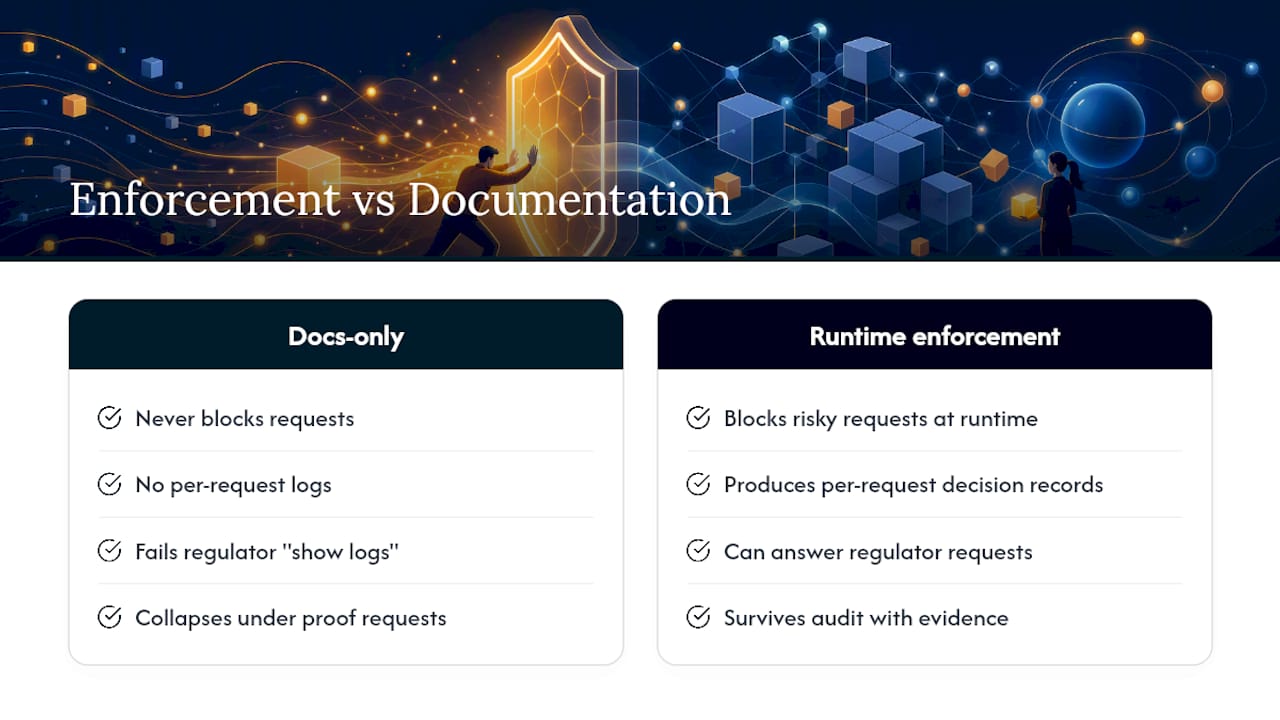
Documentation-only governance does not stop a contractor from pasting a client contract into a public chatbot. Runtime enforcement does. The gap between a written AI policy and an enforced one is where data exfiltration, intellectual property loss, and reputational damage from confabinated or biased outputs actually happen. A policy that lives in a wiki page has never blocked a single request.
The evidence gap is the real risk. Regulators are shifting from “show us your policy” to “show us your logs.” An enforcement layer that cannot produce a per-request decision record leaves you unable to answer that question, no matter how well-written your governance document is.
The NIST AI Risk Management Framework treats continuous measurement and evidence as baseline expectations, not optional extras, and legal analysis increasingly frames this as an infrastructure requirement rather than a policy exercise, since regulators are moving toward evidence-based enforcement standards that assume you can instrument your guardrails, not just describe them.
Industry reporting backs this up from the failure side. Governance programs that stay documentation-only tend to collapse the moment someone asks for proof, and analysis from CIO points to the same fix every time: embed controls that actually change decisions, keep a live inventory, and measure outcomes instead of intentions. Enforcement also has to defend against known attack patterns, not just internal misuse. The OWASP GenAI Top 10 catalogs prompt injection, data leakage, and model integrity failures that every rule set should be tested against before it ships.
The takeaway for prioritization: if you have budget for one thing before your next audit cycle, spend it on enforcement infrastructure, not another policy revision.
What Types of Enforcement Controls Should You Deploy?
Effective enforcement is a layered system, not a single filter. Think of it as four overlapping control families, each catching what the others miss.
- Content and data classification at runtime. Every prompt and response gets scanned for PII, PHI, regulated financial data, and internal IP markers before it crosses a trust boundary. This is the workhorse layer, and it needs to run on both sides of the model call.
- Context-based rules. These combine user identity, role, the sensitivity of the data being touched, and recent conversation history. A finance analyst asking about aggregate revenue is fine. The same analyst asking a model to summarize an unreleased earnings call from a document they should not have access to is not, and only a context-aware rule catches that difference.
- Role-based usage restrictions. This covers which models a team can call, which tools an agent can invoke, and how many autonomous steps an agent chain can take before it needs a human checkpoint. Model and tool whitelisting belongs here too: not every team needs access to certain code-execution tools or external API connectors.
- Graduated response actions. Redact, sanitize, block, quarantine for review, or degrade the model’s capabilities for a risky session (dropping it to a smaller, more constrained model rather than cutting access entirely).
Pro Tip: Start your policy library with quarantine and degrade actions before you jump to hard blocks. A block that fires on a false positive during a board presentation creates more organizational friction than a genuine policy violation would have, and it trains employees to route around your controls.
Sample rules worth building on day one: block any output containing a Social Security number pattern regardless of role, require a second-factor confirmation before an agent can execute a file-write action, and cap autonomous agent chains at three tool calls before requiring a human review step. None of these need custom machine learning. They need a rule engine, a classification layer, and a decision log.

Architecture Patterns for Runtime Enforcement
The PEP/PDP/PAP model works in three physical patterns, and the choice affects who owns what and how much latency you can tolerate.
An SDK (in-process) pattern embeds the enforcement library directly in your application code. It is fast, since there is no network hop, but every application team now owns a piece of your compliance surface, and rule updates require a redeploy unless the SDK pulls policy dynamically.
A sidecar pattern runs enforcement as a co-located process next to your application, communicating over a local socket. This keeps latency low while letting a central security team own the sidecar’s lifecycle independently of application release cycles.
An API gateway plugin intercepts traffic at the network edge, before it reaches any application. This is the easiest pattern to centralize and audit, since one gateway can cover every application behind it, but it adds a network hop and needs careful placement to avoid becoming a bottleneck.
| Pattern | Latency | Ownership | Best fit |
|---|---|---|---|
| SDK (in-process) | Lowest | Application teams | High-throughput services with dedicated engineering support |
| Sidecar | Low | Central security team | Mixed application fleets needing centralized policy without redeploys |
| API gateway plugin | Moderate | Platform/network team | Broad coverage across many applications with minimal app-side change |
Latency budgets matter more here than in most security tooling because AI interactions are already user-facing and time-sensitive. Architecture guidance from EVE Core recommends compiled rule sets evaluated in memory, which keeps enforcement overhead in the sub-millisecond range for most decisions. The exception is the early-exit rule: when a request hits a CRITICAL-severity match, such as a confirmed PII pattern or a known injection signature, the engine should short-circuit evaluation immediately and return a block, rather than running the request through every remaining rule. This keeps behavior deterministic under load and avoids paying evaluation cost on a request you already know you’re stopping.
Whatever pattern you choose, the audit record needs to be structured the same way every time. At minimum, capture: requester identity, role, policy version in effect, data classification detected, decision outcome, latency, and a timestamp. Design this as one canonical record per request rather than scattered log lines, since that single record is what feeds your inventory, your metrics, and your compliance queries later. Application logs built for debugging rarely capture payload-level detail at this granularity, which is one of the more common gaps teams hit when they try to retrofit RMF-level evidence onto infrastructure that was never built to produce it.
How Enforcement Maps to the NIST AI RMF
The NIST AI RMF Playbook breaks governance into four functions, and runtime enforcement artifacts map onto all of them more directly than most teams expect.
- Govern: policy versioning in your PAP, role definitions, and the ownership matrix behind who can change a rule.
- Map: your live inventory of AI systems, agents, and tools, built from actual traffic rather than a survey sent to application owners.
- Measure: the per-request decision records themselves, aggregated into hit rates, block rates, and false-positive tracking.
- Manage: incident response workflows triggered directly by CRITICAL-severity decision events, with remediation tracked back to a specific policy version.
The connecting thread is that one well-structured decision record satisfies Map and Measure at the same time: it tells you what system generated the interaction (inventory) and how that interaction was scored (measurement) in a single artifact. That efficiency matters, because most teams try to build these as separate processes and end up maintaining two systems that drift apart.
For Generative AI-specific risk categories, such as hallucination, toxic output, or IP exposure, align each category to a specific measurement method and a specific alert threshold. A hallucination-prone use case might warrant sampling-based factuality checks feeding a weekly metric, while a data-exfiltration risk warrants a hard, real-time block with immediate alerting. Not every risk needs the same measurement cadence, and treating them identically wastes review capacity on low-risk categories.
Where Enforcement Programs Break, and How to Fix It
Most enforcement failures are not technical. They are organizational.
The most common failure is fragmented ownership: security owns the network, engineering owns the application, and nobody owns the AI policy layer itself. A three-line model fixes this cleanly. The first line is the application or business team using the AI system day to day. The second line is a central AI governance function that owns policy authoring, the PDP, and the audit schema. The third line is internal audit or compliance, which verifies the second line’s controls independently. Without this split, policy changes either never happen or happen without review.
Shadow AI is the second major gap. Employees adopt tools faster than security teams inventory them, which breaks the Map function before it starts. Network-level discovery (watching for API calls to known model providers) and browser extension audits catch most of what a self-reported survey misses.
- Version every policy change and keep a rollback path; control drift happens silently when rule updates go untracked.
- Tune false-positive rates deliberately rather than accepting whatever the default threshold gives you.
- Route CRITICAL-severity blocks directly into your existing incident response tooling instead of a separate AI-only queue.
Pro Tip: Run a monthly diff between your policy version history and your incident log. If violations cluster right after a rule change, that change is probably too aggressive or too loose, and you’ll catch it in weeks instead of finding out during an audit.
Running Enforcement Day to Day
Operationalizing enforcement comes down to three things: clear ownership, metrics you actually check, and a runbook for when something fires.
- Set an ownership matrix. Assign a named owner for policy authoring, a separate owner for the enforcement infrastructure itself, and a rotating on-call owner for incident triage. These should rarely be the same person.
- Track a small set of metrics. Policy hit rate (how often rules fire), blocked-request volume, latency added per decision, and population stability index (PSI) to catch when the traffic pattern hitting your model has shifted enough that your rules may no longer fit it.
- Write a short playbook per severity tier. CRITICAL events page someone immediately and freeze the offending session. HIGH events get reviewed within a business day. LOW events roll into a weekly summary.
- Set a retention policy for decision records up front. Most compliance frameworks expect audit evidence retained for a fixed period, and deciding this after an incident is too late.
tekRESCUE Perspective: Turning Policy Into Enforceable Controls
Most companies we talk to already have an AI policy document. Almost none of them have anything enforcing it. That gap is exactly what tekRESCUE’s AI Profit and Growth Assessment is built to find: where your governance stops on paper and where it needs to start running in your infrastructure.
A typical roadmap after the assessment looks like this: inventory what’s actually in use across the organization, pilot enforcement on the highest-risk workflow first, scale the same controls across remaining systems, generate the audit evidence your compliance team needs, then hand off a documented operating model your internal team can run without us. It’s a deliberate sequence, not a big-bang rollout, because rushed enforcement creates false positives that erode trust in the whole program.
— Randy Bryan
Get an AI Profit and Growth Assessment
Writing an AI policy is the easy part. Enforcing it in real time, with evidence your compliance team can actually hand to an auditor, is where most programs stall out, and that gap is exactly what tekRESCUE was built to close.

tekRESCUE’s AI Profit and Growth Assessment maps where your organization’s AI use already outpaces its controls, then builds a prioritized, risk-aware roadmap instead of a generic checklist. Unlike most AI consultants, tekRESCUE pairs 30 years of cybersecurity background with the AI strategy work, so the recommendations account for how a control actually behaves in production, not just how it reads in a policy document. If your team needs runtime enforcement that produces real audit evidence rather than another binder nobody opens, book an assessment through tekRESCUE AI and get a roadmap built around your actual systems.