An AI governance framework is the set of standards, roles, and processes an organization uses to keep its AI systems trustworthy, accountable, and legal. For most companies, the practical starting point is the NIST AI Risk Management Framework (AI RMF), a voluntary playbook built around four functions: Govern, Map, Measure, and Manage. This article walks through those functions, how they connect to ISO 42001, the OECD principles, and the EU AI Act, and where tekRESCUE fits if you’d rather not build this alone.
TL;DR:
- Most organizations should start with the NIST AI Risk Management Framework to build operational AI governance without requiring certification or legal risk.
- Implementing a clear ownership structure and building a risk inventory are essential early steps before investing in monitoring tools or pursuing ISO certification.
- Aligning governance policies and training with actual workflows helps ensure employee adoption and avoids governance being perceived as only compliance burdens.
- Prioritizing governance over certification and focusing on real owners for each function significantly improves risk mitigation and program effectiveness.
- Companies operating in or selling into the EU must treat EU AI Act compliance as a non-negotiable legal requirement, regardless of voluntary frameworks followed.
Table of Contents
- What Counts as an AI Governance Framework Today
- The Four NIST Functions, Translated Into Actual Work
- Building the Committee, Policies, and Tooling That Make It Real
- Where Voluntary Guidance Ends and Legal Obligation Begins
- A Realistic Timeline for Getting This Running
- What A Standards-First Practitioner Sees That Most Guides Miss
- Ethics Isn’t a Values Statement, It’s a Design Constraint
- Your Data Practices Are Your AI Governance Practices
- People Adopt Governance When They Understand Why It Exists
- Governance Only Works If the Right People Are Talking
- What The Research Actually Supports, And What It Doesn’t
- Get a Governance Roadmap Built Around Your Actual Business
- Sources
What Counts as an AI Governance Framework Today
Four names dominate every serious conversation about AI governance right now, and each does a different job. Confusing them wastes budget and, worse, creates gaps regulators or auditors will find before you do.
The NIST AI Risk Management Framework (AI RMF) is voluntary guidance from the U.S. government, built for any sector and any organization size. It gives you a common vocabulary and a four-function structure (Govern, Map, Measure, Manage) rather than a checklist you either pass or fail. Because it’s free, sector-agnostic, and doesn’t require certification, it’s the fastest place for most organizations to start.
The OECD AI Principles sit one level up, at the policy level. Adopted by dozens of countries and updated in 2024, they establish five values, inclusive growth, human-centered values, transparency, robustness and security, and accountability, that shape how national governments write AI law. You won’t implement OECD principles directly in a workflow, but you will see their fingerprints in almost every regulation that follows them.
ISO/IEC 42001 is different again: it’s a certifiable management-system standard, similar in structure to ISO 27001 for information security. If a customer, regulator, or board wants third-party proof that you run a real AI management system, not just a policy document nobody reads, ISO 42001 is the credential that provides it.
The EU AI Act is the one binding law in this group. It classifies AI systems by risk tier and imposes legal obligations, documentation, transparency, human oversight, that apply regardless of whether you’ve adopted any voluntary framework at all.
A simple way to map them:
- NIST AI RMF: your operational playbook, adopt first, no certification required
- OECD AI Principles: the values layer behind most national policy, useful context rather than a to-do list
- ISO/IEC 42001: the certification to pursue once your program matures and external validation matters
- EU AI Act: the binding compliance requirement if you operate in or sell into the EU market
Most organizations run NIST as the operational backbone, treat ISO 42001 as the maturity milestone, and monitor the EU AI Act (and emerging U.S. state and federal rules) as the compliance floor that shifts under their feet.
The Four NIST Functions, Translated Into Actual Work
NIST’s framework structures AI risk management around four functions: Govern, Map, Measure, and Manage. Read as prose, they sound abstract. Read as a job description, they’re concrete enough to assign to specific people this quarter.
Govern is the foundation, and it’s the one function NIST insists can’t be siloed. The AI RMF Core explicitly frames Govern as cross-cutting, meaning it has to run through Map, Measure, and Manage continuously rather than sitting as a one-time policy sign-off. Practically, Govern means naming who owns AI risk decisions, writing an AI use policy, documenting approval workflows, and setting escalation paths when something looks wrong. If nobody can answer “who signs off on a new AI vendor” in under ten seconds, you don’t have a Govern function yet.
Map is where you inventory reality. Most companies underestimate how many AI tools are already running inside their business, procurement software with embedded scoring, an HR platform doing resume screening, a customer service bot nobody formally approved. Mapping means building that inventory, scoping each use case by risk (a chatbot answering FAQs carries different stakes than a model influencing loan approvals), and identifying who’s affected if the system fails or behaves unfairly.
Measure is the technical and analytical layer. This is where TEVV, test, evaluation, verification, and validation, lives. NIST’s own guidance recommends combining continuous automated monitoring with scheduled human-led audits to catch model drift, emerging bias, or performance decay before it becomes a customer complaint or a headline. Measurement cadence depends on stakes: a high-risk hiring or lending model needs monthly or even weekly checks; a low-risk internal drafting tool might only need quarterly review.
Manage closes the loop. It’s where you decide what to do about the risks Measure surfaced, accept them, mitigate them, transfer them through insurance or contract terms, or kill the deployment. Manage also covers incident response: who gets notified when a model produces a harmful or biased output, and how fast.
- Govern: policy, ownership, escalation paths, cross-cutting and continuous
- Map: use case inventory, risk scoping, stakeholder impact analysis
- Measure: TEVV, bias and performance metrics, monitoring frequency tied to risk level
- Manage: risk treatment, incident response, budget authority to act on findings
The interdependency matters more than the individual definitions. If Measure finds a problem but Manage has no budget authority to fix it, you’ve built a reporting function, not a governance function. That’s the single most common failure mode in early-stage programs: lots of dashboards, no authority behind them.
Pro Tip: Assign Measure and Manage to different people, even on a small team. When the same person both finds the risk and decides whether it’s worth fixing, uncomfortable findings quietly disappear.
A functioning governance program doesn’t just avoid fines, it protects revenue. Industry practitioners increasingly frame governance as a value driver rather than a cost center, since fewer model surprises and clearer accountability tend to build the kind of trust that keeps enterprise customers and regulators comfortable extending you room to operate.
For teams weighing tradeoffs between model risk and deployment speed, structured frameworks like the risk-reward toolkit from Ciphora offer a useful way to formalize that Measure-stage decision-making instead of leaving it to gut feel.
Building the Committee, Policies, and Tooling That Make It Real
A framework on paper doesn’t govern anything. What governs AI is a committee that actually meets, policies people have actually read, and tools that catch problems before customers do.
The governance committee doesn’t need to be large. Five to eight people covering legal, IT/security, a business unit leader, HR (if AI touches hiring or performance), and an executive sponsor with budget authority is usually enough. Meet monthly at minimum, more often during initial rollout. The mandate should be narrow and specific: approve new AI use cases above a defined risk threshold, review Measure findings, and authorize Manage-stage remediation spending. A committee without spending authority is a discussion group, not governance.
Priority policies, in order of urgency:
- Acceptable use policy: what employees can and can’t do with AI tools, including public tools like consumer chatbots
- Vendor and third-party AI policy: due diligence requirements before buying or integrating any AI-embedded product
- Data handling policy for AI: what data can be fed into models, especially customer or employee data
- Incident response policy: who’s notified and what happens when an AI system produces a harmful, biased, or clearly wrong output
- Model documentation standard: minimum records required for every deployed model (purpose, training data source, known limitations, owner)
Process flow should follow a consistent path: intake (someone proposes an AI use case), risk scoping (Map), committee review, approval or conditions, deployment with monitoring built in from day one, and scheduled post-deployment review. Skipping the intake step is how organizations end up with dozens of unofficial AI tools nobody governs.
On tooling: you don’t need enterprise software to start, but you do need a model registry (even a well-maintained spreadsheet counts early on), some form of output monitoring, and a lineage record showing what data trained or fine-tuned each model. As your inventory grows past a dozen or so active use cases, dedicated monitoring platforms become worth the investment.
Pro Tip: Start your model registry before you think you need one. Retrofitting documentation onto AI systems that have been running unmonitored for a year is far more expensive than logging them from day one.
Where Voluntary Guidance Ends and Legal Obligation Begins
The four frameworks covered so far don’t compete with each other, they stack. Confusing “voluntary best practice” with “legal requirement” is the most expensive governance mistake a leadership team can make.
NIST AI RMF and the OECD AI Principles are both voluntary. Adopting them signals maturity and reduces risk, but no regulator will fine you for skipping them. ISO/IEC 42001 sits in the middle: still voluntary, but certifiable, meaning a third-party auditor can verify you actually run the system you claim to. The EU AI Act is the outlier: binding law, with tiered obligations based on how risky your AI application is, and real penalties for noncompliance if you operate in or sell into the EU.
The practical sequencing most enterprises land on:
- Adopt NIST AI RMF first: no cost barrier, immediate operational value
- Reference OECD principles when writing policy language, especially for international operations
- Pursue ISO 42001 certification once your program has run long enough to have real evidence to audit, typically 12 to 18 months in
- Treat EU AI Act compliance as non-negotiable if you have any EU market exposure, regardless of where your other governance work stands
U.S. federal policy is also shifting under this landscape. Recent national policy guidance from the White House signals a stronger push toward AI oversight, including legislative recommendations aimed at closing gaps between voluntary frameworks and enforceable rules. Organizations that already run NIST-aligned governance will have a much easier time adapting to whatever legislation eventually lands, since the underlying documentation and accountability structures transfer directly.
The bottom line for planning purposes: treat certification and legal compliance as separate tracks with separate deadlines, but let NIST’s operational structure serve both at once. It’s the connective tissue that makes ISO audits smoother and EU AI Act documentation less painful to assemble.
A Realistic Timeline for Getting This Running
Governance programs stall when leadership tries to build everything at once. Sequencing matters more than speed.
Months 0 to 3, quick wins:
- Complete a full AI use case inventory across every department, including tools employees adopted without formal approval
- Assign named owners for Govern, Map, Measure, and Manage, even if it’s the same two or three people wearing multiple hats initially
- Draft and circulate the acceptable use policy and incident response policy
Months 3 to 9, building the engine:
- Stand up TEVV processes for your highest-risk use cases first, not all of them at once
- Pilot continuous monitoring on one or two models before scaling it organization-wide
- Run governance training for every employee who touches AI tools, not just the technical team
Months 9 to 18, scaling and formalizing:
- Extend vendor due diligence requirements to every AI-embedded supplier contract
- Begin ISO 42001 certification preparation if third-party validation matters to your customers or board
- Run a full internal audit against your documented policies before any external audit
Budget signposts vary widely by organization size, but the pattern holds: early-stage governance (months 0 to 3) costs mostly staff time, not new spend. Monitoring tooling and training programs (months 3 to 9) are where the first real budget line appears. Certification and expanded audit work (months 9 to 18) is where costs scale with the size of your AI footprint. Organizations that skip the early, cheap phase almost always pay more later, fixing undocumented systems is harder than documenting them from the start.
What A Standards-First Practitioner Sees That Most Guides Miss
Most AI governance advice reads like it was written for a company that already has a compliance department, a data science team, and a general counsel with AI expertise. That’s not the reality for most of the businesses tekRESCUE works with, construction firms, nonprofits, professional services shops, real estate operations, where the person responsible for “AI governance” is often the same person running IT, HR, and half of operations.
tekRESCUE built the AI Profit and Growth Assessment around that gap. The assessment maps directly onto NIST’s four functions: it inventories what AI is already running in your business (Map), documents who owns what decisions (Govern), evaluates where models or vendor tools carry real risk (Measure), and hands you a prioritized plan for what to fix first (Manage). Thirty years of combined IT and cybersecurity experience shapes that plan, which is why tekRESCUE treats security and AI adoption as one conversation instead of two separate initiatives that never talk to each other.
What should you expect from an AI partner engagement? A clear inventory of your current AI exposure, a documented risk map tied to your actual business processes, and a roadmap that names owners and timelines rather than generic recommendations. Good questions to ask any partner before signing: How do you map findings to a recognized framework like NIST? What happens to security review during AI rollout? Who owns the plan after the engagement ends?
The AI Profit and Growth Assessment exists precisely because most businesses don’t need a 40-page policy document. They need someone to tell them, in order, what to fix first.
Ethics Isn’t a Values Statement, It’s a Design Constraint
Ethical AI governance fails most often not because leadership disagrees with the values, but because those values never get translated into anything a developer or vendor can actually check against.
The core principles echoed across NIST, OECD, and ISO 42001 converge on a similar set: fairness (does the system treat similar people similarly), transparency (can you explain, in plain language, how a decision got made), accountability (is there a named human responsible when something goes wrong), and human oversight (can a person intervene before harm occurs, not just after).
The mistake most organizations make is writing these as aspirational statements in an ethics document nobody references again. Ethical principles only function as governance when they’re operationalized: a fairness principle becomes a bias-testing requirement built into your Measure function. A transparency principle becomes a documentation standard that specifies what “explainable” actually means for your use case. Accountability becomes a named role in your Govern structure, not a diffuse organizational commitment.
Ethics in AI governance also has to account for context. A recommendation engine suggesting products carries different ethical weight than a system influencing hiring, credit, or medical triage. Treating every AI use case with identical ethical scrutiny wastes resources on low-stakes tools while under-scrutinizing the ones that can genuinely harm someone. Scope your ethical review to match actual stakes, and you’ll get more real oversight for the same effort.
Your Data Practices Are Your AI Governance Practices
Every AI governance conversation eventually becomes a data governance conversation, because models are only as trustworthy as the data feeding them.
Start with provenance: do you know where the training or fine-tuning data for every model in your inventory actually came from? Vendors don’t always disclose this clearly, and “the vendor handles it” is not an answer that survives a customer data breach or a regulatory inquiry. Document data sources as part of your Map function, not as an afterthought.
Privacy management inside AI systems raises specific questions that generic data privacy policies don’t answer. Can personal data fed into a model be effectively removed later, or does it persist in ways that make deletion requests technically impossible? Are you feeding customer or employee data into third-party AI tools whose data retention practices you haven’t reviewed? Many organizations discover, too late, that an employee pasted sensitive client information into a public AI chatbot with no enterprise data agreement in place.
Access controls matter as much for AI systems as for traditional databases, arguably more, since AI models can surface patterns and inferences that weren’t visible in the raw data. Someone with access to a model’s outputs may be able to infer information they’d never have direct database access to see.
Build data governance and AI governance as one integrated function, not two separate committees that occasionally compare notes. The organizations that treat them separately consistently find gaps precisely where the two should overlap.
People Adopt Governance When They Understand Why It Exists
The best-designed governance framework fails if employees see it as a compliance obstacle rather than a tool that protects them and the business. Change management determines whether your policies get followed or quietly ignored.
Training has to go beyond a one-time onboarding slide deck. Employees using AI tools daily need practical, role-specific guidance: what can I paste into this chatbot, what needs approval before I automate this task, who do I tell if the output looks wrong. Generic “AI ethics” training that never touches someone’s actual workflow gets forgotten within a week.
Communication matters as much as content. Framing governance purely as risk avoidance, “don’t do this, don’t do that”, breeds resentment and workarounds. Framing it as enabling faster, safer adoption, “here’s how you can use this tool with confidence”, gets buy-in. The difference in language changes whether employees see the governance committee as a partner or an obstacle.
Resistance usually clusters in two groups: technical teams who feel oversight slows innovation, and frontline staff who feel new tools threaten their roles. Address both directly rather than hoping training alone fixes it. Technical teams respond well to governance frameworks that come with clear approval timelines, nobody objects to review if it doesn’t take six weeks. Frontline staff respond to honesty about what AI will and won’t change about their jobs.
Revisit training at least annually, and immediately after any major incident or policy update. Governance training that never changes signals that the program itself isn’t evolving, which undermines trust in the whole effort.
Governance Only Works If the Right People Are Talking
AI governance touches more stakeholders than almost any other organizational function, legal, IT, HR, business unit leaders, customers, regulators, and sometimes the public. Communication failures between these groups are where governance programs quietly break down.
Internally, the governance committee needs a communication cadence that reaches beyond its own membership. A quarterly summary to the full leadership team, not just committee members, keeps AI risk visible at the level where budget decisions get made. Business unit leaders need a clear, fast channel to propose new AI use cases without waiting weeks for a response, slow approval processes are the single biggest driver of shadow AI adoption, where employees quietly use unapproved tools because the official process felt too slow.
Externally, customers and partners increasingly ask how you govern the AI systems that touch their data or their decisions. Having a clear, honest answer, even a simple one, builds more trust than a vague reassurance. Regulators, too, respond better to organizations that can show documented process than those that respond defensively when asked.
Board-level communication deserves its own attention. Boards don’t need technical detail about TEVV methodology, but they do need to understand the organization’s overall AI risk exposure, what’s been mitigated, and what remains open. A short, recurring board briefing tied to your Manage function keeps governance visible at the level where it can actually get funded.
The throughline across all of this: governance communication works best when it’s routine and proactive, not reactive and triggered only by an incident.
What The Research Actually Supports, And What It Doesn’t
Most governance advice treats frameworks like a compliance checklist you finish once. NIST’s own guidance contradicts that directly, Govern is explicitly cross-cutting and continuous, which means the organizations still telling clients “adopt a framework and you’re done” are giving advice the research doesn’t support.
The conventional wisdom also overweights certification. ISO 42001 matters, but chasing certification before you have a working Measure and Manage cycle is backwards. Auditors certify what you actually do, not what you intend to do. Get the operational habit right first.
If you take one thing from this article, prioritize assigning real owners to Govern and Manage before anything else. A risk inventory with nobody empowered to act on it is theater. Everything else, tooling, certification, policy language, works better once that authority structure exists. Skip that step and you’ll have documentation that looks impressive and protects nobody.
— Randy Bryan
Get a Governance Roadmap Built Around Your Actual Business
Most companies trying to build AI governance alone end up with either a policy binder nobody reads or an expensive consultant relationship that treats security as an afterthought. tekRESCUE takes a different path: the AI Profit and Growth Assessment maps your actual AI exposure to the NIST functions covered in this article, then hands you a prioritized plan instead of a generic framework document.
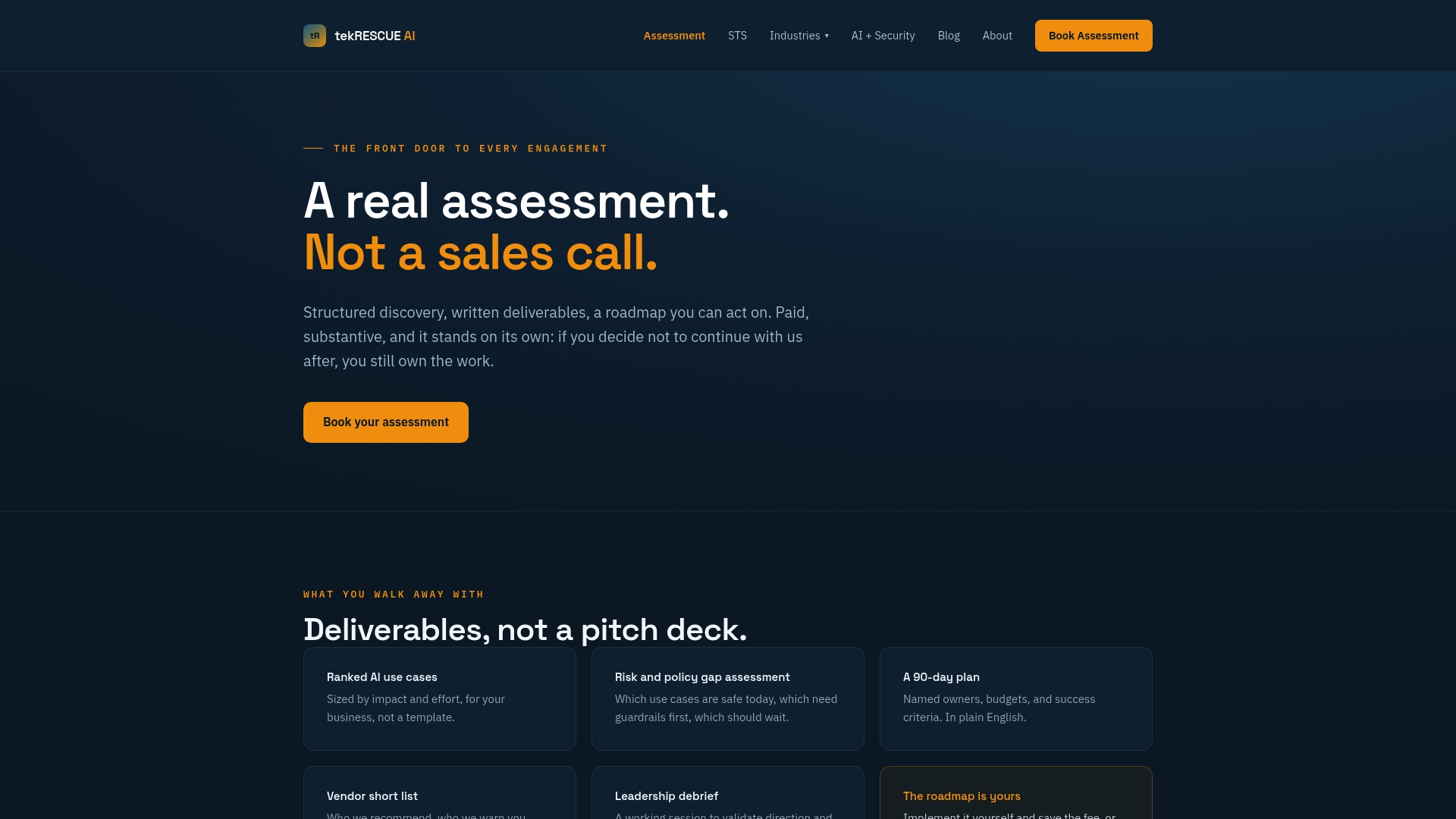
That plan names owners, sets realistic timelines, and treats cybersecurity as part of the AI conversation from day one rather than a separate initiative you tackle later. Whether you’re a construction firm juggling a dozen unofficial AI tools or a professional services shop trying to figure out what “governance” even means for a team your size, the assessment gives you a concrete starting point instead of another framework to file away. If you’re ready to see where your organization actually stands, start with an AI Profit and Growth Assessment and get a roadmap built around what your business is actually doing with AI, not a generic template.