AI data governance is the operational program that makes artificial intelligence auditable, safe, and compliant, covering every dataset, prompt, and model artifact across training, inference, and monitoring. The first move isn’t writing a policy. It’s inventorying what you already have: every training set, every fine-tuning corpus, every prompt log, every vector database feeding a model.
Most organizations can’t answer a basic question when a regulator or a customer asks it: where did this model’s training data come from? That gap is the entire problem. The NIST AI Risk Management Framework and the EU AI Act both start from the same premise: you can’t govern what you haven’t mapped.
Regulatory pressure is only building. Industry analysis in 2026 points to provenance, lineage, and bias documentation as the primary artifacts auditors now expect, not optional extras.
- Inventory every AI data flow: training sets, fine-tuning corpora, prompts, and model outputs.
- Tag ownership for each dataset: who created it, who approved its use, who can revoke access.
- Flag any dataset with no documented lineage as high risk, immediately.
Pro Tip: If you can’t produce a one-page origin summary for a training dataset in under ten minutes, that dataset doesn’t have governance. It has a folder.
Key Takeaways
AI data governance succeeds when provenance, in-flight protections, and RBAC are enforced through infrastructure and code, not written policy alone.
| Point | Details |
|---|---|
| Start with inventory | Map every dataset, prompt, and model artifact before writing any policy language. |
| Enforce through code | Policy-as-code and pre-training checks catch gaps that written policies never stop. |
| Follow the 90-day pattern | Discovery, classification, and audit wiring in sequence beats trying to govern everything at once. |
| Map to regulation early | NIST AI RMF, EU AI Act Article 10, and ISO 42001 all expect the same core evidence: lineage and fitness reports. |
| Get a roadmap, not a checklist | tekRESCUE AI’s AI Profit and Growth Assessment builds a governance roadmap around your actual systems, integrating security controls from the start. |
Table of Contents
- What AI Data Governance Actually Means
- The Controls That Make Up the Minimum Viable Program
- A Five-Step Framework: Map, Measure, Manage, Govern, Operate
- Your First 90 Days: A Week-by-Week Playbook
- How the Framework Maps to NIST, the EU AI Act, and ISO 42001
- Where Governance Programs Actually Break
- What Practitioners Learn the Hard Way
- Are You Ready for an Audit Right Now?
- A Practitioner’s View on What Gets Overlooked
- Turning This Framework Into a Working Program
- Sources
What AI Data Governance Actually Means
AI data governance is the set of controls that manage data specifically as it moves through the AI lifecycle: collection, labeling, training, validation, inference, and the ongoing memory that agentic systems and RAG pipelines accumulate. That’s a narrower and stranger job than traditional data governance, because the data doesn’t just sit in a warehouse. It gets absorbed into model weights, echoed back in outputs, and sometimes retained in ways nobody planned for.
Three terms get used interchangeably, and that’s a mistake:
- Traditional data governance manages structured records: who can access a customer database, how long records are retained, how accurate a field is.
- AI governance covers the broader question of whether an AI system should be deployed at all: risk classification, human oversight, model behavior, and organizational accountability.
- AI data governance sits between them: it governs the specific data feeding and flowing out of AI systems, including prompts, embeddings, and synthetic outputs that traditional frameworks never anticipated.
The failure modes are distinct too. A traditional data leak exposes records. An AI data governance failure can permanently bake biased or unlicensed content into a model that then gets deployed across a thousand customer interactions before anyone notices. You can delete a leaked spreadsheet. You often can’t cleanly extract a dataset’s influence from a trained model, which is exactly why provenance has to be captured before training, not reconstructed after.
The Controls That Make Up the Minimum Viable Program
A workable AI data governance program rests on six technical and organizational controls. Skip any one of them and you have a policy document, not a program.
Lineage and provenance. Every dataset needs a versioned record: source, collection date, transformation history, and consent basis. This isn’t bureaucracy for its own sake. Auditors treat undocumented provenance as if the data doesn’t legally exist, and that standard is only getting stricter.

Data quality built for AI, not spreadsheets. Representativeness matters more than raw volume. A model trained on data that’s demographically skewed or six years stale will perform unevenly the moment it meets real users. Temporal alignment, does the training data reflect current conditions, matters as much as accuracy.

In-flight protections. Data moving into prompts or third-party model calls needs redaction, differential privacy, or federated learning approaches so sensitive information never leaves your control unmasked. This is where most programs are thinnest.
Access control and audit logging. Role-based access control (RBAC) and least-privilege principles apply to training data and inference endpoints alike. Every access gets logged, not just database queries.
- Bias detection and fairness audits, run on a schedule, not just before launch.
- Model cards documenting intended use, known limitations, and training data composition.
- Decision logs showing who approved a model for production and why.
Drift monitoring. Performance degrades unevenly across subgroups long before it degrades overall. Monitoring by segment, with alerting thresholds, catches this before customers do.
A Five-Step Framework: Map, Measure, Manage, Govern, Operate
The NIST AI RMF built its functions, Map, Measure, Manage, Govern, around a simple idea: you can’t manage risk in an AI system without first knowing what data feeds it. Extending that logic into a fifth operational step, Operate, gives you a framework that runs continuously instead of sitting in a binder.
- Map. Build a registry of every dataset, tool, and model artifact in use. Data engineering owns the technical inventory; a data steward owns the metadata (source, consent, sensitivity).
- Measure. Define quality and fairness metrics for each dataset and model: representativeness thresholds, drift tolerances, bias test pass criteria. ML engineers build the automated tests; legal and privacy sign off on acceptance criteria.
- Manage. Enforce policy through code, not memos. Pre-training checks confirm consent metadata is present before a training job runs. Infrastructure-level enforcement turns governance from a suggestion into a gate.
- Govern. Establish approval workflows with named owners and stewards. Every model that reaches production has a documented sign-off trail, because that trail is what an auditor asks for first.
- Operate. Monitor continuously, feed drift and incident data back into the registry, and re-certify datasets and models on a fixed schedule rather than waiting for something to break.
| Framework step | Primary owner | Core deliverable |
|---|---|---|
| Map | Data engineering + steward | Dataset and model artifact registry |
| Measure | ML engineering | Quality and fairness test suite |
| Manage | Platform/MLOps | Policy-as-code gates on training pipelines |
| Govern | Legal + risk + data owner | Approval workflow and audit trail |
| Operate | Security + data steward | Drift monitoring and re-certification schedule |
The step most teams shortcut is Manage, because it requires engineering time up front. That’s also the step Ethyca’s guidance on enforcement identifies as the difference between programs that survive an audit and ones that produce a binder nobody can verify.
Your First 90 Days: A Week-by-Week Playbook
Governance programs stall when they try to do everything at once. A 90-day pattern that practitioners commonly follow breaks the work into three phases, each with a distinct output.
- Weeks 1 through 3: discovery. Inventory every AI tool and dataset in active use. Rank use cases by risk and business impact, and pick the top two or three to govern first rather than trying to cover everything simultaneously.
- Weeks 4 through 7: classification and access hardening. Classify data by sensitivity, deploy prompt-level redaction for anything touching third-party models, and tighten single sign-on (SSO), SCIM provisioning, and RBAC across your AI tools.
- Weeks 8 through 12: enforcement and testing. Wire pre-training policy checks into your pipelines, connect audit logs to your SIEM or GRC platform, and run your first documented bias tests on production models.
| Timeframe | Milestone | What “done” looks like |
|---|---|---|
| Weeks 1 to 3 | Discovery complete | Registry lists top 20 datasets and tools with owners assigned |
| Weeks 4 to 7 | Access hardened | RBAC enforced, prompt redaction live on external model calls |
| Weeks 8 to 12 | Enforcement live | Audit logs flow to SIEM/GRC, first bias test report filed |
| 3 to 6 months | Automation mature | Lineage tracked across pipelines automatically, model registry comprehensive |
By month six, the goal is automated bias testing running on a schedule instead of a one-time event, lineage capture happening as a pipeline byproduct rather than a manual task, and a model registry detailed enough that a new hire could reconstruct any model’s data history in an afternoon. That’s the maturity marker that separates a documented program from a lived one.
How the Framework Maps to NIST, the EU AI Act, and ISO 42001
Every control above exists because a specific regulatory framework asks for it, which is worth knowing before an auditor asks first.
- NIST AI RMF organizes its Map, Measure, Manage, Govern functions to align directly with the framework’s five steps above, giving you a ready-made cross-reference when a US-based reviewer asks how your program maps to federal guidance.
- EU AI Act Article 10 requires that training, validation, and testing datasets for high-risk AI systems meet specific quality criteria and be documented for relevance, representativeness, and error identification. Your lineage records and dataset fitness reports are the direct evidence equivalent.
- ISO/IEC 42001 takes a management-system approach, similar to ISO 27001 for security, requiring documented roles, continuous improvement cycles, and internal audits of the AI governance program itself, not just individual models.
- In the United States, there’s no single federal AI data law yet, though the White House’s national AI policy framework signals movement toward AI-ready data standards. State laws are filling the gap unevenly, which means your documentation needs to satisfy the strictest applicable state requirement, not the loosest.
Regulatory scrutiny in 2026 increasingly centers on provenance and auditability as the primary evidence auditors request, across nearly every jurisdiction watching this space. If your documentation satisfies Article 10’s dataset quality criteria, it will satisfy most other regimes with minor adjustments, because the underlying ask, prove where the data came from and prove it’s fit for purpose, is remarkably consistent.
Where Governance Programs Actually Break
Most AI data governance failures share a handful of root causes, and every one of them is preventable with a small process change made early.
- Undocumented provenance. A training dataset with no origin record is treated by auditors as though it doesn’t exist, no matter how well the model performs.
- Policy without infrastructure. Writing a governance policy PDF and never wiring it into your training pipeline means the policy governs nothing. Enforcement has to live in code.
- Missing in-flight controls. Data flowing unredacted into third-party model APIs is the most common exfiltration path, and it’s rarely caught until a customer or regulator asks about it.
- Accountability gaps. Either everything routes through one overloaded central team, or every business unit governs itself with no documented standard. Both fail audits for the same reason: nobody can point to who decided what.
The fix for most of this is boring on purpose: policy-as-code that gates training runs, consent metadata that travels with the data instead of living in a separate spreadsheet, and a recurring cross-functional review where legal, security, and ML engineering actually look at the same dashboard together.
What Practitioners Learn the Hard Way
Programs that survive their first audit almost always share one habit: they started versioned documentation before anyone asked for it. Waiting until a regulator or customer requests evidence means reconstructing months of history from memory and scattered files, which almost never holds up.
The organizations that pass audits without scrambling are the ones that treated every training dataset as a managed asset with its own fitness-for-purpose report from day one, not the ones that wrote the report after the fact.
tekRESCUE has spent 30 years in IT and cybersecurity before turning that experience toward AI risk, and the pattern shows up constantly during an AI Profit and Growth Assessment: businesses that integrate security controls with AI initiatives from the start produce cleaner audit trails than those that treat governance as an add-on. The customized roadmaps that come out of that assessment typically call for three concrete artifacts: a dataset fitness-for-purpose report, a model card per production model, and consent propagation logs showing where permission for data use was granted and where it expired.
Pro Tip: Assign a named data steward to every dataset before you assign a use case to a model. Ownership without a name attached to it disappears the moment there’s a staffing change.
Are You Ready for an Audit Right Now?
Run this quick self-check before you assume your program is further along than it is.
- Can you list your top 20 AI tools and datasets, with an owner named for each, in under an hour?
- Does every high-risk dataset have documented lineage and consent metadata, not just a note that it “should” exist somewhere?
- Is RBAC enforced on training and inference systems, with pre-training policy checks blocking jobs that lack required metadata?
- Could you produce a dataset fitness-for-purpose report, a model card, and an audit trail sample for your highest-risk model this week?
If the honest answer to any of these is no, that’s your priority list, in order. Weeks, not years, is the realistic timeline to close these gaps once you know exactly where they are.
A Practitioner’s View on What Gets Overlooked
Most guidance on this topic treats governance as a compliance checkbox, something you bolt on to satisfy a future auditor. That framing undersells what’s actually at stake. A model trained on undocumented, unlicensed, or quietly biased data isn’t just a compliance risk, it’s a business risk that shows up as bad decisions, damaged trust, or a product that has to be pulled and retrained at real cost.
The mistake I see most often isn’t a lack of policy. It’s a policy that never touched the infrastructure doing the actual work. Write the governance rules into the pipeline itself, and the compliance evidence falls out as a byproduct. Leave it as a separate document, and you’re gambling that nobody ever asks a hard question. Start the inventory this week. Measure something concrete within thirty days. That’s the whole difference between a program and a promise.
Turning This Framework Into a Working Program
Reading a framework and running one are different problems. Most organizations know they need lineage records, RBAC, and bias testing. Few have the bandwidth to wire all of it into existing infrastructure while also running the business. That gap is exactly where tekRESCUE AI works.
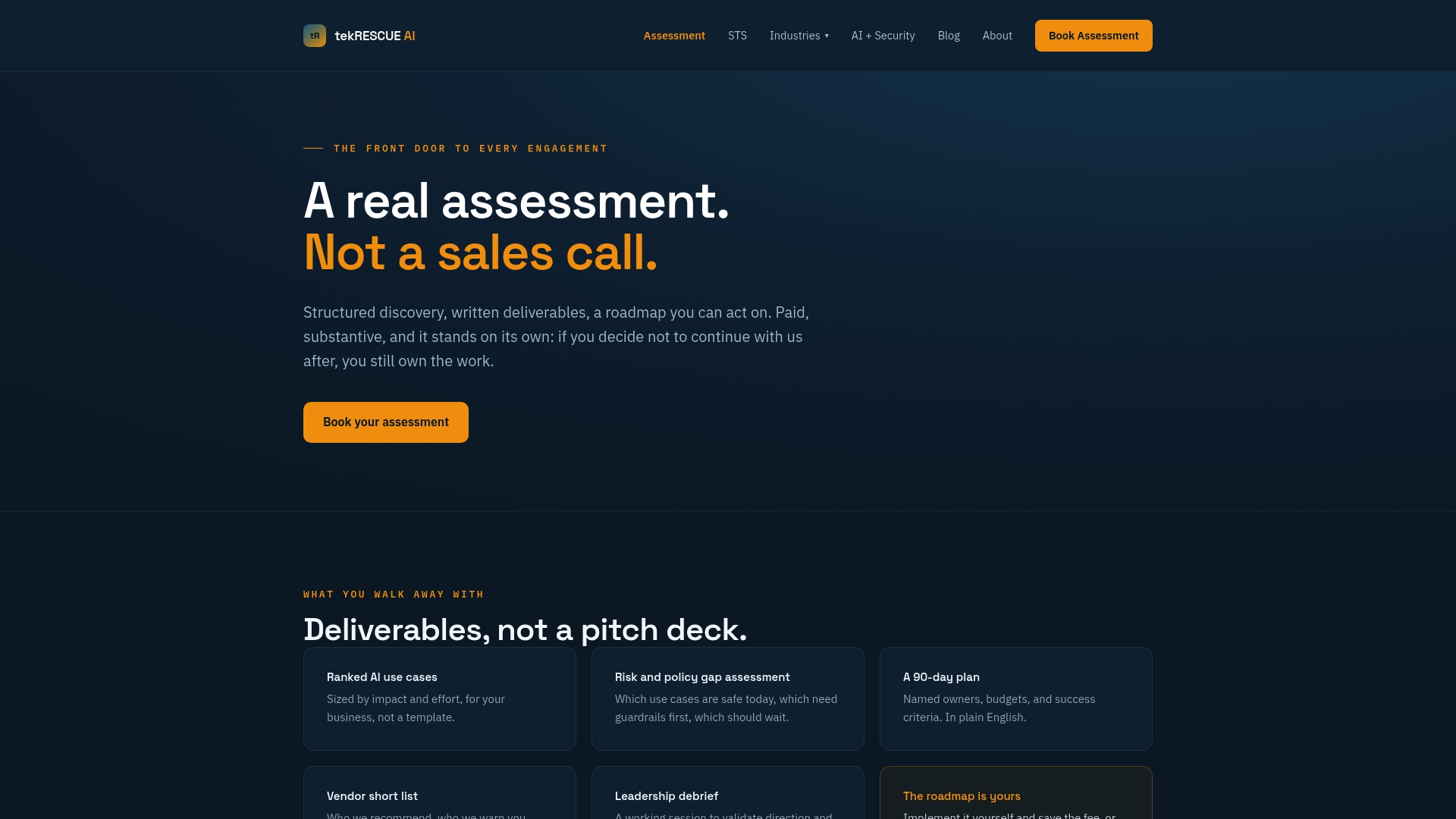
The AI Profit and Growth Assessment maps directly onto the 90-day playbook above: it starts with the same discovery and inventory work, then builds a customized roadmap showing where AI creates efficiency and where your current data practices create exposure. Because tekRESCUE AI brings 30 years of cybersecurity experience into that assessment, the roadmap doesn’t stop at “which AI tools to adopt.” It identifies the access controls, in-flight protections, and audit logging your specific systems need before you scale usage further. Data leaders, security and privacy teams, and ML engineers all get a shared document instead of three separate interpretations of the same risk.
If you’re past the point of wondering whether you need AI data governance and ready to build it, schedule an AI Profit and Growth Assessment and get a roadmap built around your actual infrastructure, not a generic template.
Sources
- Data Governance Frameworks for AI Compliance | 2026 - Dataversity
- NIST AI Risk Management Framework - NIST
- AI Data Governance: Framework, Best Practices & How to Implement It (2026) - Strac
- How to Enforce AI Data Governance at Scale | Ethyca