AI data classification uses machine learning, embeddings, and language models to automatically label and risk-rank data, catching sensitive content that regex and keyword rules miss. The real payoff is scale: it finds what deterministic tools overlook across unstructured files. But it only works safely in production when paired with confidence thresholds, human review, and deterministic checks as a backstop.
TL;DR:
- AI data classification excels at processing unstructured data, such as documents and chat logs, where regex-based tools fail to detect sensitive information without keyword overlap.
- Accuracy depends on data type, domain language, and threshold tuning, with continuous monitoring and retraining essential to maintain detection performance over time.
- Implementing strict confidence thresholds and involving human review for ambiguous cases reduces false positives and prevents costly false negatives in high-risk categories.
- Security risks include potential data exposure during model training and adversarial manipulation like prompt injections, requiring measures such as local inference and input sanitation.
- Successful deployment requires careful scoping, stakeholder engagement, and integration with existing systems, emphasizing label-action mapping before model selection.
Table of Contents
- What Is AI Data Classification and How Does It Work?
- How Accurate Is AI Data Classification in Production?
- What Are the Security Risks of AI-Based Classification?
- How Do You Roll Out AI Data Classification Safely?
- Where Does AI Classification Deliver Real Value?
- What Does tekRESCUE Recommend Before You Deploy AI Classification?
- How Do You Measure and Benchmark Classification Model Performance?
- Which Governance Frameworks Apply to AI Data Classification?
- How Do You Integrate AI Classification With Existing Data Systems?
- How Do You Get Staff to Trust and Adopt AI Classification Tools?
- The Editorial Take: Where AI Classification Actually Earns Its Keep
- Sources
What Is AI Data Classification and How Does It Work?
AI data classification does not replace pattern matching. It works alongside it, filling in exactly where fixed rules fall apart.
A regex rule can catch a well-formatted credit card number or a Social Security number with near-perfect reliability. What it cannot do is recognize that a paragraph describing a patient’s diagnosis without using the word “diagnosis” is still protected health information. That’s the gap AI closes.
Here’s how the core methods break down:
- Rule-based and regex matching handles structured, predictable formats: card numbers, national ID formats, IP addresses. Fast, cheap, and precise when the pattern is fixed.
- Named entity recognition (NER) pulls out people, organizations, locations, and dates from free text, useful for finding names buried in contracts or support tickets.
- Embeddings and semantic similarity convert text into vectors and compare meaning rather than wording, so a document about “quarterly layoffs” and one about “workforce reduction plans” land in the same sensitivity cluster even with zero overlapping keywords.
- LLM inference handles ambiguous, context-dependent judgment calls, like deciding whether a chat log discussing a merger is material nonpublic information or routine speculation.
- OCR and format normalization convert scanned contracts, faxed medical records, and legacy TIFF files into machine-readable text before any classification model can touch them.
The reason this matters for security teams isn’t academic. Forbes’ analysis on AI’s role in data classification points out that semantic and contextual models catch sensitive data in context, cutting the false positives and false negatives that plague regex-only pipelines. A rule-based scanner flags every 16-digit number as a potential card number; a semantic model knows the difference between a card number and a tracking ID.
How Accurate Is AI Data Classification in Production?
Accuracy in AI classification isn’t a single number. It’s a range that shifts by data type, domain language, and how aggressively you tune your thresholds.
LLM-based classifiers tend to perform well on plain-language content like emails and support tickets, where context clues are abundant. They struggle more with dense technical documents, code repositories, and industry-specific jargon where the model hasn’t seen enough training examples to build confidence. Enterprise deployments increasingly rely on multi-model detection, running several classifiers in parallel and cross-checking their outputs, paired with confidence scoring that routes uncertain results to a human reviewer instead of an automated action, according to Knostic’s analysis of dynamic risk classification.

Model drift is a documented problem, not a hypothetical one. Language changes, new document templates appear, and a model trained six months ago starts missing patterns it used to catch. Retraining on fresh samples can recover a meaningful share of lost accuracy in favorable conditions, but only if someone is actually monitoring for the drop in the first place.
Pro Tip: Set a confidence floor, not a ceiling. Anything scored below your threshold — which varies depending on data sensitivity — should route to human review by default, not get flagged as an exception.
Track these KPIs from day one of any pilot:
- Precision per sensitivity tier, not one blended average across all data types.
- False-negative ceiling for your highest-risk category, since missed PHI or PCI data costs far more than a false alarm.
- Leak logs tied directly to classification decisions, so you can trace an incident back to a specific model output.
- Time-to-detection for newly created sensitive files, which tells you whether your scanning cadence matches your data growth.
Broader benchmarking on how classification models degrade and recover under retraining is tracked in aggregate by resources like Statohub’s machine learning statistics, useful context when you’re setting internal targets rather than guessing at what “good” looks like.
What Are the Security Risks of AI-Based Classification?
Feeding sensitive data into a classification model creates a second attack surface most security teams don’t budget for.
The first risk is data sovereignty and training exposure. If your classification vendor’s model trains on the documents you feed it, your contract terms, employee records, or customer PII could end up shaping outputs for other customers. For any workflow touching protected health information, HHS security guidance for HIPAA applies directly, and inference-only or on-premises model execution is the safer default rather than an optional hardening step.
The second risk is adversarial manipulation. Prompt injection can trick an LLM-based classifier into mislabeling sensitive content as benign, and poisoning attacks during a retraining cycle can quietly degrade detection for a specific data type over time.
Practical mitigations worth building into your architecture:
- Run inference-only deployments or local models for regulated data categories.
- Sanitize and obfuscate inputs before they reach a third-party API, especially for anything touching ePHI or financial account data.
- Bake data-handling terms into vendor contracts explicitly, not as boilerplate.
- Log every classification decision with an explainability trail auditors can actually follow.
Pro Tip: Ask any AI classification vendor point blank whether your data trains their model. If the answer is vague, treat that vagueness as your answer.
How Do You Roll Out AI Data Classification Safely?
Rolling out AI classification works best as a narrow, measured pilot, not a company-wide flip of the switch.
- Classify at the source. Tag data where it’s created or ingested, and map every label to a specific enforcement action, whether that’s a DLP block, an access restriction, or an audit flag.
- Scope a tight pilot. A workable starting point is five labels, three workflows, and roughly 25 pilot users, tracking blocked prompts and exception requests as your primary signals.
- Set confidence thresholds by risk tier. Higher-sensitivity categories get tighter thresholds and more human review, not the same blanket setting across every data class.
- Build a review cadence. Weekly spot checks during the pilot, shifting to monthly once false-positive rates stabilize.
- Monitor for drift and automate retraining triggers. Set alerts when precision drops below a defined floor rather than waiting for a quarterly review to catch it.
- Integrate with existing systems. Connect classification outputs to your metadata catalog, DSPM or DLP platform, and activity telemetry so labels actually drive enforcement instead of sitting in a report nobody opens.
Full discovery scans catch more than sampling alone. Varonis’s research on data classification notes that sampling-only approaches routinely miss rare but critical sensitive files, making activity-prioritized scanning a better fit for programs where compliance exposure is the driving concern.
Where Does AI Classification Deliver Real Value?
Four use cases consistently show measurable return once AI classification moves past the pilot stage.
- Compliance discovery. Finding scattered PCI and PHI data across file shares and email archives, generating audit evidence, and speeding up e-discovery requests that used to take weeks of manual review.
- RAG and generative AI safety. Classifying data at the prompt and retrieval level, not just at rest, so a chatbot doesn’t surface a customer’s Social Security number because it happened to sit in an indexed document. Governance frameworks increasingly treat data-in-motion controls as mandatory for any AI pipeline touching sensitive sources.
- Least-privilege enforcement. Activity telemetry showing who actually touches a file, not just who has access to it, drives smarter access certification and shrinks unnecessary permission sprawl.
- Lifecycle management. Automated archival and deletion of data past its retention window, which directly shrinks the scope of what a breach or audit has to cover.
What Does tekRESCUE Recommend Before You Deploy AI Classification?
tekRESCUE built the AI Profit and Growth Assessment around one premise: you can’t secure what you haven’t mapped, and you can’t scale AI safely without knowing where the risk actually sits.
The assessment investigates your current data sprawl, existing access patterns, and where AI tools are already touching sensitive information, often before anyone in leadership realizes it. From there, it prioritizes findings by business impact instead of a generic checklist.
Three deliverables come out of that process:
- A classification schema tailored to your actual data categories, not a generic industry template.
- A pilot plan scoped to a realistic sample size and timeline your team can actually execute.
- A retraining and monitoring cadence so classification accuracy doesn’t quietly decay six months after launch.
Some organizations have the internal bandwidth to run this playbook themselves. Others, especially where AI adoption is outpacing security oversight, benefit from an AI partner handling the integration and ongoing managed security work. If that’s where you are, tekRESCUE AI starts every engagement with the assessment before recommending a single tool.
How Do You Measure and Benchmark Classification Model Performance?
Benchmarking an AI classification model means testing it against a labeled dataset where the correct answers are already known, then measuring how often the model agrees with the ground truth.
Precision and recall remain the two numbers that matter most. Precision tells you how many of the model’s “sensitive” flags were actually sensitive; recall tells you how many truly sensitive items it caught out of the total that existed. A model tuned for high recall will flag more borderline content, which is often the right tradeoff for regulated data, since a missed PHI record is more costly than a reviewer clearing a false alarm.
F1 score, which balances precision and recall into a single figure, is useful for comparing model versions over time but shouldn’t be the only metric you track. A model can have a strong blended F1 score while quietly underperforming on your highest-risk category, which is exactly why per-tier precision tracking matters more than a single headline number.
Benchmark against a holdout set that reflects your actual data, not a generic public dataset. Your legal contracts, engineering wikis, and customer support logs have their own vocabulary and structure, and a model that scores well on a public benchmark can still stumble on your specific document types. Re-run benchmarks after every retraining cycle, and keep a version history of model performance so you can catch regressions before they hit production.
Which Governance Frameworks Apply to AI Data Classification?
NIST’s SP 1800-39 demonstration gives the clearest operational reference point available for AI data classification programs right now. The NCCoE demonstration walks through discovering, identifying, and labeling unstructured data using defined schemas, and it explicitly ties classification practices to Zero Trust architecture and to preparing data for AI model training.
For any organization handling health data, classification decisions touching electronic protected health information have to align with HHS’s HIPAA security rules. That means inference-only deployments and local model execution aren’t optional hardening for healthcare data; they’re often the difference between a defensible audit trail and a compliance gap.
Beyond sector-specific rules, general data governance frameworks now expect classification to cover data in motion, not just data at rest. That shift matters specifically because of how generative AI pipelines work: a prompt, a retrieval, and a model output are all momentary events that a traditional at-rest scan will never see. Governance policy has to extend to that layer explicitly, covering what gets classified, when, and what happens when a classification decision conflicts with a user’s request.
Document your classification schema, your review cadence, and your escalation path in writing, and treat that documentation as the artifact an auditor will actually ask for.
How Do You Integrate AI Classification With Existing Data Systems?
AI classification tools rarely replace your existing data infrastructure. They sit inside it, feeding labels into systems your team already relies on.
The most common integration point is the metadata catalog, where classification labels get attached to files, database columns, and API responses so downstream systems know what they’re handling without re-scanning everything from scratch. From there, labels need to flow into your DSPM or DLP platform to actually trigger enforcement, whether that’s blocking an upload, restricting a share link, or flagging an anomalous access pattern for review.
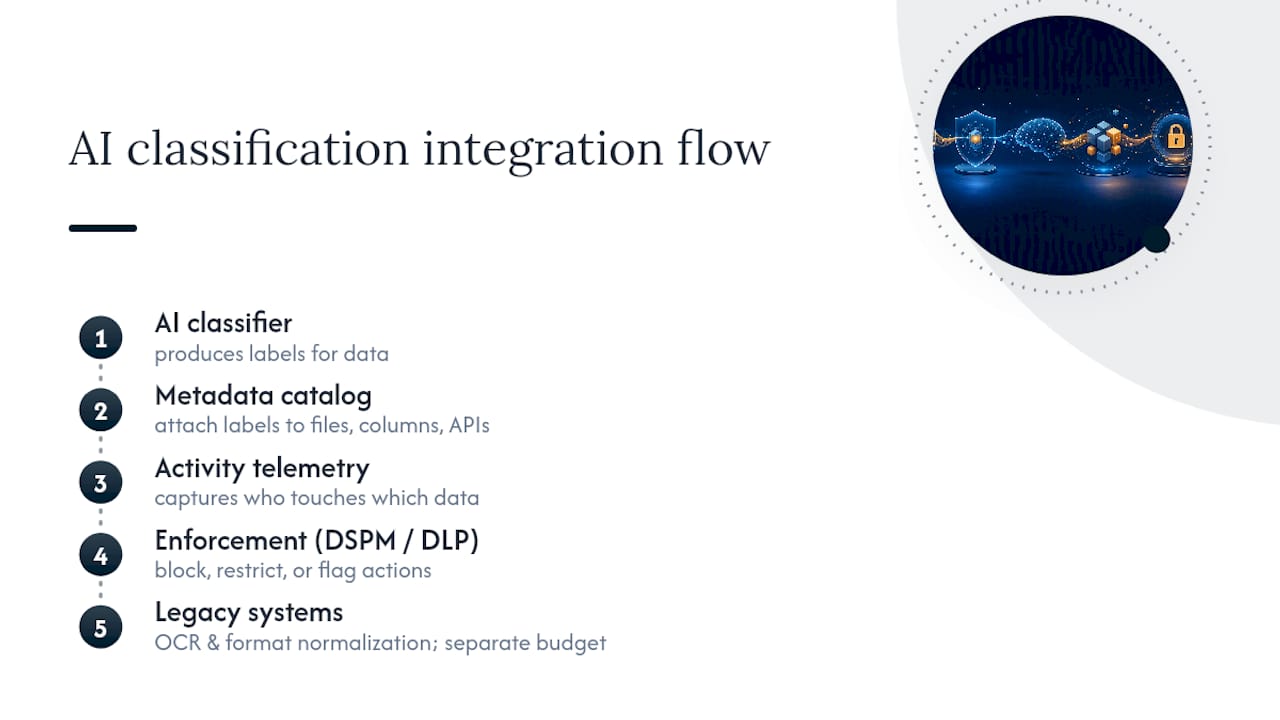
Activity telemetry is the piece most programs underuse. Classification tells you what data is sensitive; telemetry tells you who’s actually touching it and how often. Combining the two lets you prioritize scanning toward files people are actively using rather than burning compute cycles on an archive nobody has opened in three years. That prioritization approach is worth building early, since activity-based scanning catches real exposure faster than blanket, unprioritized sweeps.
Legacy systems are the sticking point most teams underestimate. A classification pipeline built for modern cloud storage often chokes on a decade-old file server full of scanned PDFs and inconsistent folder structures. Budget separately for OCR and format normalization work on that legacy layer; it rarely fits neatly into the same timeline as your cloud rollout.
How Do You Get Staff to Trust and Adopt AI Classification Tools?
The biggest adoption failure isn’t technical. It’s a security team rolling out a classification tool and having employees quietly route around it because it slows them down or flags things that make no sense to them.
Start change management with the people whose workflows the tool touches first, not with a company-wide announcement. If legal reviews contracts daily, involve them in defining what “sensitive” means for that specific document type before the model ever sees production data. Their early buy-in becomes your best defense against silent workarounds later.
Explain false positives honestly instead of pretending the tool is flawless. A classification model will occasionally flag something harmless as sensitive, and if staff don’t understand why, they’ll stop trusting every flag it produces, including the ones that matter. A short, plain-language explanation of how confidence scoring works goes further than a polished slide deck.
Train reviewers specifically on how to handle the human-in-the-loop queue. Reviewing a flagged item isn’t the same skill as spotting sensitive data cold; it requires understanding what the model saw, why it scored the way it did, and when to override it. Build that training around real examples from your own pilot data, not generic vendor scenarios.
Revisit training after every major retraining cycle. A model that behaves differently after a retrain will produce different flags, and staff need to know what changed before they start second-guessing a tool they’d only just gotten comfortable with.
The Editorial Take: Where AI Classification Actually Earns Its Keep
The conventional pitch for AI data classification oversells the automation and undersells the operational discipline it demands. Vendors talk about “set it and forget it” accuracy. The evidence says otherwise: models drift, confidence thresholds need tuning by data tier, and retraining without monitoring just delays the same accuracy problem to a worse moment.
Where AI genuinely wins is unstructured data at scale, the contracts, chat logs, and scanned documents that regex was never built to read. Where deterministic tools still win is anything with a fixed, predictable format, a credit card number, a national ID pattern. Trying to force an LLM to do a regex’s job wastes compute and adds latency for no accuracy gain.
The priority most teams get backwards: they chase model selection before they’ve defined what enforcement action each label should trigger. A perfectly accurate classifier attached to no downstream action is an expensive report generator. Start with the label-to-action map, then pick the model. That order, more than any specific tool, determines whether the program actually reduces risk or just produces dashboards nobody checks.
— Randy Bryan