Successful AI change management comes down to one thing: getting people to actually use AI in ways that create measurable business value, not just technical rollout. Right now, 88% of companies say they use AI regularly, yet most leaders still can’t point to the returns they expected. If you lead people through this shift, your next move is simple: run a focused AI readiness pilot before you scale anything. Anchor it in a structured method like Prosci’s ADKAR model, assign real owners, and measure adoption against a baseline. A tool like tekRESCUE’s AI Profit & Growth Assessment can help you map that pilot before you commit real budget to it.
Key Takeaways
Sustainable AI adoption depends on redesigned workflows, named owners, and measured pilots, not on tool access or usage volume alone.
| Point | Details |
|---|---|
| Usage isn’t value | High AI usage without workflow redesign leaves outcomes stalled, per HBR. |
| Ownership must be shared | HR, IT, and business leaders each own a distinct piece of the rollout, not just IT alone. |
| Govern before you launch | Data access rules and human review checkpoints need to exist before the pilot starts, not after. |
| Measure against baseline | Capture time or cost baselines first, then track adoption rate to calculate real ROI. |
| Assess before you scale | tekRESCUE’s AI Profit & Growth Assessment maps workflows, risk, and pilot design before wider rollout. |
Table of Contents
-
Why AI Change Management Needs a Different, People-First Approach
-
Redesigning Workflows and Org Structure for AI-Augmented Teams
-
How a Security-First AI Partner Runs an AI Profit & Growth Assessment
Why AI Change Management Needs a Different, People-First Approach
Rolling out AI is not like rolling out a new CRM or an ERP upgrade. The old playbook assumed a stable tool with a fixed feature set, a training manual, and a go-live date. AI breaks all three assumptions, and that’s why so many rollouts stall right after launch.
Here’s what actually makes AI different on the ground:
-
It behaves unpredictably. The same prompt can produce different outputs, which erodes trust faster than a buggy software update ever did.
-
It moves faster than training cycles. Tools update monthly, sometimes weekly, while most training programs are built for annual refreshers.
-
It blurs task ownership. Employees suddenly have to decide what work is theirs to do, what’s the AI’s job, and where the line sits.
-
It raises new data and privacy questions. Every use case touches sensitive information in ways a spreadsheet template never did.
-
It threatens identity, not just workflow. People don’t just fear losing a task. They fear losing the part of their job that made them valuable.
That last point explains the gap between usage and results. HBR’s research shows widespread AI adoption paired with stalled outcomes because employees experiment with tools without ever rewiring the workflows around them. Adoption without redesign is just expensive novelty.
This is exactly why Culture Amp frames AI change management as a shared effort between HR, IT, and business leadership rather than a project IT owns alone. HR carries the human side, communication and training. IT handles the technical gating. Business leaders own the outcome. No single department can pull this off solo.
A Concise, 5-Step Roadmap for AI Change Management
You don’t need a 40-page transformation plan. You need five steps, clear owners, and metrics you can actually check on a Friday afternoon. This roadmap borrows Prosci’s ADKAR logic and McKinsey’s outcome-based approach and turns both into something you can run this quarter.
1. Prepare and sponsor
Owner: Executive sponsor plus a cross-functional lead from HR, IT, and the business unit.
-
Name a visible senior sponsor who talks about the initiative publicly, not just in a kickoff email.
-
Define one outcome the pilot must hit, framed as a business result, not a technology milestone.
-
Set a shared vocabulary for the rollout so “AI project” means the same thing to finance as it does to operations.
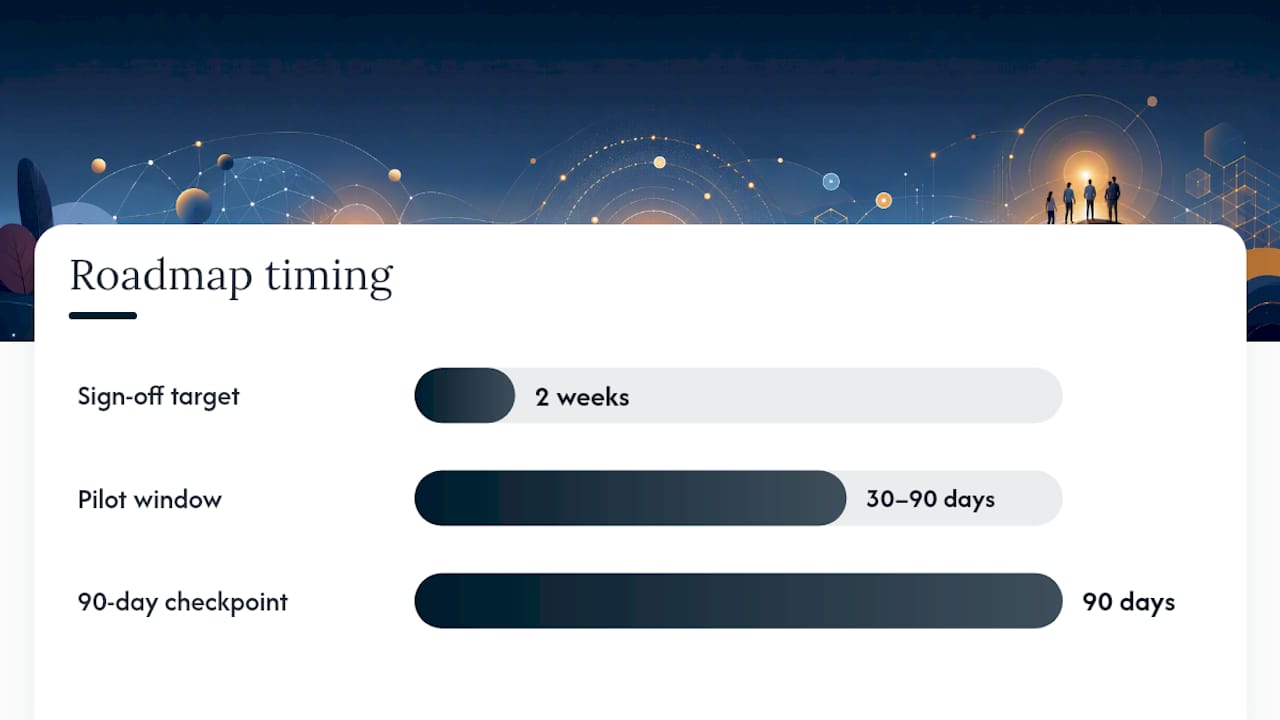
Success metric: A documented charter with a named sponsor and one measurable target, signed off within two weeks.
2. Pilot and measure
Owner: Business process owner, supported by IT.
-
Pick one workflow, not five, and instrument it so you can see real usage, not intended usage.
-
Set a baseline before the pilot starts. You cannot prove value against a number you never captured.
-
Run the pilot for a fixed window, typically 30 to 90 days, with a hard review date on the calendar.
Success metric: Weekly active usage against baseline, tracked from day one.
3. Redesign workflows
Owner: Process owner, with the AI change lead facilitating.
-
Map the workflow as it exists today, then map it again with AI inserted at the right decision points.
-
Remove steps that no longer add value instead of just bolting AI onto the old process.
-
Assign clear human checkpoints where judgment still needs to sit with a person.
Success metric: Cycle time reduction on the redesigned workflow, measured against the pre-AI baseline.
4. Build skills and culture
Owner: HR and learning and development, with input from early adopters.
-
Train people on the specific workflow they’ll touch, not generic “AI literacy.”
-
Identify a handful of AI change agents in each team who can answer peer questions faster than a help desk ticket.
-
Create a low-stakes space where people can experiment without fear of breaking something that matters.
Success metric: A substantial share of trained employees actively using the tool after training.
5. Scale and sustain
Owner: Steering committee spanning IT, HR, and the business.
-
Set gating criteria before scaling: adoption rate, error rate, and a minimum satisfaction score.
-
Fund a reinforcement budget, because skills decay fast without ongoing support.
-
Revisit governance every quarter as new use cases emerge.
Success metric: Adoption rate sustained past the 90-day mark without sponsor intervention.
Pro Tip: Pilots fail most often because they’re either too small to matter or too big to control. Pick a workflow with real business stakes but a contained blast radius, one team, one process, one clear before-and-after.
Pro Tip: If your governance committee doesn’t exist before the pilot launches, don’t launch the pilot. Retrofitting governance after employees start relying on a tool is far harder than building it first.
Pro Tip: Executive attention tends to disappear right after go-live, exactly when frontline confusion peaks. Put a recurring 30-day check-in on the sponsor’s calendar before the pilot even starts.
How Do You Build Governance and Trust in AI?
Governance is not a compliance checkbox. It’s the reason employees feel safe using AI instead of quietly avoiding it. Without a clear policy, people either overtrust the output or ignore the tool entirely, and both outcomes waste the investment you just made.
A workable governance policy needs to answer four questions in plain language:
-
What data can this tool access, and what data is explicitly off-limits?
-
Where does a human have to review the output before it goes anywhere near a customer or a decision?
-
Which use cases are approved, and which are prohibited outright?
-
How is every AI-assisted decision logged so you can trace it later?
Human-in-the-loop gating works best when you place the manual review step right before anything leaves the building, a client email, a contract clause, a financial report. Let the AI draft, let the person approve, and make that approval step visible in the workflow, not an informal habit someone might skip when they’re busy.
Pro Tip: Write your AI governance statement the way you’d explain it to a new hire on day one, not the way legal would write it for a regulator. Plain language reduces fear far more than a dense policy document ever will.
Redesigning Workflows and Org Structure for AI-Augmented Teams
Most AI rollouts fail at the workflow level, not the technology level. The tool works fine. The process around it never changed, so the AI just adds a new step instead of removing old ones. McKinsey’s research on reconfiguring work points to the same fix: build the workflow around the outcome you want, not around the old process you’re used to.
Before you touch any tooling, map the current process with three questions in mind:
-
Where does time actually go today, and which steps are pure waste versus genuinely necessary?
-
Where are the real decision points, and who currently owns each one?
-
Where do errors creep in today, and would a human or an AI catch them faster?
Once you’ve mapped it, define roles clearly instead of assuming everyone will figure it out. A workable structure usually includes an owner who is accountable for the outcome, a reviewer who checks AI output before it moves downstream, a subject-matter expert who validates accuracy, and an AI steward who monitors performance and flags drift.
-
Owner: accountable for the business result the workflow produces.
-
Reviewer: checks every AI-assisted output before it reaches a customer or decision point.
-
Subject-matter expert: validates that the output is actually correct, not just plausible.
-
AI steward: tracks tool performance over time and escalates when quality slips.
Baker Tilly’s take on managing change in the AI era makes an important point here: start by talking to the people whose jobs are changing, and co-create the new process with them, rather than designing it in a conference room and announcing it later.
Picture a legal team piloting AI-assisted contract drafting. The AI produces a first draft in minutes instead of hours. A reviewer checks clause language against company standards. A subject-matter expert confirms nothing material was missed. The result is a contract cycle that used to take three days now moving in one, with the same level of scrutiny on the final version.

Skills, Training, and Creating AI Change Agents
Training for AI can’t be a single afternoon workshop. It needs a path people move through over weeks, tied to the actual work they do, not generic platform tutorials.
A practical training roadmap moves through four stages: awareness of what the tool does and doesn’t do, role-based practice on real tasks, coaching from someone who’s already fluent, and reinforcement that keeps the skill from decaying.
Prosci’s ADKAR framework maps cleanly onto that same path:
-
Awareness: Employees understand why the change is happening and what problem it solves for them specifically.
-
Desire: Leaders show, not just tell, why using the tool benefits the employee, not just the company.
-
Knowledge: Role-specific training replaces generic AI literacy sessions.
-
Ability: Employees practice on real work with a coach nearby, not a simulation environment.
-
Reinforcement: Managers check in on usage and confidence at 30, 60, and 90 days.
Culture Amp’s guidance on shared ownership applies directly here. HR should own the reinforcement piece since sustained behavior change is a people function, not a technical one.
Pro Tip: Track confidence alongside usage. An employee who uses the tool daily but doesn’t trust the output is one bad experience away from quietly going back to the old way.
Piloting, Measurement, and Cost Considerations
A pilot without a clear hypothesis is just an experiment nobody can evaluate. Before you launch anything, write down five things: the hypothesis you’re testing, the primary metric that proves or disproves it, the owner accountable for the result, the sample size or team scope, and the timeline with a fixed review date.
TechTarget’s checklist for getting AI change management right recommends involving the process owner directly in workflow redesign and observing real usage rather than assuming adoption from license counts. A tool nobody opens twice a week isn’t adopted, no matter what the dashboard says.
A simple ROI formula works better than an elaborate financial model at this stage:
Baseline time or cost saved × adoption rate = value delivered.
Say a team spends 10 hours a week on a task an AI tool cuts to 6 hours, a 4 hour weekly saving per person. That gap between technical capability and real adoption is exactly what HBR’s research on stalled AI outcomes is describing.
Before scaling past the pilot, run the result through a simple decision matrix:
-
Impact: Did the pilot move the metric you set at the start, not just a vanity number?
-
Risk: Are there unresolved data, security, or compliance gaps that scale would multiply?
-
Scalability: Can this workflow support ten times the current volume without new bottlenecks?
-
Cost: Does the ongoing cost, licensing, training, oversight, still make sense against the value delivered?
If a pilot clears impact and scalability but stumbles on risk, fix the risk gap before you scale, not after.
How a Security-First AI Partner Runs an AI Profit & Growth Assessment
Most organizations don’t need another generic AI seminar. They need someone to walk their actual workflows and tell them where AI creates value and where it creates exposure. That’s the model behind tekRESCUE’s AI Profit & Growth Assessment.
The assessment typically follows five steps:
-
Scoping: Define which departments, workflows, and business goals are in play.
-
Data review: Identify what data feeds each candidate workflow and where sensitivity concerns exist.
-
Workflow mapping: Document current process steps, decision points, and time spent.
-
Pilot design: Select one or two high-value, contained use cases with clear success metrics.
-
Security review: Flag vulnerabilities the AI rollout could introduce, drawing on cybersecurity practices most generic AI consultants never touch.
The deliverables from an assessment like this usually include a prioritized roadmap of use cases ranked by value and feasibility, a risk register flagging where data or compliance exposure exists, and a pilot plan with owners and metrics ready to launch. Booz Allen’s research on scaling trustworthy AI backs this same sequence: human-centered design paired with early-adopter outreach moves capability into daily use faster than a top-down tool rollout ever does.
For a business considering its first serious AI initiative, the value of this kind of assessment isn’t the AI recommendation itself. It’s knowing exactly where the risk sits before you write a check for a rollout you can’t fully secure.
What Lessons Do Real AI Pilots Actually Teach?
Three patterns show up again and again. A pilot succeeds when a process owner co-designs the workflow instead of receiving it as a finished product from IT. A pilot stalls when leadership treats go-live as the finish line and stops paying attention right when frontline confusion peaks. And a stalled pilot recovers when someone finally asks employees what’s actually blocking them, usually a trust issue or an unclear approval step, not a technology gap.
If you lead one of these initiatives, keep three things on your calendar: a recurring sponsorship check-in, a structured listening session with frontline users after launch, and a clear threshold for when you reinvest versus when you cut losses. HBR’s roundtable on AI adoption failures makes the same point from a different angle: the failures are almost always organizational, not technical. Protecting human judgment inside the new workflow matters as much as the tool itself.
The single highest-leverage move I’d recommend: don’t let executive attention drop after rollout. That’s the exact moment frontline teams need it most.
How tekRESCUE Helps: Assessment, Secure Pilot, Scale
tekRESCUE gives you what a generic AI vendor can’t: a rollout plan that treats security review as part of the change process, not an afterthought bolted on once something goes wrong. Where most consultants hand you a tool recommendation, tekRESCUE maps your actual workflows, flags the data and compliance exposure inside them, and builds a pilot plan around what you can secure and sustain.
That approach comes from 30 years in IT and cybersecurity, which shows up in the deliverables: a prioritized roadmap of use cases, a risk register specific to your systems, and a pilot plan with real owners and metrics, not a generic template. Every recommendation in the AI Profit & Growth Assessment accounts for where AI creates efficiency and where it creates new vulnerability, so you’re not choosing between speed and safety.
If you’re standing at the point this article just walked you through, deciding which workflow to pilot and whether your governance is ready, the next step is straightforward. Request an AI Profit & Growth Assessment from tekRESCUE and get a roadmap built around your actual operations before you commit budget to a wider rollout.