An AI Center of Excellence is the centralized team that sets the standards, tools, and guardrails an organization needs to move AI projects from scattered pilots into secure, measurable production systems. If you’re starting one, your first move isn’t picking a use case. It’s securing executive sponsorship and writing a charter that names who owns risk, who owns budget, and what success looks like in ninety days.
TL;DR:
- Most organizations should focus on securing executive sponsorship and defining clear success criteria before selecting AI use cases or expanding pilots.
- The AI CoE must have a dedicated leader with direct access to senior decision-makers and a cross-disciplinary team including ML engineers, governance, security, and domain experts.
- Its responsibilities should include setting technical standards, managing vendor procurement, overseeing data classification, and responding to AI-specific incidents, guided by detailed risk controls.
- Once initial demand exceeds capacity, organizations should transition toward a decentralized model with shared infrastructure, embedded liaisons, and pre-approved templates to avoid bottlenecks.
- Building operational foundations such as monitoring, logging, rollback procedures, and compliance early ensures the CoE can scale and sustain AI deployment beyond pilot projects.
Table of Contents
- Who Should Build and Staff an AI Center of Excellence?
- What Should the AI CoE Own, and What Risks Does It Manage?
- Where Should the AI CoE Sit, and When Should It Change?
- What Technical Foundations Does an AI CoE Need to Build?
- How Do You Move an AI Project From Pilot to Production Safely?
- How Should You Prioritize Which AI Use Cases Come First?
- What KPIs Prove the AI CoE Is Working?
- When Should the AI CoE Shift From Control to Enablement?
- How tekRESCUE AI Helps Build a Risk-Aware AI CoE
- Why Operational Rigor Beats Innovation Theater
- Start With an Assessment, Not a Guess
- Where to Go for Standards and Policy Context
- Sources
- FAQ
Who Should Build and Staff an AI Center of Excellence?
The person leading your AI CoE needs direct access to whoever signs off on budget and risk tolerance, usually a CEO, COO, or CIO. Without that access, the CoE turns into a suggestion box. Its recommendations get nodded at in meetings and ignored the moment a business unit wants to move fast. Harvard Business Review’s early guidance on building an AI CoE pointed at this exact failure mode: cross-functional teams stall out when nobody with real authority is backing them.
Beyond the leader, a working CoE needs a specific mix of skills, not a pile of generalists:
- ML engineering and LLMOps to build, version, and maintain models in production
- Data platform expertise to keep pipelines and data stores clean and queryable
- Governance and risk staff to write policy and run reviews
- Security specialists who understand both traditional infrastructure and AI-specific attack surfaces
- Product owners who translate business problems into scoped pilots
- Domain subject matter experts pulled in from the business units actually using the tools
- Enablement staff who train employees and answer the “can I use this for X” questions before they become shadow IT
Your steering committee sits above this group and should meet monthly, not quarterly. It needs a mix of business unit leaders, IT, legal, and finance, and its job is to approve budget, resolve cross-department disputes, and keep the CoE’s mandate current as the organization’s AI maturity shifts. Microsoft’s Cloud Adoption Framework treats this pairing of a resourced central team and an empowered steering committee as the single biggest determinant of whether a CoE survives its first year.
Most organizations start with a small full-time core supplemented by matrixed staff who split time between the CoE and their home department. That hybrid model works until the CoE’s backlog outgrows what part-time attention can handle.
Pro Tip: Give your CoE leader a hard veto over any AI deployment touching customer data or financial systems. A soft “advisory” role invites teams to route around governance the first time it slows them down.
What Should the AI CoE Own, and What Risks Does It Manage?
A CoE that can’t say exactly what it’s accountable for will drift into either doing everything or doing nothing useful. The responsibilities need to be explicit from day one:
- Standards and reference architecture for how AI tools connect to company data and systems
- Procurement review for any new AI vendor or platform before a contract gets signed
- Data classification so sensitive information never lands in the wrong model context
- Pre-launch reviews covering privacy, legal, and security sign-off, folded into the delivery pipeline rather than bolted on at the end
- Incident response with a defined process for what happens when a model produces something wrong, biased, or leaked
The risk taxonomy underneath this needs to cover data leakage through prompts or logs, model drift as usage patterns change, supply chain risk from third-party models and plugins, and increasingly, agent misbehavior when autonomous systems take actions without a human checking each step. NIST’s AI Risk Management Framework gives a usable structure for categorizing these risks and assigning controls to each one, rather than treating “AI risk” as a single undifferentiated worry.
Runtime guardrails matter as much as upfront review. Every AI system should run on least-privilege access, meaning it can only touch the data and systems it strictly needs for its task, nothing more.
Where Should the AI CoE Sit, and When Should It Change?
Early on, centralize everything. When an organization has no AI governance and no shared standards, a centralized CoE that controls tooling, data access, and deployment approval is the only way to avoid five departments quietly building five incompatible systems. This is the right model for the first six to twelve months of most programs.
The signal to shift comes when business units start asking sharper questions instead of basic ones, when your intake queue backs up because the central team can’t keep pace with demand, and when several teams have proven they can follow your standards without hand holding. At that point, Microsoft’s framework recommends moving toward an advisory and enablement model, where the CoE sets policy and reviews high risk deployments but stops being the bottleneck for every request.
A few patterns work well during that transition:
- Platform teams that maintain shared infrastructure (data pipelines, model catalogs, security tooling) while business units build on top of it
- Three lane routing, where low-risk requests self-serve through pre-approved templates, medium-risk requests get expedited review, and high-risk requests still route through the full CoE process
- Embedded liaisons, CoE staff who spend part of their week inside a business unit to catch problems early
The trap to avoid is letting the CoE keep acting like a gatekeeper long after teams have earned more autonomy. That’s how a governance function turns into the thing everyone routes around.
What Technical Foundations Does an AI CoE Need to Build?
Before any model touches production, your data needs an inventory. Most organizations don’t actually know what data lives where, which of it is sensitive, and which of it is clean enough to feed an AI system without embarrassing results. Start with a classification pass, then build agent-ready data stores and vector indexes for the systems that will need retrieval.
A working reference architecture typically includes:
- An orchestration layer that routes requests to the right model and enforces access rules
- Retrieval pipelines for grounding model outputs in real company data rather than letting a model guess
- Connectors to ERPs and CRMs that respect the same permission structure as the rest of the business
- Golden datasets used consistently for testing, so you can tell whether a model update actually improved anything
Retrieval-augmented generation, or RAG, is how most enterprise AI systems avoid hallucinating answers about internal policy or customer accounts. Instead of relying on what a model learned during training, RAG pulls current, verified information at the moment of the query and feeds it into the response. Public data catalogs like Data can be a useful source when you’re building out test datasets for grounding experiments before wiring in proprietary data.
LLMOps is the operational discipline that keeps all of this maintainable: cataloging which models are in use where, versioning prompts and configurations, running performance tests before any upgrade goes live, and controlling rollouts so a vendor’s silent model update doesn’t break a production workflow overnight. OWASP’s Top 10 for Large Language Model Applications is worth building into your technical review checklist, since it catalogs the security failure modes specific to LLMs, like prompt injection and insecure plugin design, that traditional security reviews often miss.
The gap that sinks most programs: industry reporting on what successful AI CoEs actually do points to a consistent pattern: organizations that scale AI beyond pilots invest in these operational foundations first, while the ones that stay stuck in pilot purgatory keep funding new proof-of-concepts instead.
How Do You Move an AI Project From Pilot to Production Safely?
Every project needs acceptance criteria defined before it starts, not after someone asks why the pilot is taking six months. That means a golden dataset the model has to perform against, red-team tests that actively try to break or misuse the system, and A/B experiments comparing the AI-assisted workflow against the current process.
Once something is live, the CoE needs to watch it continuously:
- Accuracy metrics measured against the same golden dataset used in testing
- Safety metrics tracking harmful, biased, or off-policy outputs
- Cost metrics since token usage and compute can spiral quietly
- Usage metrics to see whether people are actually adopting the tool
- Drift indicators that flag when input patterns or output quality shift from baseline
Drift detection should trigger a defined response, not a shrug. Set thresholds that automatically flag a model for review, define what retraining or reconfiguration looks like, and have a rollback plan ready before you need it. Waiting until a model is visibly broken to figure out how to revert it is how a minor issue becomes a customer-facing incident.
Every action a model or agent takes should leave an audit trail: what data it accessed, what it output, and who approved the deployment it ran under. This traceability is what turns “the AI did something weird” into an investigable, fixable event instead of a mystery.
Pro Tip: Build your rollback procedure and test it before launch, the same way you’d test a database backup. A rollback plan you’ve never actually run is a rollback plan that will fail exactly when you need it most.

How Should You Prioritize Which AI Use Cases Come First?
A repeatable intake form beats ad hoc requests every time. At minimum, capture the business problem, the data sources involved, the sensitivity of that data, the expected user volume, and who owns the outcome if it goes wrong.
Score each request on two axes: business value and risk. High-value, low-risk requests (internal document search, meeting summarization, draft generation with human review) should move fast with light governance. High-value, high-risk requests (anything touching customer financial data or automated decision-making) need full CoE review before a single line of code ships.
- Low-risk, high-value pilots: internal knowledge search, first-draft content generation, meeting transcription and summarization
- High-risk categories needing extra controls: customer-facing chatbots handling account data, anything with automated approval or denial authority, agentic workflows that take actions without a human in the loop
Pilot fast inside guardrails you’ve already built, rather than building guardrails custom to each new pilot. That’s the difference between a CoE that ships and one that spends its budget reinventing the wheel every quarter.
What KPIs Prove the AI CoE Is Working?
Executive support doesn’t survive on good intentions; it survives on numbers a board can read in five minutes. Track:
- Time to production, how long it takes a use case to go from intake to live deployment
- ROI, measured against the specific cost or revenue metric the use case targeted
- Incident rate, the number of governance or safety issues caught before and after launch
- Adoption rate, how many eligible employees are actually using an approved tool
- Model quality, tracked against the same golden datasets used in evaluation
Map each of these to a business metric your board already tracks, whether that’s cost per ticket, cycle time, or revenue per rep, so the CoE’s report isn’t a separate conversation from the company’s actual performance review. Run a retrospective after every major deployment and feed what you learn back into your intake scoring and technical standards. Reporting on operational foundations rather than pilot counts is what keeps funding alive past year one.
When Should the AI CoE Shift From Control to Enablement?
Watch for three readiness signals: business units passing your technical reviews without major revisions, a backlog that’s growing faster than your team, and multiple departments independently asking for the same kind of tooling. That convergence is your cue to start decentralizing.
Even as you loosen control, some things stay centralized permanently: security standards, data classification rules, vendor approval, and incident response. What can move to the business units is day-to-day development, prompt tuning, and low-risk deployment decisions, once teams are certified.
- Build a certification process that verifies a team’s technical lead understands your standards before handing them deployment authority
- Run structured knowledge transfer sessions rather than a single handoff document nobody reads
- Stand up communities of practice so teams building similar things learn from each other instead of solving the same problem five times
- Provide sandbox environments where teams can experiment against real data patterns without touching production
Microsoft’s Cloud Adoption Framework frames this evolution as the natural endpoint for a CoE that’s done its job well: it disperses capability instead of hoarding it. Resources like benchmarked’s work on AI-native scaling offer useful reference points for what that distributed maturity actually looks like in practice.
How tekRESCUE AI Helps Build a Risk-Aware AI CoE
Some AI partners work with organizations building programs like this, combining AI strategy work with cybersecurity discipline that many CoEs underinvest in. The engagement typically starts with an AI Profit and Growth Assessment, which maps where AI can create real efficiency and where it introduces genuine exposure. From there, organizations receive a prioritized roadmap, followed by options for managed AI security and staff enablement. That sequence, assess first, then build with guardrails already in place, mirrors the operational approach this article recommends.
Why Operational Rigor Beats Innovation Theater
Most AI programs die from a lack of plumbing, not a lack of ideas. Every organization I’ve watched succeed with AI treated observability, drift monitoring, and access control as first-class work, not afterthoughts bolted on after a flashy demo. The ones that failed spent their first year building pilots nobody could safely put into production.
Leaders should measure their CoE by what it can operate reliably at 2 a.m., not by how impressive its demo looked in the boardroom. Invest in the boring parts first: logging, rollback plans, least-privilege access. The exciting use cases will still be there once the foundation can support them.
— Randy Bryan
Start With an Assessment, Not a Guess
Most organizations building an AI Center of Excellence don’t need another framework to read. They need someone to look at their actual data, actual systems, and actual risk exposure, and tell them where to start. That’s the gap the AI Profit and Growth Assessment fills.
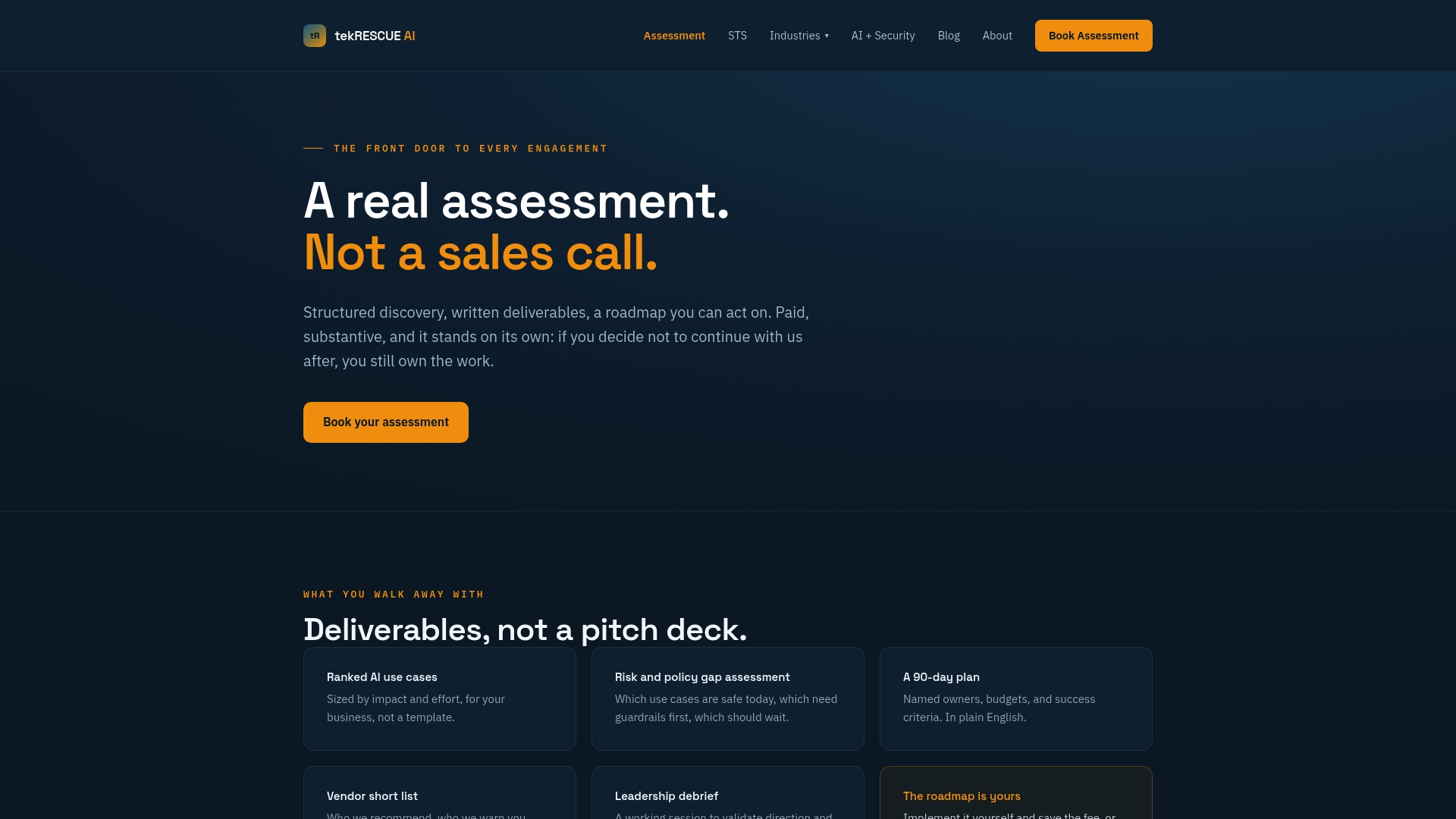
Unlike a generic strategy deck, the assessment maps specific opportunities against specific vulnerabilities in the environment, then provides a prioritized roadmap instead of a list of buzzwords. Building security into every recommendation from the start ensures plans account for where data lives and who can access it, not requiring major revisions once legal questions arise. This approach is especially relevant for sectors juggling limited IT staff and regulatory exposure.
If you’re past the point of reading guides and ready to see what AI could actually do inside your organization, start with the AI Profit and Growth Assessment and get a roadmap built around your business instead of a generic template.
Where to Go for Standards and Policy Context
For the regulatory and technical backbone behind everything above, start with the NIST AI Risk Management Framework, the federal executive order on trustworthy AI, Microsoft’s Cloud Adoption Framework for AI, and OWASP’s LLM security project.
Sources
- Establish an AI Center of Excellence - Cloud Adoption Framework | Microsoft Learn
- NIST AI Risk Management Framework (NIST.AI.100-1)
- How to set up an AI Center of Excellence | Harvard Business Review
FAQ
What Is an AI Center of Excellence?
An AI Center of Excellence is a centralized, cross-functional team that sets strategy, governance, and technical standards to help an organization move AI projects from isolated pilots into secure, measurable production systems.
What Does an AI CoE Actually Do Day to Day?
It reviews and approves AI use cases, maintains data and security standards, provides shared technical infrastructure like reference architectures and model catalogs, and monitors deployed systems for drift, cost, and safety issues.
What Is a Center of Excellence in General?
A center of excellence is any centralized group an organization builds to concentrate specialized expertise, in this case AI, so best practices and governance spread consistently instead of forming separately in every department.
Can tekRESCUE AI Help Us Set Up an AI CoE?
Yes. tekRESCUE AI’s AI Profit and Growth Assessment maps AI opportunities against security risk and delivers a prioritized roadmap, which is the practical starting point most organizations need before formalizing a CoE.
How Long Does It Take to Stand Up an AI CoE?
Most organizations can staff a core team and publish a charter within a few weeks, but reaching the operational maturity described in Microsoft’s Cloud Adoption Framework, enough to shift from centralized control to enablement, typically takes six to twelve months of consistent execution.